
Substrates
Mukunuwenna greens
A source-scoped account of Sri Lankan Mukunuwenna crop forms, field guidance and two described household food preparations, with identity and recipe gaps kept explicit.
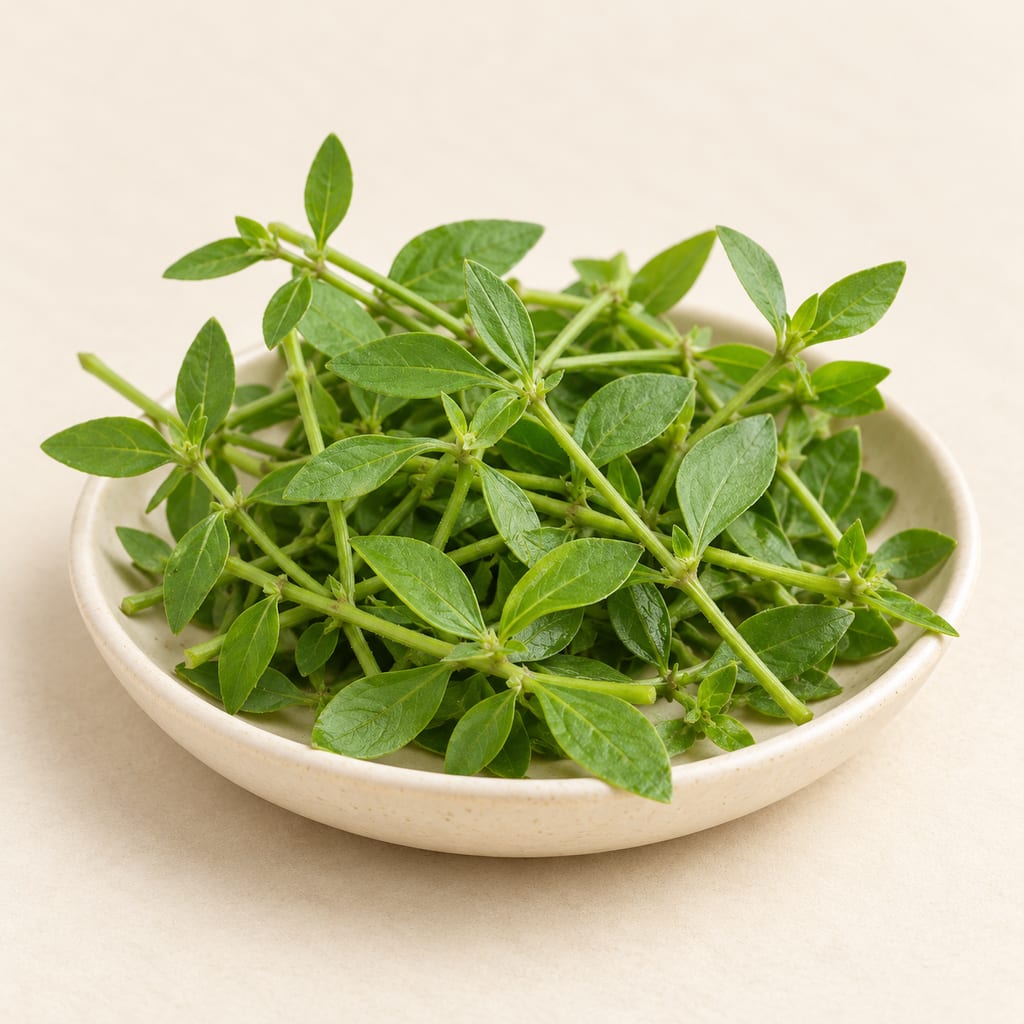
Identity and names
Kew’s Plants of the World Online accepts Alternanthera sessilis (L.) DC. HORDI’s Sinhala crop page labels Mukunuwenna with that binomial; the English page uses the same name and species in its crop entry. The Tamil HORDI page uses பொன்னாங்கன்னி for its A. sessilis crop. These links apply to those institutional pages: a shared common name elsewhere is not enough to identify a plant. No specimen or field key was checked. Kew lists Sri Lanka in the introduced distribution, which is a database-level area record rather than a site-level history or ecological assessment.
Sri Lankan crop forms and cultivation context
HORDI describes vine and bushy forms. It calls the Piliyandala type the most popular in the market, associates one short-internode form with Pannipitiya and Arawwala, and names another Weda Mukunuwenna. These are crop descriptions; formal cultivar identity was not established. HORDI says the Low Country wet zone is most suitable and that irrigation allows cultivation elsewhere in Sri Lanka. It recommends well-drained lowlands, pH 6–7, stem cuttings 10–12 cm or longer, field beds and drainage, and frequent irrigation to keep the upper bed moist while avoiding standing water. Its field page describes 20 cm by 10 cm spacing and first harvest about four weeks after planting, then intervals of three to four weeks, with fields maintained for around two years. These are source-specific field recommendations, not home-container or greenhouse instructions or universal climate limits.
Sources for this section
Reported Sri Lankan food uses
HORDI identifies Mukunuwenna as a popular commercial leafy vegetable. A 2025 open article reports qualitative observation and discussions with selected elderly participants in Galle district. Its Mukunuwanna entry identifies Alternanthera sessilis and describes mallung made with finely chopped greens cooked with grated coconut, onions and spices. It also describes porridge using whole-plant extract, coconut milk, red rice, shallots and chopped garlic. This records what the article describes; it does not establish the prevalence of the dishes across Sri Lanka or a measured household method. The article includes traditional medicinal framing, but no health benefit is claimed here.
Household preparation evidence and limits
The Galle article names ingredients and broad preparation forms but provides no measured quantities, yield, complete ordered steps, timing, endpoint, storage duration or safety controls. These are descriptive food reports, not executable recipes.
Sources for this section
Fermentation and equipment
The HORDI and Galle accounts describe vegetable dishes and porridge, not a fermented product or microbial starter. They name no specialized equipment for the reported dishes.
Unresolved growing and handling questions
The HORDI information is field crop guidance. It does not state a hardiness zone, frost threshold, heat or humidity ceiling, light or photoperiod response, seasonal planting calendar, container dimensions, heated or unheated greenhouse regime, or household regrowth performance. The sources also do not establish raw-leaf storage, prepared-dish shelf life, a validated cooking endpoint, contaminants or lookalike identification. Kew’s introduced-area listing does not establish local invasiveness or conservation status. HORDI disease descriptions are not repeated here as current household pesticide or treatment directions.
Sources for this section
Research gaps
No specimen or expert identification; common-name-only material is not identified.
HORDI is local field guidance; household outdoor containers and heated/unheated protected culture are not addressed.
No species-specific frost, heat, humidity, photoperiod or planting-season thresholds.
No measured recipe formula, endpoint, food-safety assessment or storage duration for mallung/porridge.
No local conservation/invasiveness assessment; Kew lists Sri Lanka as introduced but gives no site-level history.
No rights-reviewed images; imagery does not gate this text.
Research status
The underlying plant account received a partial source review. Its review scope is described in the original plant article.
Sources for this section
Places
Unknown
Relationship not established · Place not establishedThe available research does not establish a single origin for this ingredient.
Community
No community contributions have been published for this entry yet.
Share what you made
Sign in to contribute. Published comments and photos are free to read.
Sources
Royal Botanic Gardens, Kew, Plants of the World OnlineIngredient research
Alternanthera sessilis (L.) DC.Cited in: Identity and names; Unresolved growing and handling questions; Research gaps
Sri Lanka Department of Agriculture, Horticultural Crops Research and Development InstituteIngredient research
HORDI Crop – MukunuwennaCited in: Identity and names; Sri Lankan crop forms and cultivation context; Reported Sri Lankan food uses; Fermentation and equipment; Unresolved growing and handling questions; Research gaps
Sri Lanka Department of Agriculture, Horticultural Crops Research and Development InstituteIngredient research
Sinhala: HORDI Crop – MukunuwennaCited in: Identity and names; Sri Lankan crop forms and cultivation context; Unresolved growing and handling questions; Research gaps
Sri Lanka Department of Agriculture, Horticultural Crops Research and Development InstituteIngredient research
Tamil: HORDI Crop – MukunuwennaCited in: Identity and names; Sri Lankan crop forms and cultivation context; Research gaps
Piyoda Darmasiri Wijesekara, Journal of Ethnic Foods 12, article 27 (2025)Ingredient research
An exploration of the porridge tradition in Southern Sri Lankan cultureCited in: Reported Sri Lankan food uses; Household preparation evidence and limits; Fermentation and equipment; Research gaps
FermenteaResearch provenance
Alternanthera sessilis in Sri Lankan food and cultivation: original plant researchCited in: Research status