
Substrates
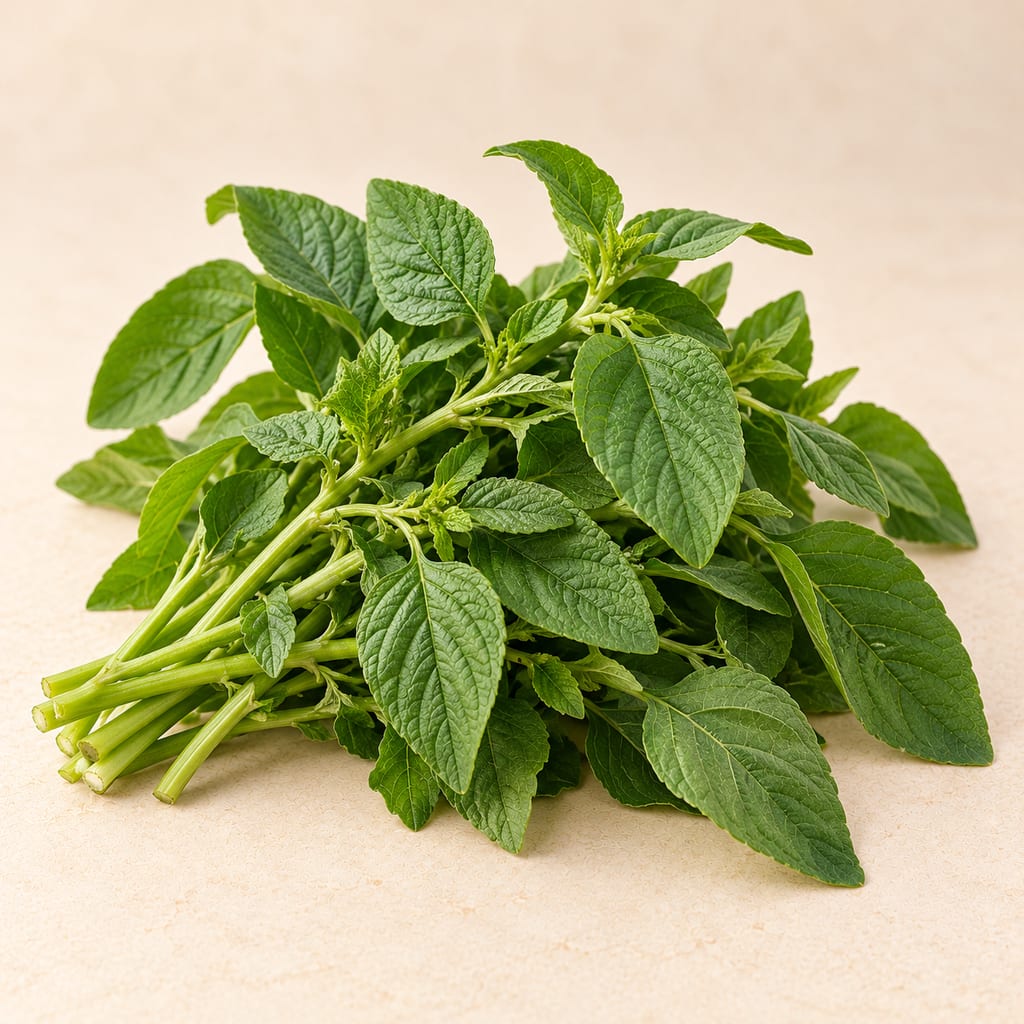
Spleen amaranth greens
Ugandan reports associate A. dubius with leafy use and dodo, while Rwanda sources record additional leafy use and conflicting local names. Kew lists the species as introduced in Rwanda; eHinga guidance is crop-group information, not an accession-specific trial.
Species and local-name limits
Kew accepts Amaranthus dubius Mart. ex Thell. as an annual species, with a native range from Mexico to tropical America and an introduced listing for Uganda. The FAO EcoCrop record instead lists “Mart.” as authority and Southeast Asia as native. PROTA distinguishes the tropical-American origin of the weedy plant from a hypothesis that cultivated types may have developed from weedy ancestors in tropical Asia. These are differently scoped source statements; the discrepancy is retained rather than resolved by assuming that all cultivated material shares one origin.
An Oxfam Novib synthesis table for Northern and Eastern Uganda pairs A. dubius with “spleen amaranth” and dodo, while a free-list annex records dodo with Amaranthus spp. A Kampala International University repository thesis title also links A. dubius leaves with dodo in Bushenyi-Ishaka, but its full text was not retrieved. These reports do not establish that every plant called dodo is this species. A separate Central Uganda study identifies bugga as A. lividus; the NARO red-amaranthus/bugga guide is not species-specific evidence for A. dubius.
Sources for this section
- Amaranthus dubius Mart. ex Thell. | Plants of the World Online →
- Amaranthus dubius | EcoCrop crop record →
- Improving diets and reducing food scarcity with the help of local food plants in Northern and Eastern regions of Uganda →
- Extractive value, ash value and moisture content of Amaranthus dubius leaves (“dodo”) in Bushenyi-Ishaka Town Council, South Western Uganda →
- Production Guidelines for Red Amaranthus (Bugga) in Uganda →
- Division of labour in nakati (Solanum aethiopicum) production in central Uganda →
Food use and other reported use
PROTA describes cooked leaves as the main use of A. dubius and says the leaves are tender and fairly neutral in taste. Its account gives a 5–10 minute cooking statement and describes combination with bitter-leaved vegetables in Kenya; this is a compiled account, not a complete Ugandan recipe. PROTA also reports that A. dubius plants are used in Uganda for potash preparation, but gives no locality, plant part or procedure. No preparation method is inferred from that brief report.
The Oxfam report provides a regional naming and food-plant association, not a measured recipe. A Mabira Forest Reserve article’s publisher abstract describes research on wild edible plants, but its PDF was not retrieved and its table-search lead is not treated as verified evidence that the sampled dodo was A. dubius.
Sources for this section
- Amaranthus dubius Mart. ex Thell. →
- Improving diets and reducing food scarcity with the help of local food plants in Northern and Eastern regions of Uganda →
- Traditional use of wild edible plants in the communities adjacent Mabira Central Forest Reserve, Uganda →
- Extractive value, ash value and moisture content of Amaranthus dubius leaves (“dodo”) in Bushenyi-Ishaka Town Council, South Western Uganda →
Growing observations, not a local prescription
PROTA describes A. dubius in humid tropical lowlands and reports that vegetable amaranths grow well at day temperatures above 25°C and nights not below 15°C. It says shade is disadvantageous except under drought stress, and describes fertile, loose, well-drained soils. Its account reports irrigation before wilting when rainfall is insufficient and greater drought susceptibility than A. cruentus. These are compiled crop-account observations, not Uganda-tested temperature, soil or watering limits. FAO EcoCrop separately describes best adaptation to low humidity; the difference in source framing is unresolved. No frost hardiness scheme or Uganda-specific temperature response was established.
For propagation, PROTA gives 4,000–6,000 seeds per gram, direct sowing or nursery transplanting after two to three weeks, and about 20 cm row spacing in its crop account. It describes first harvest around three to four weeks after direct sowing and repeated-cutting schedules for market production. These are source-specific production figures, not verified local household instructions. The sources do not establish a productive container scale, greenhouse method, local seasonal calendar, measured pH interval or local pest-control schedule. PROTA notes that seed can re-establish plants in home gardens; Kew lists Uganda as introduced, but local invasion status or containment rules were not assessed.
Identity and food-safety limits
PROTA says A. dubius is difficult to distinguish morphologically from A. spinosus and notes that spineless A. spinosus plants have been observed. It also distinguishes smaller weedy plants from larger, more erect and succulent cultivated forms. Common names and a single visible feature are not a consumer identification key.
PROTA reports nitrate and oxalate in leaves and stems and describes a common practice of cooking amaranth in ample water and discarding the water. Its account does not establish a universally safe dose or preparation endpoint. No complete measured household recipe, harvest-site assessment, safe-storage period or validated food-safety procedure was found in the inspected evidence.
Rwanda records and historical framing
Kew lists A. dubius as native from Mexico to tropical America and introduced in Rwanda. The current Flora of Rwanda profile also marks it introduced; its linked records page currently returns zero rows even though the profile offers a two-record link. That limited live table result does not establish absence from Rwanda or from herbarium holdings.
Rwanda reports use more than one historical frame. The 2005 CBD report places A. dubius in a table of wild edible plants described as indigenous and attributes its record to Kanyonyo et al. (1992). Seburanga’s 2013 historical crop table instead labels A. dubius a neo-immigrant. These are source-specific historical classifications; neither changes Kew’s current introduced-range listing.
Sources for this section
- Amaranthus dubius Mart. ex Thell. | Plants of the World Online →
- Flora of Rwanda: Amaranthus dubius species profile and linked records →
- Second National Report on the Implementation of the Convention on Biological Diversity: Rwanda (French edition) →
- Decline of Indigenous Crop Diversity in Colonial and Postcolonial Rwanda →
Rwanda food reports and names
The 2005 CBD report’s table 8 assigns Imbogeli and leaf use to A. dubius, citing Kanyonyo et al. (1992), but the report’s inspected bibliography does not supply a full Kanyonyo citation. The original study was not located. An indexed excerpt from Laure’s 1986 French household-food survey instead assigns Dodo to A. dubius and A. patulus, and Imbogeli to A. lividus; only indexed table text and catalogue records were accessible, not the full book.
A full author-uploaded copy of a Nyungwe study reports A. dubius with the Kinyarwanda labels Imbwija, imbogeri and bwiza bw’is hyamba, and lists leaves and young stems as consumed parts. Its interviews and collections concern Gatare and Buruhukiro in Nyamagabe District; the inspected paper gives no voucher accession. The 2014 CBD report separately assigns Imbogeri to A. spinosus. These regional records do not establish a single nationwide name map or verify every named plant as A. dubius.
Sources for this section
- Second National Report on the Implementation of the Convention on Biological Diversity: Rwanda (French edition) →
- Des vivres ou du thé ? L'alimentation et les conditions de vie de familles rwandaises →
- Local Knowledge and Use of Wild Edible Plants in Eastern Part of Nyungwe National Park in Rwanda: Prospects for Forest Biodiversity Conservation →
- Fifth National Report to the Convention on Biological Diversity: Rwanda →
Rwanda growing information and its limits
The eHinga amaranth page lists A. dubius among leafy types. Its crop guidance gives broad amaranth recommendations, including warm and humid growing conditions, well-drained loam rich in organic matter, and direct sowing or nursery transplant options. The page reports direct sowing at about 0.5 cm in rows 40 cm apart, or transplanting 22–25-day seedlings at 40 × 30 cm. These figures belong to the platform’s group-level guide, not an A. dubius accession trial or a universal home schedule. A new attempt to reopen this live page timed out; the listed details are retained from the earlier full-page inspection recorded in the research dossier.
Rwanda’s agriculture ministry reports indigenous Amaranthus production at Rubona station, but does not name a species, accession, plot design or treatment. No Rwanda-specific frost threshold, measured pH response, district calendar, productive container trial or greenhouse result was verified.
Sources for this section
Preparation evidence still missing
The Rwanda records establish reported food use and parts, not a complete household batch. They do not provide a species-confirmed method with quantities, yield, full sequence, monitoring endpoint and storage details. The source conflicts and missing original Kanyonyo study leave those practical details unresolved.
Sources for this section
- Second National Report on the Implementation of the Convention on Biological Diversity: Rwanda (French edition) →
- Des vivres ou du thé ? L'alimentation et les conditions de vie de familles rwandaises →
- Local Knowledge and Use of Wild Edible Plants in Eastern Part of Nyungwe National Park in Rwanda: Prospects for Forest Biodiversity Conservation →
Research gaps
Ugandan dodo is not consistently recorded at species level; no voucher-confirmed local market or household specimen was inspected.
Kew, FAO EcoCrop and PROTA differ in their origin and authority treatments; weedy-plant origin and hypotheses about cultivated types remain source-specific.
PROTA’s cultivation values are compiled account evidence, not a Uganda trial; no frost scheme, pH range, tested local calendar, container trial or greenhouse protocol was established.
PROTA’s food and composition summaries do not establish a safe dose or universal preparation endpoint. No complete regional recipe, harvest-site assessment or validated food-safety process was found.
The full Mabira article and KIU thesis were not retrieved; their leads are not treated as verified species-specific food methods.
Rwanda reports conflict over Imbogeli, Imbogeri, Imbwija and Dodo assignments; they do not support an exclusive countrywide name map.
The Kanyonyo et al. 1992 original cited by the 2005 CBD table was not located; the full Laure 1986 book was not inspected beyond indexed excerpts and catalogue records.
The Nyungwe article reports leaves and young stems, but no voucher accession was stated in the inspected author-uploaded copy.
eHinga values are crop-group guidance, and the current page could not be reopened during this publication pass; no A. dubius Rwanda accession trial, district calendar, frost scheme, container yield or greenhouse result was verified.
MINAGRI’s Rubona statement names Amaranthus only; it is not a species-specific trial.
Sources for this section
- Amaranthus dubius Mart. ex Thell. | Plants of the World Online →
- Amaranthus dubius Mart. ex Thell. →
- Amaranthus dubius | EcoCrop crop record →
- Improving diets and reducing food scarcity with the help of local food plants in Northern and Eastern regions of Uganda →
- Traditional use of wild edible plants in the communities adjacent Mabira Central Forest Reserve, Uganda →
- Extractive value, ash value and moisture content of Amaranthus dubius leaves (“dodo”) in Bushenyi-Ishaka Town Council, South Western Uganda →
- Production Guidelines for Red Amaranthus (Bugga) in Uganda →
- Division of labour in nakati (Solanum aethiopicum) production in central Uganda →
- Flora of Rwanda: Amaranthus dubius species profile and linked records →
- Second National Report on the Implementation of the Convention on Biological Diversity: Rwanda (French edition) →
- Des vivres ou du thé ? L'alimentation et les conditions de vie de familles rwandaises →
- Local Knowledge and Use of Wild Edible Plants in Eastern Part of Nyungwe National Park in Rwanda: Prospects for Forest Biodiversity Conservation →
- Fifth National Report to the Convention on Biological Diversity: Rwanda →
- Decline of Indigenous Crop Diversity in Colonial and Postcolonial Rwanda →
- Amaranth crop guidance →
- Annual Report 2019–2020 →
Research status
The underlying plant account received a partial source review. Its review scope is described in the original plant article.
Sources for this section
Places
Unknown
Relationship not established · Place not establishedThe available research does not establish a single origin for this ingredient.
Community
No community contributions have been published for this entry yet.
Share what you made
Sign in to contribute. Published comments and photos are free to read.
Sources
Royal Botanic Gardens, KewIngredient research
Amaranthus dubius Mart. ex Thell. | Plants of the World OnlineCited in: Species and local-name limits; Growing observations, not a local prescription; Rwanda records and historical framing; Research gaps
Plant Resources of Tropical Africa (PROTA4U)Ingredient research
Amaranthus dubius Mart. ex Thell.Cited in: Food use and other reported use; Growing observations, not a local prescription; Identity and food-safety limits; Research gaps
Food and Agriculture Organization of the United NationsIngredient research
Amaranthus dubius | EcoCrop crop recordCited in: Species and local-name limits; Growing observations, not a local prescription; Research gaps
Oxfam Novib / Seeds for ResilienceIngredient research
Improving diets and reducing food scarcity with the help of local food plants in Northern and Eastern regions of UgandaCited in: Species and local-name limits; Food use and other reported use; Identity and food-safety limits; Research gaps
Ethnobotany Research and ApplicationsIngredient research
Traditional use of wild edible plants in the communities adjacent Mabira Central Forest Reserve, UgandaCited in: Food use and other reported use; Research gaps
Kampala International University Institutional RepositoryIngredient research
Extractive value, ash value and moisture content of Amaranthus dubius leaves (“dodo”) in Bushenyi-Ishaka Town Council, South Western UgandaCited in: Species and local-name limits; Food use and other reported use; Research gaps
National Agricultural Research Organisation (NARO) Information HubIngredient research
Production Guidelines for Red Amaranthus (Bugga) in UgandaCited in: Species and local-name limits; Research gaps
African Journal of Agricultural ResearchIngredient research
Division of labour in nakati (Solanum aethiopicum) production in central UgandaCited in: Species and local-name limits; Research gaps
Flora of RwandaIngredient research
Flora of Rwanda: Amaranthus dubius species profile and linked recordsCited in: Rwanda records and historical framing; Research gaps
Republic of Rwanda / Convention on Biological DiversityIngredient research
Second National Report on the Implementation of the Convention on Biological Diversity: Rwanda (French edition)Cited in: Rwanda records and historical framing; Rwanda food reports and names; Preparation evidence still missing; Research gaps
Éditions de l'ORSTOM, Travaux et documents no. 198Ingredient research
Des vivres ou du thé ? L'alimentation et les conditions de vie de familles rwandaisesCited in: Rwanda food reports and names; Preparation evidence still missing; Research gaps
Journal of Research in Forestry, Wildlife and Environment 12(4):66–75Ingredient research
Local Knowledge and Use of Wild Edible Plants in Eastern Part of Nyungwe National Park in Rwanda: Prospects for Forest Biodiversity ConservationCited in: Rwanda food reports and names; Preparation evidence still missing; Research gaps
Republic of Rwanda / Convention on Biological DiversityIngredient research
Fifth National Report to the Convention on Biological Diversity: RwandaCited in: Rwanda food reports and names; Research gaps
International Journal of BiodiversityIngredient research
Decline of Indigenous Crop Diversity in Colonial and Postcolonial RwandaCited in: Rwanda records and historical framing; Research gaps
eHinga Rwanda crop information platformIngredient research
Amaranth crop guidanceCited in: Rwanda growing information and its limits; Research gaps
Ministry of Agriculture and Animal Resources, Republic of RwandaIngredient research
Annual Report 2019–2020Cited in: Rwanda growing information and its limits; Research gaps
FermenteaResearch provenance
Spleen amaranth (Amaranthus dubius): original plant researchCited in: Research status