
Substrates
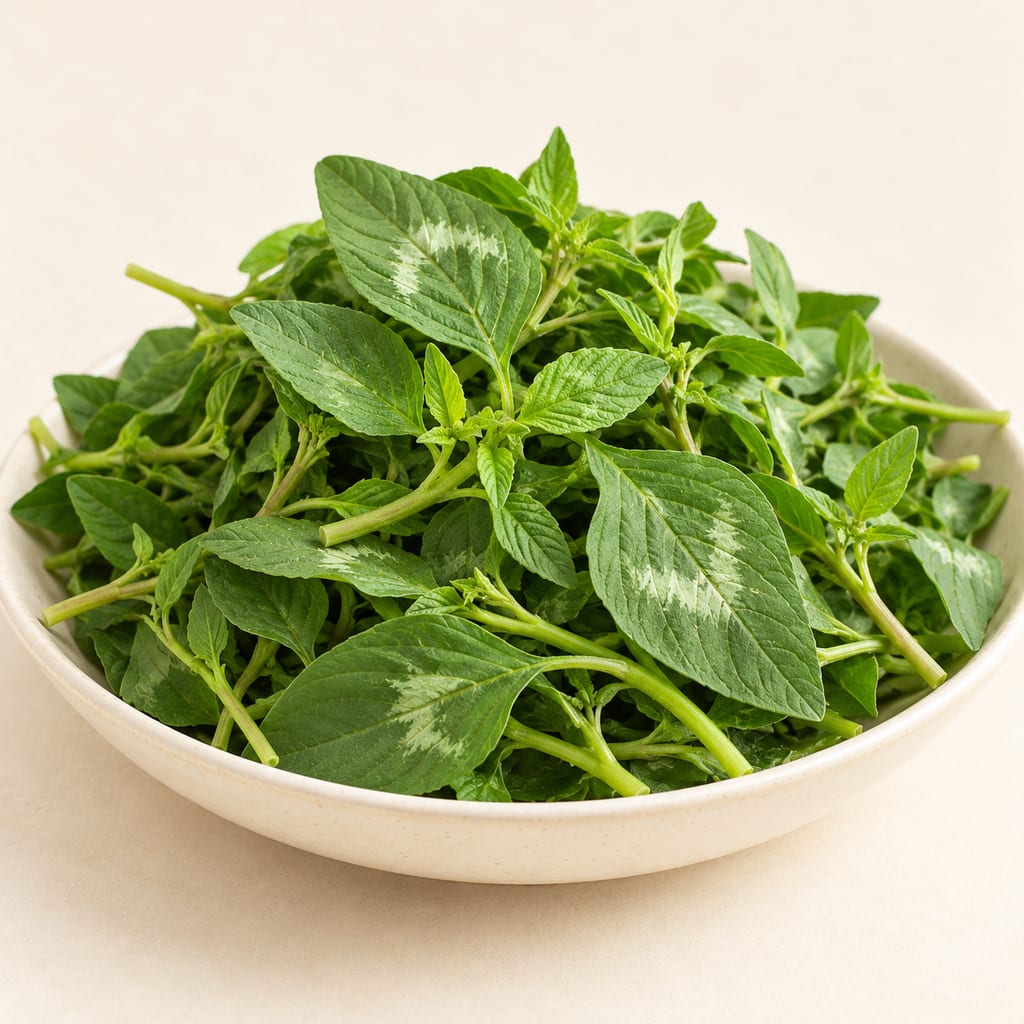
Spiny amaranth greens
Amaranthus spinosus is recorded as a collected vegetable in several regional sources, but the Taishan study’s narrative and supplementary table do not agree on which plant part is used. Its food accounts are ethnobotanical records, not a complete preparation or a safety recommendation.
Species and regional labels
Kew accepts Amaranthus spinosus L. and describes it as an annual native from Mexico through tropical America, with introduced records in China and many other regions. PROTA describes spiny or prickly amaranth as widespread in warm regions and rarely cultivated. India Flora Online records regional names including kateli in Hindi, mullu harivi and mullu dantu in Kannada, mullukeerai in Tamil, and mulla totakura in Telugu. These names are regional labels rather than an identification key; PROTA notes that this species may be difficult to separate from A. dubius when spines are absent.
Food accounts and a source discrepancy
PROTA reports leaves and young plants collected in tropical Africa and elsewhere for home use as cooked, steamed or fried vegetables. A 2016 study of the Chakma community in Rangamati Hill District, Bangladesh, records young leaves of A. spinosus as cooked vegetables; it gives no complete recipe. A separate study in Taishan County, Guangdong, China, describes shoots as vegetables and roots used in a soup discussed as a health-related traditional preparation. That language is reported as source framing, not endorsed as a benefit claim.
The article's broader discussion includes §4.1.1, “Health-promoting effects of WEPs”; its specific A. spinosus account appears in §4.1.3, “The consumption of non-native plants.” The authors report identifying survey plants and depositing vouchers; supplementary Table S3 lists voucher ZSY-008 for A. spinosus. The row lists shoots, Wv (wild vegetables), “Stew soup,” and Medical plant “No”; its footnote says an asterisk marks non-native species, and the row carries one. This author-reported voucher and source label do not identify other plants. The categorical No does not resolve the separate narrative root report or establish absence of traditional medicinal use. The plant-part discrepancy remains; the reports are not combined into one method.
Sources for this section
Collection and growing evidence
PROTA describes the plant as rarely cultivated and reports collection for household use, especially where other vegetables are scarce. Its species account says it grows best in sun or light shade, prefers soils high in organic matter but can grow on sandy soils, and has best growth at moderate soil moisture while tolerating wet soils and drought. PROTA also reports that flowering is suppressed at light intensity below 30% and is earliest or most abundant in areas with 11–12-hour daylengths; these account-level observations are not measured household yield targets or setpoints. The Taishan paper concerns wild edible plant knowledge and local collection/food practices; it is not a cultivation trial. Kew’s introduced-range listing for China and the Taishan table’s starred non-native label describe biogeographic status in their respective sources, not a recommendation to collect or plant the species.
No universal pH interval, irrigation or drainage schedule, frost or heat threshold, reliable sowing calendar, container scale, greenhouse conditions or yield schedule was established. PROTA's sun/light-shade and soil-moisture descriptions do not supply production controls. Spontaneous occurrence and weediness are not substitutes for productive-crop guidance, and no growing recommendation is inferred from the food reports.
Handling, preparation and unresolved safety
PROTA notes paired spines and reports that they can injure grazing animals’ mouths; this is not a complete human handling assessment. The Taishan narrative’s root-soup description and the supplementary table’s shoot-only listing do not provide a single agreed plant part. No complete household method, ingredient quantity, yield, cooking endpoint, storage condition or validated safety control is established by these records.
The Taishan table’s “Medical plant” field is preserved as a source category only. This article makes no medicinal or health-benefit claim and does not treat the row’s “No” as a safety finding. Species identification, harvest-site conditions, human handling and food-safety evidence remain unresolved.
Research gaps
Taishan narrative describes roots in soup while supplementary Table S3 lists shoots as the edible part and stew soup as the mode; the source conflict is unresolved.
The Taishan table marks the row non-native and has a Medical plant No value, while its narrative separately describes roots in a health-related soup; the categorical field is not an efficacy or safety assessment.
PROTA gives broad sun/light-shade, soil and moisture observations, but no pH target, numeric irrigation or drainage schedule, frost/heat threshold, tested productive calendar, container scale or greenhouse yield protocol was established.
No complete recipe, human handling guidance, harvest-site assessment or validated food-safety method was established.
Sources for this section
- Amaranthus spinosus L., Plants of the World Online →
- Amaranthus spinosus (PROTA) →
- Amaranthus spinosus L., India Flora Online →
- An ethnobotanical study on wild edible plants in Taishan County, Guangdong, China →
- Data Sheet 1: Supplementary Tables S1–S3 for the Taishan County ethnobotanical study →
- Wild edible vegetables used by the Chakma community of Rangamati Hill District, Bangladesh →
Research status
The underlying plant account received a partial source review. Its review scope is described in the original plant article.
Sources for this section
Places
Unknown
Relationship not established · Place not establishedThe available research does not establish a single origin for this ingredient.
Community
No community contributions have been published for this entry yet.
Share what you made
Sign in to contribute. Published comments and photos are free to read.
Sources
Royal Botanic Gardens, KewIngredient research
Amaranthus spinosus L., Plants of the World OnlineCited in: Species and regional labels; Collection and growing evidence; Research gaps
Plant Resources of Tropical Africa, hosted by Pl@ntUseIngredient research
Amaranthus spinosus (PROTA)Cited in: Species and regional labels; Food accounts and a source discrepancy; Collection and growing evidence; Handling, preparation and unresolved safety; Research gaps
Indian Institute of Science, Centre for Ecological SciencesIngredient research
Amaranthus spinosus L., India Flora OnlineCited in: Species and regional labels; Research gaps
Frontiers in Sustainable Food SystemsIngredient research
An ethnobotanical study on wild edible plants in Taishan County, Guangdong, ChinaCited in: Food accounts and a source discrepancy; Collection and growing evidence; Handling, preparation and unresolved safety; Research gaps
Frontiers in Sustainable Food Systems / figshareIngredient research
Data Sheet 1: Supplementary Tables S1–S3 for the Taishan County ethnobotanical studyCited in: Food accounts and a source discrepancy; Handling, preparation and unresolved safety; Research gaps
Eco-friendly Agriculture JournalIngredient research
Wild edible vegetables used by the Chakma community of Rangamati Hill District, BangladeshCited in: Food accounts and a source discrepancy; Research gaps
FermenteaResearch provenance
Spiny amaranth (Amaranthus spinosus): original plant researchCited in: Research status