
Substrates
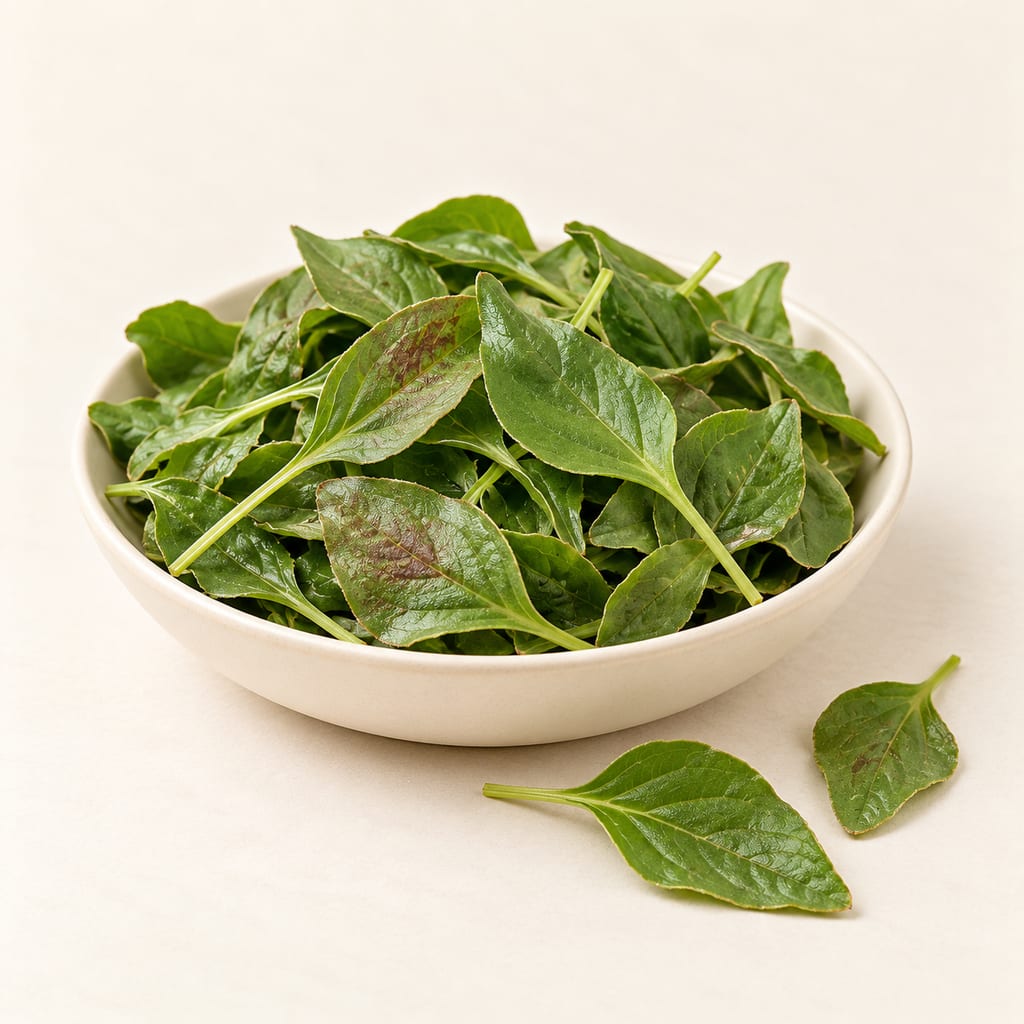
Amaranthus thunbergii leaves
A Kabbe survey lists Amaranthus thunbergii leaves as a leafy vegetable, but its preparation field is ambiguous. Similarity to A. dinteri complicates older food records, and cultivation evidence is limited to one trial known through indexed excerpts.
Name and species distinction
Plants of the World Online accepts Amaranthus thunbergii Moq. and lists Namibia in its native range. A 2020 Kabbe survey row prints the local-name string “Libowa/Ihato” but does not assign a language to it. The veterinary guide lists other local names with language labels in its A. thunbergii entry; those names remain source-specific rather than a cross-community identification key.
Kolberg’s Namibian literature review warns that A. thunbergii and A. dinteri are similar and may have been confused in earlier food reports.
Sources for this section
- Amaranthus thunbergii Moq. | Plants of the World Online →
- Ethnobotanical Survey and In Vitro Evaluation of Antimicrobial Activity of Plants Traditionally Used as Herbs and Spices from Kabbe Constituencies in Zambezi Region, Namibia →
- Indigenous Namibian leafy vegetables: A literature survey and project proposal →
- Toxic plants of veterinary importance in Namibia, second revised edition →
Reported food use
The Kabbe thesis table identifies A. thunbergii Moq., project voucher T020, leaves, and the category “Leafy vegetable. Medical uses.” Its preparation field says “Infusion,” but the table does not explain whether this refers to the vegetable use or a separate traditional-use entry. It provides no edible cooking method.
A separate 1992 Topnaar account reports cooked leaves and stems of A. dinteri, including frying with onions, and lists vouchers VdE 18.6.b and VdE 4.4.k. That source-specific preparation is not attributed to A. thunbergii.
Sources for this section
- Ethnobotanical Survey and In Vitro Evaluation of Antimicrobial Activity of Plants Traditionally Used as Herbs and Spices from Kabbe Constituencies in Zambezi Region, Namibia →
- Indigenous Namibian leafy vegetables: A literature survey and project proposal →
- Plant Uses by the Topnaar of the Sesfontein Area, Namib Desert →
Cultivation evidence
An IGLV-VIVA repository record describes a 2005–06 cultivation-trial report for traditional leafy vegetables in northern Namibia. Indexed excerpts mention a Rundu A. thunbergii trial sown in November 2005 and three harvest dates through January 2006. The full report was not retrieved, so its trial layout, accession, inputs and results remain unverified.
Kew’s broad range and biome description and older accounts of disturbed-ground occurrence are not crop requirements. The reviewed sources do not establish a general planting calendar, soil or water target, mature container method, or greenhouse system.
Hazards and limits
The Namibian veterinary guide reports nitrate poisoning risk to ruminants in livestock contexts. It does not establish a human food threshold, preparation rule or dose. The sources reviewed here provide no complete A. thunbergii recipe or household storage endpoint.
Namibian Forest Act excerpts describe rules tied to land and forest status, permissions and management plans. No species-specific protected-plant listing or collection permission for a particular site was established.
Research gaps
Clarify whether the Kabbe table’s “Infusion” refers to edible vegetable preparation or a separate traditional-use category.
Retrieve the complete IGLV-VIVA report and verify the Rundu trial accession, methods, soil, water, harvest data and any results.
No source reviewed establishes a complete species-specific home recipe, human safety endpoint, storage period, mature container or greenhouse production, or universal cultivation optimum.
No species-specific protected-plant status or permission for any collection site was established.
Sources for this section
- Amaranthus thunbergii Moq. | Plants of the World Online →
- Ethnobotanical Survey and In Vitro Evaluation of Antimicrobial Activity of Plants Traditionally Used as Herbs and Spices from Kabbe Constituencies in Zambezi Region, Namibia →
- Indigenous Namibian leafy vegetables: A literature survey and project proposal →
- Plant Uses by the Topnaar of the Sesfontein Area, Namib Desert →
- Evaluation of the cultivation trials of indigenous/traditional green leafy vegetables under the IGLV-VIVA 2005–2006 program →
- Toxic plants of veterinary importance in Namibia, second revised edition →
- Forest Act, 2001 (Act 12 of 2001), consolidated version as amended →
Research status
The underlying plant account received a partial source review. Its review scope is described in the original plant article.
Sources for this section
Places
Unknown
Relationship not established · Place not establishedThe available research does not establish a single origin for this ingredient.
Community
No community contributions have been published for this entry yet.
Share what you made
Sign in to contribute. Published comments and photos are free to read.
Sources
Royal Botanic Gardens, Kew; Plants of the World Online / World Checklist of Vascular PlantsIngredient research
Amaranthus thunbergii Moq. | Plants of the World OnlineCited in: Name and species distinction; Cultivation evidence; Research gaps
Abner Tomas; University of Namibia, MSc thesis, 2020Ingredient research
Ethnobotanical Survey and In Vitro Evaluation of Antimicrobial Activity of Plants Traditionally Used as Herbs and Spices from Kabbe Constituencies in Zambezi Region, NamibiaCited in: Name and species distinction; Reported food use; Research gaps
Herta H. Kolberg; National Plant Genetic Resources Centre, National Botanical Research Institute; Agricola 12:54–60, 2001Ingredient research
Indigenous Namibian leafy vegetables: A literature survey and project proposalCited in: Name and species distinction; Reported food use; Cultivation evidence; Research gaps
Patrick Van Damme, Veerle Van den Eynden and Patrick Vernemmen; Afrika Focus 8(3–4):253–281, 1992Ingredient research
Plant Uses by the Topnaar of the Sesfontein Area, Namib DesertCited in: Reported food use; Research gaps
Patrick Hilger; Namibia Environmental Information Service repository record, 2006Ingredient research
Evaluation of the cultivation trials of indigenous/traditional green leafy vegetables under the IGLV-VIVA 2005–2006 programCited in: Cultivation evidence; Research gaps
Namibian Ministry of Agriculture, Water and Forestry, 2012Ingredient research
Toxic plants of veterinary importance in Namibia, second revised editionCited in: Name and species distinction; Hazards and limits; Research gaps
Republic of Namibia; NamibLIIIngredient research
Forest Act, 2001 (Act 12 of 2001), consolidated version as amendedCited in: Hazards and limits; Research gaps
FermenteaResearch provenance
Amaranthus thunbergii in Namibia: original plant researchCited in: Research status