
Substrates
Green amaranth greens
Fiji and Mauritius sources describe Amaranthus viridis food use and crop guidance; local labels and regional field advice remain tied to their own sources.
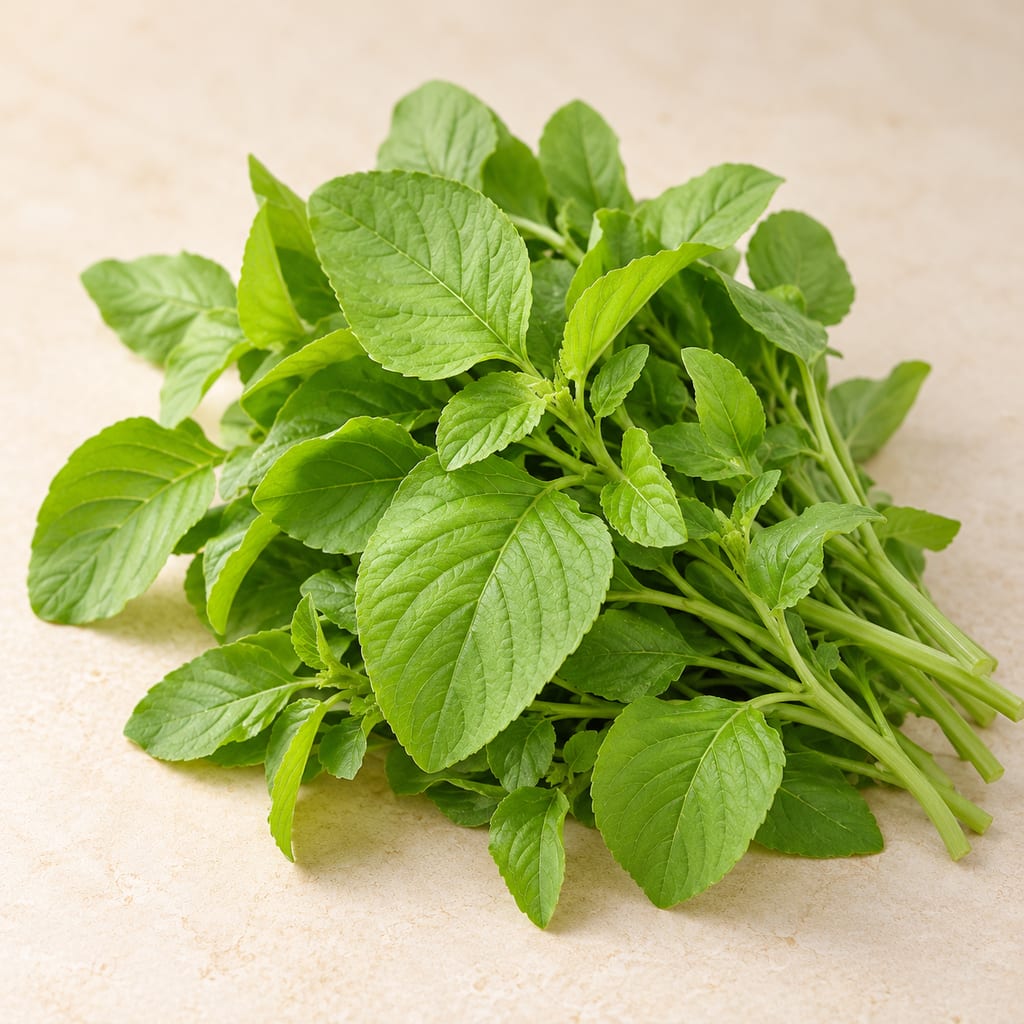
Species and Fiji names
Kew accepts Amaranthus viridis L., describes it as an annual native from southeastern Mexico to tropical America, and lists Fiji among its introduced areas. The Fiji Ministry crop guide and farm manual name A. viridis and a Local Selection. The Pacific Community handbook calls A. viridis “tubua” in Fiji. These records do not identify every plant sold as moca or tubua or establish that the names are interchangeable across communities.
Food accounts
The SPC handbook describes young leaves and tops cooked as a green vegetable. Auckland Museum authors list moca as A. viridis among plants from their iTaukei dishes and describe curry or stir-fry use like spinach. They report separate Fijian-Indian and iTaukei restaurant meals during a Fiji visit, but do not say which meal included moca or provide a measured recipe.
Sources for this section
Fiji crop guidance and regional handbook context
Search-extracted Fiji guide entries report all-year planting, 4 kg/ha seed, rows 75 cm apart with 30 cm between plants, a planting site near water, and sowing by seedbed transplant or broadcasting; the current guide extract gives 6–10 days to germination. The entries describe pulling plants and tying them in bundles for market sale. The original pages and table layout were not visually checked, and the entries do not identify a trial accession or plot.
Harvest, growing limits and specimen context
The SPC handbook gives regional guidance to sow directly or transplant seedlings, use well-cultivated soil and ample water, and pick young shoots about a month after sowing with further growth for about two months. These are Pacific handbook statements, not a Fiji replicated trial or irrigation schedule. No Fiji-specific frost, heat, humidity, shade, pH, drainage, container or greenhouse threshold was established.
Identity and preparation limits
The museum article records Fiji food and name observations, but its herbarium specimen AK72720 was collected in Auckland's Remuera suburb, possibly in the early 1900s. It is not a Fiji voucher for the food plant. The food accounts do not give a complete species-linked household batch, storage conditions or validated safety endpoint; this article does not supply an executable recipe or identification advice.
Sources for this section
Mauritius crop name and field guidance
The Mauritius Food and Agricultural Research and Extension Institute (FAREI) lists Amaranthus viridis as Amarante, Brède Kotachee and Brède Malbar, with a “Locale” variety. Its profile places planting in January through December and lists subhumid, humid and superhumid zones. These are agency crop labels, not a voucher-linked identification of every plant using those names.
FAREI describes direct sowing in well-drained soil at pH 6.0–7.5 and reports average water demand of 3–4.5 mm per day. Its profile gives a 5–6 week cycle for whole-plant harvest, while its harvest section says pulling whole plants may begin 3–4 weeks after sowing; it does not explain the difference. The guide also reports repeat cuts every 2–4 weeks before flowering and an 8–10 month multicut cycle. These are Mauritius extension statements, not a measured accession trial or home-container schedule. The sources reviewed here do not give a Mauritius-specific frost or heat threshold, greenhouse regime or complete dish account.
Research gaps
No Fiji field or market specimen links a crop accession to moca or tubua; shared vernaculars do not identify all market plants.
Ministry and SPC original pages were not retrieved or visually checked; their growing values remain excerpt or regional handbook evidence.
The museum authors do not identify which Fiji meal included moca or provide a complete recipe batch.
No Fiji-specific soil pH, irrigation quantity, frost/heat/light threshold, repeat-cut trial, container crop or greenhouse production evidence was established.
No source-specific storage guidance or validated food-safety endpoint was found.
FAREI does not link its Mauritius local crop names to a voucher or accession, provide a complete species-specific household dish, or explain the two whole-plant harvest timings.
The Mauritius extension profile does not establish productive container or greenhouse conditions.
Sources for this section
- Amaranthus viridis L. | Plants of the World Online →
- Crop Farmer's Guide: A Farmer's Guide to a Better Harvest →
- Fiji Farm Management Manual 2014, Technical Information on Crops →
- The Leaves We Eat: Pacific Foods, SPC Handbook No. 31, entry 17 →
- A taste of iTaukei plants →
- Amarante/Brède Kotachee/Brède Malbar (Amaranthus viridis), Guide Agricole crop page →
- Le Guide Agricole 2019, Amarante / Brède Kotachee / Brède Malbar, printed pp. 102–105 →
Research status
The underlying plant account received a partial source review. Its review scope is described in the original plant article.
Sources for this section
Places
Unknown
Relationship not established · Place not establishedThe available research does not establish a single origin for this ingredient.
Community
No community contributions have been published for this entry yet.
Share what you made
Sign in to contribute. Published comments and photos are free to read.
Sources
Royal Botanic Gardens, KewIngredient research
Amaranthus viridis L. | Plants of the World OnlineCited in: Species and Fiji names; Harvest, growing limits and specimen context; Research gaps
Fiji Ministry of AgricultureIngredient research
Crop Farmer's Guide: A Farmer's Guide to a Better HarvestCited in: Species and Fiji names; Fiji crop guidance and regional handbook context; Research gaps
Fiji Ministry of AgricultureIngredient research
Fiji Farm Management Manual 2014, Technical Information on CropsCited in: Species and Fiji names; Fiji crop guidance and regional handbook context; Research gaps
John M. Bailey, South Pacific Commission, first printed 1992; reprinted 1997Ingredient research
The Leaves We Eat: Pacific Foods, SPC Handbook No. 31, entry 17Cited in: Species and Fiji names; Food accounts; Harvest, growing limits and specimen context; Research gaps
Ricky-Lee Erickson and Yumiko Baba, Auckland War Memorial Museum, 2023Ingredient research
A taste of iTaukei plantsCited in: Food accounts; Identity and preparation limits; Research gaps
Food and Agricultural Research and Extension Institute (FAREI), MauritiusIngredient research
Amarante/Brède Kotachee/Brède Malbar (Amaranthus viridis), Guide Agricole crop pageCited in: Mauritius crop name and field guidance; Research gaps
Food and Agricultural Research and Extension Institute (FAREI), MauritiusIngredient research
Le Guide Agricole 2019, Amarante / Brède Kotachee / Brède Malbar, printed pp. 102–105Cited in: Mauritius crop name and field guidance; Research gaps
FermenteaResearch provenance
Amaranthus viridis in Fiji and Mauritius: original plant researchCited in: Research status