
Substrates
Alache greens (Anoda cristata)
Regional Mexican food accounts and a Guerrero common-garden study document Anoda cristata names, dishes and growing observations, with identification and safety limits kept explicit.
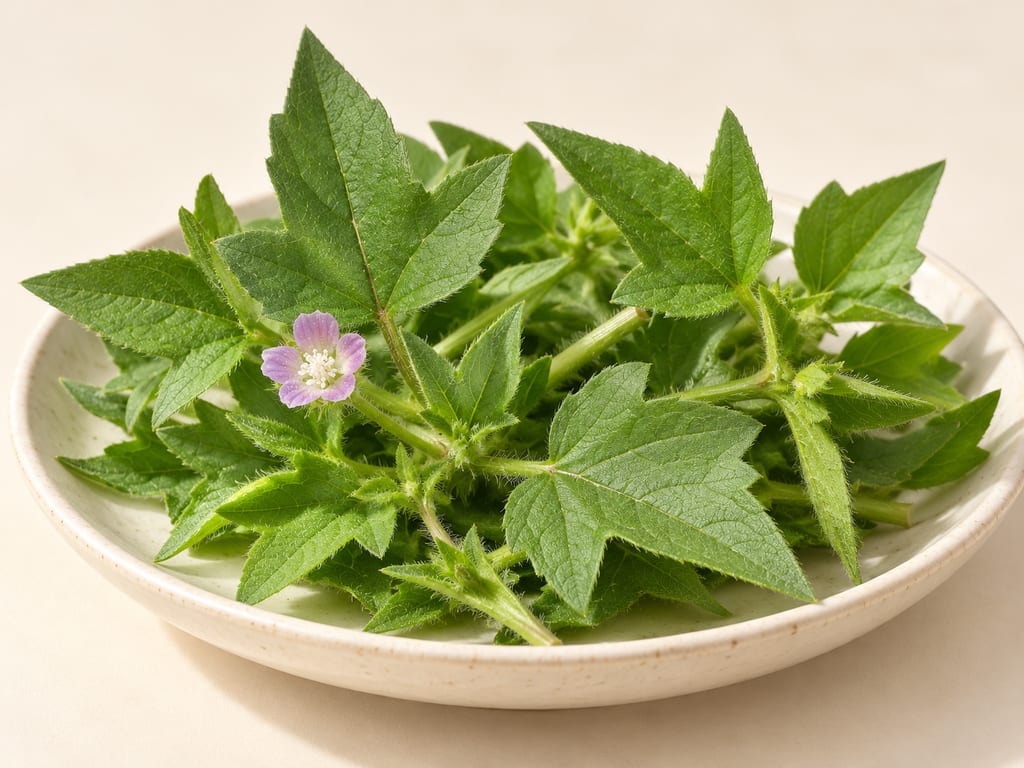
Name and botanical scope
Kew accepts Anoda cristata (L.) Schltdl. in Malvaceae. A Veracruz cookbook entry links alache, alachi and pax’tamac, among other names, to its account of this plant. These names are evidence for the places and text that use them; they do not identify an unvouchered plant in another setting.
Sources for this section
Food accounts from Veracruz
The cookbook records distinct regional dishes: a Totonacapan soup called sopa de pax’tamac that uses flowers and leaves, a Grandes Montañas entry for tacos made with alache flowers, and a separate Totonacapan flower-and-egg dish served with pipián. The flower-taco entry is associated with Nahua communities of Zongolica and Coscomatepec. These are source-reported food traditions, not validated instructions for identifying or preparing an unknown plant.
Sources for this section
Place and season
The Veracruz account says the plant grows in some humid ravines, is gathered when flowering, and flowers nearly all year in that local description. A 2001 abstract separately reports rainy-season food use in fields near Santiago Mamalhuazuca, State of Mexico. These observations belong to their respective places and do not form a national harvest calendar.
Growing observations in Guerrero
A common-garden study in La Montaña, Guerrero, distinguishes plants sown in small beds, volunteers tolerated among maize, and spontaneous plants in disturbed places. It reports a research nursery sequence and later outdoor transplanting; this documents experimental propagation and local management categories, not a household growing prescription.
The study setting is not a tolerance range
The Guerrero study describes its locality at about 1,300 m, with warm subhumid summer-rain climate and source-cited precipitation of 700–1,500 mm and temperature of 18–26°C. The figures describe the study setting, not temperature or rainfall limits for this species. The paper reports nursery use of prepared soil and shade mesh, every-third-day watering, and transplanting after true leaves developed during the rainy season. It does not establish mature container production, a greenhouse crop, soil pH, or garden yield.
Food and laboratory limits
A 1989 UNAM thesis analyzed dried, ground leaves, tender stems and flowers from Alcozauca. It reports qualitative alkaloid-test reactivity and says fresh or steamed preparation effects needed further study. The screening does not identify a particular toxin, quantify human exposure, or validate a safe amount or cooking endpoint. These older tests should not be read as either proof of safety or proof of toxicity.
What remains unresolved
The inspected sources do not provide a voucher-backed field-identification guide, a validated food-safety endpoint, storage guidance, mature pot-growing conditions, or a species-wide frost or heat limit. The regional recipe entries are not combined into one method.
Sources for this section
- Anoda cristata (L.) Schltdl. →
- Las flores en la cocina veracruzana →
- Efecto de la selección humana sobre rasgos seleccionados y correlacionados en Anoda cristata (L.) Schltdl. (Malvaceae) →
- Determinación de la composición nutricional y toxicológica de los quelites: Anoda cristata, Crotalaria pumila, Euphorbia graminea y Leucaena macrophylla →
Research gaps
No voucher-matched field identification source or diagnostic key was established.
The recipe entries report traditional batches but do not validate plant identity, food safety, storage or a hazard-control endpoint.
The 1989 thesis screening does not identify a specific toxin or establish human risk; fresh/steamed preparation effects remain unresolved.
The Guerrero study is an experimental/local context; no species-wide climate tolerance, soil pH, mature container crop, greenhouse food production, yield or regrowth guidance was established.
The State of Mexico source was inspected only as article metadata and bilingual abstracts.
Sources for this section
- Anoda cristata (L.) Schltdl. →
- Las flores en la cocina veracruzana →
- Efecto de la selección humana sobre rasgos seleccionados y correlacionados en Anoda cristata (L.) Schltdl. (Malvaceae) →
- Ethnobotany of Anoda cristata (L.) Schltdl. (Malvaceae) in Santiago Mamalhuazuca, Ozumba, State of Mexico →
- Determinación de la composición nutricional y toxicológica de los quelites: Anoda cristata, Crotalaria pumila, Euphorbia graminea y Leucaena macrophylla →
Research status
The underlying plant account received a partial source review. Its review scope is described in the original plant article.
Sources for this section
Places
Unknown
Relationship not established · Place not establishedThe available research does not establish a single origin for this ingredient.
Community
No community contributions have been published for this entry yet.
Share what you made
Sign in to contribute. Published comments and photos are free to read.
Sources
Royal Botanic Gardens, Kew, Plants of the World OnlineIngredient research
Anoda cristata (L.) Schltdl.Cited in: Name and botanical scope; What remains unresolved; Research gaps
Lesterloon Sánchez Trinidad; Secretaría de Cultura, Dirección General de Culturas Populares, Indígenas y Urbanas; 2017Ingredient research
Las flores en la cocina veracruzanaCited in: Name and botanical scope; Food accounts from Veracruz; Place and season; Food and laboratory limits; What remains unresolved; Research gaps
Bernal-Ramírez et al.; Botanical Sciences 99(2), 2021; DOI 10.17129/botsci.2784Ingredient research
Efecto de la selección humana sobre rasgos seleccionados y correlacionados en Anoda cristata (L.) Schltdl. (Malvaceae)Cited in: Growing observations in Guerrero; The study setting is not a tolerance range; What remains unresolved; Research gaps
Rendón, Bye and Núñez-Farfán; Economic Botany 55:545–554, 2001Ingredient research
Ethnobotany of Anoda cristata (L.) Schltdl. (Malvaceae) in Santiago Mamalhuazuca, Ozumba, State of MexicoCited in: Place and season; Research gaps
Dulce Maria Ramos Mora; Universidad Nacional Autónoma de México, Facultad de Ciencias, 1989Ingredient research
Determinación de la composición nutricional y toxicológica de los quelites: Anoda cristata, Crotalaria pumila, Euphorbia graminea y Leucaena macrophyllaCited in: Food and laboratory limits; What remains unresolved; Research gaps