
Substrates
Japanese udo shoots
Japanese udo is Aralia cordata, eaten as wild shoots and leaves or cultivated blanched stems, with separate home-garden and commercial forcing guidance.
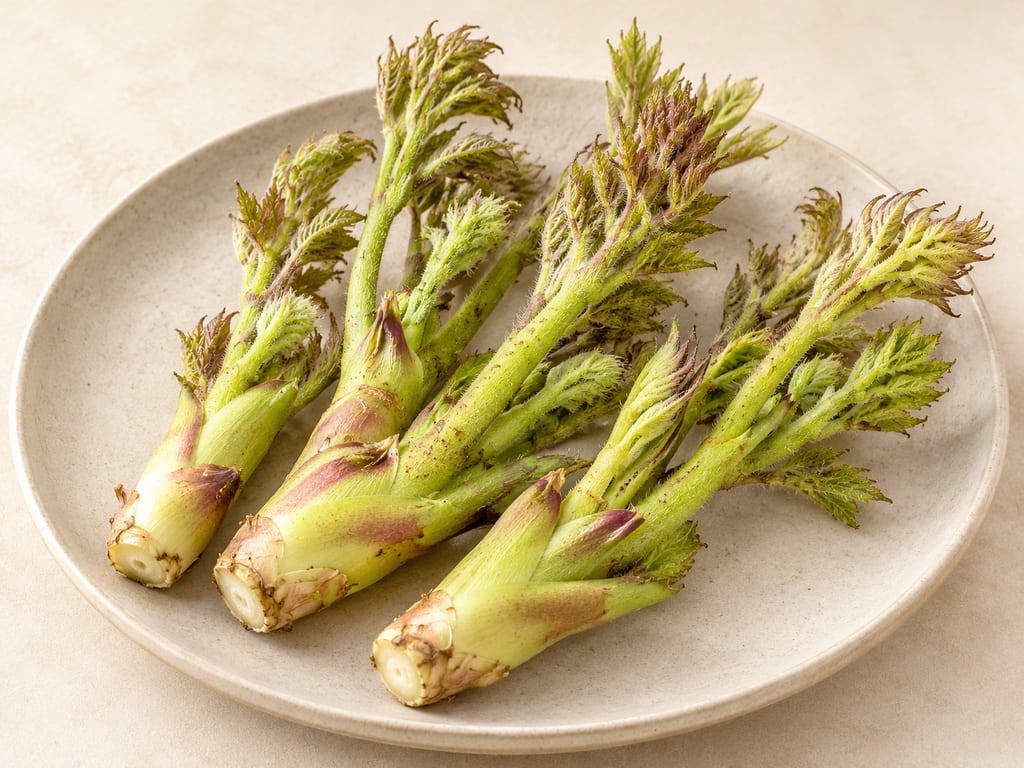
Name and species boundary
Kew accepts Aralia cordata Thunb. and lists Aralia edulis as a synonym. The Japanese food name is udo (うど), and “Japanese spikenard” is also used in horticulture. Those common names do not identify every plant sold as spikenard or called wild udo; this article concerns the accepted species.
Sources for this section
Japanese food reports
A review of Japanese foodways records centred on about 1930 lists 121 udo food-use reports and records the plant at 44% of 278 study sites. The review distinguishes wild udo, commonly eaten as shoots and leaves, from cultivated plants whose stems are blanched. These are findings from the study collection, not evidence of a single national custom or current use in every region.
Sources for this section
Food descriptions and recipe limits
A Japanese gardening guide describes young udo stems and leaves in tempura, dressed dishes and simmered preserves. The historical review also reports blanched cultivated stems. These sources give serving examples, not a complete recipe with quantities, yield, cooking endpoint or storage life.
Sources for this section
A Japanese home-growing guide
Hanano Yamato’s guide describes sun to partial shade and well-drained soil. It suggests one plant in a deep vegetable planter or deep No. 10 pot, filled less than halfway to leave room for earthing-up. It advises watering when the soil surface dries and avoiding water shortage. The guide says to let the plant establish in its first year; from the next spring, mound soil around shoots in three stages, about 15 cm at two-week intervals, to blanch the stems. It reports harvest from the second year and around April in early districts. This is the company’s gardening guidance, not a measured yield trial.
Sources for this section
Akita field production and heated forcing
Akita Prefecture’s regional commercial guide covers named udo cultivars, root division, open-field rootstock production and heated-house forcing. It gives pH 6.0–6.5 for its field soil and reports transplanting in spring; rootstocks are lifted around November after three frosts for forcing. For selected cultivars and stages, it reports about 18°C until sprouting, then 15–17°C, with nights above 5°C, and warns of rot at 27°C or higher. These are crop-specific commercial figures, not home greenhouse settings, universal temperature limits or guarantees for an unnamed cultivar.
Sources for this section
What remains unknown
The home guide’s cold- and heat-resistance marks have no published scale on the page. The inspected sources do not establish a numeric frost threshold, humidity or photoperiod response, unheated-greenhouse method, household yield, post-harvest storage life, or local collection rules. The guide’s soil-mounding method is a cultivation technique; it is not a food-preservation process.
Sources for this section
Research gaps
No specimen, cultivar or voucher was assessed; common names alone do not establish identity.
No complete udo recipe, measured yield, post-harvest storage duration or food-safety endpoint was established.
Cold/heat symbols in the home guide are undefined; no universal climate limits or unheated-greenhouse method were found.
Akita forcing figures are regional commercial guidance for named cultivars and do not establish household or cultivar-independent performance.
Local harvest permissions and conservation status were not assessed.
Research status
The underlying plant account received a partial source review. Its review scope is described in the original plant article.
Sources for this section
Places
Unknown
Relationship not established · Place not establishedThe available research does not establish a single origin for this ingredient.
Community
No community contributions have been published for this entry yet.
Share what you made
Sign in to contribute. Published comments and photos are free to read.
Sources
Royal Botanic Gardens, Kew, Plants of the World OnlineIngredient research
Aralia cordata Thunb.Cited in: Name and species boundary; What remains unknown; Research gaps
Osawa et al., Journal of Ethnobiology and Ethnomedicine 20 (2024), article 89Ingredient research
Ethnobotanical review of traditional use of wild food plants in JapanCited in: Name and species boundary; Japanese food reports; Food descriptions and recipe limits; Research gaps
Akita Prefecture; hosted by Japan Ministry of Agriculture, Forestry and FisheriesIngredient research
野菜栽培技術指針 (Vegetable cultivation technical guide)Cited in: Akita field production and heated forcing; What remains unknown; Research gaps
Hanano YamatoIngredient research
うど 育て方・栽培方法Cited in: Food descriptions and recipe limits; A Japanese home-growing guide; What remains unknown; Research gaps
FermenteaResearch provenance
Japanese udo (Aralia cordata): original plant researchCited in: Research status