
Spices and aromatics
Japanese mugwort leaves
Food reports and naming limits for Artemisia princeps, set beside Japanese yomogi food traditions whose species identity is not always specified.
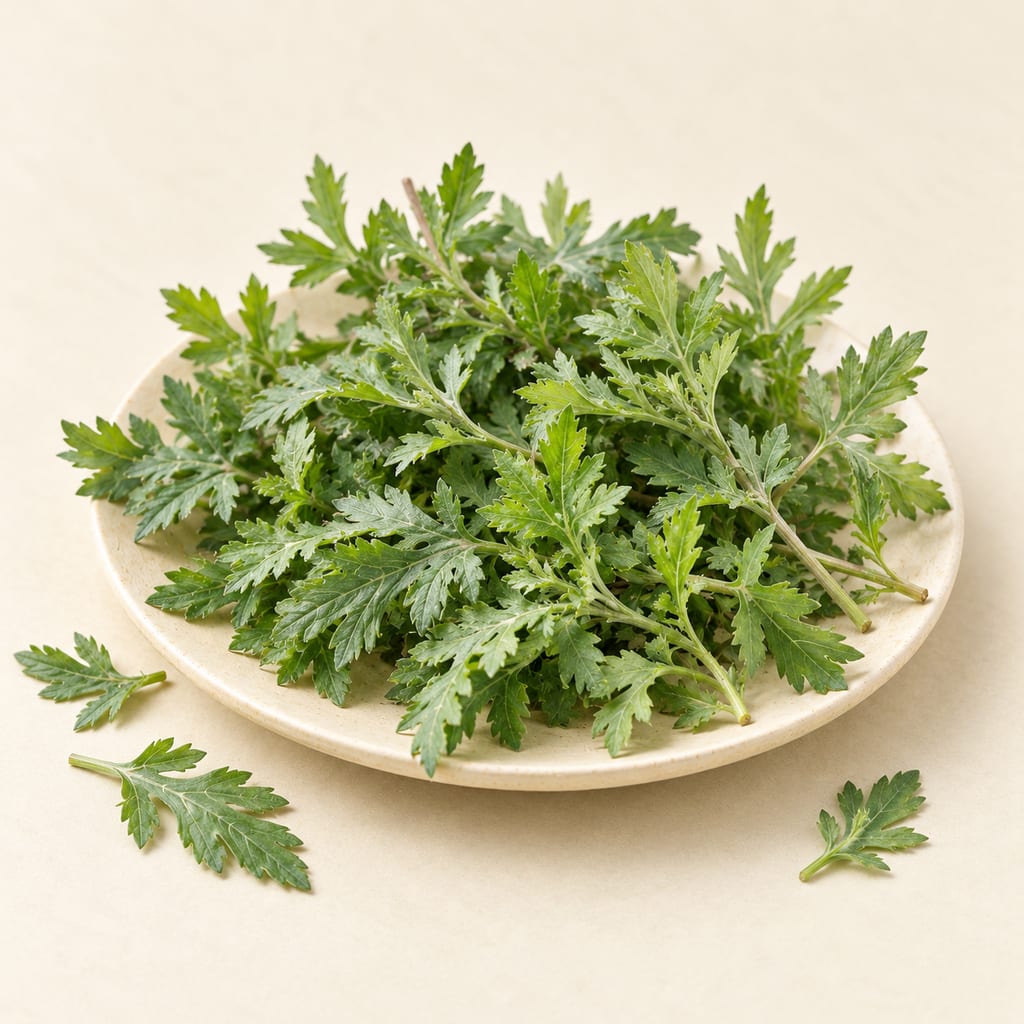
Accepted name and changing common names
Kew accepts Artemisia princeps Pamp. as a perennial native from China to temperate eastern Asia. The Japanese Medical Herb Association explains that yomogi can broadly mean several Artemisia plants; in mainland Japan the narrow use commonly refers to a taxon called A. indica var. maximowiczii in some Japanese references. Kew treats that name as a synonym of A. princeps, while the association notes that Japanese taxonomic sources differ. In Hokkaido and Okinawa, the article gives different plants as the usual referents of yomogi. A common name therefore does not settle species identity.
Sources for this section
Food reports from Korea and Japan
The Korean Rural Development Administration page labels its entry Artemisia princeps and reports young leaves eaten as namul. Its description also says the named folk-herb category can include leaves from related Artemisia plants, so the report does not define a single food cultivar or a field identification test. Japan's agriculture ministry records Tochigi kusa-mochi as a spring dish made with rice flour and yomogi, traditionally gathered as shoots emerge from mid-March to mid-April. That page gives a household preparation, but names no botanical species; it is regional yomogi context rather than confirmed A. princeps use.
Sources for this section
Lookalike and material-identification limits
The Japanese Medical Herb Association warns that plants gathered as yomogi can be confused with poisonous monkshood, anemone and celandine. Its warning concerns gathering under a broad common name; it is not a diagnostic key. A 2006 Korean study reports that Artemisia materials sold in medicinal markets were sometimes not clearly distinguished, including substitutions involving A. capillaris or A. iwayomogi. That study concerns medicinal-market material and a laboratory DNA marker, not culinary safety or a household identification method. Neither this article nor a photograph can confirm a gathered plant.
Cultivation evidence and what remains unknown
Kew describes A. princeps as a temperate perennial. The Korean Rural Development Administration entry labels the plant A. princeps and reports long rhizomes, growth around cultivated ground and fields, and strong reproductive capacity, but gives no tested garden setup. JAMHA’s 2022 article gives broader guidance for yomogi and Artemisia plants: many are cold- and pest-tolerant, propagation can be by seed, division or cuttings, and the short-day plants flower from summer into autumn. For food, the article says to shade growth to keep it tender and generally harvest soft shoot tips as bolting begins in early summer. Those genus-level observations are not a measured A. princeps cultivation recipe; the article gives no species-specific soil pH, irrigation, container depth or greenhouse protocol. A. montana and other plants called yomogi are not substituted for A. princeps evidence.
Research gaps
No source reviewed here resolves all Japanese taxonomic treatments of the yomogi names or identifies the plant in the Tochigi kusa-mochi tradition to species.
No field identification guide, specimen examination or local gathering permission review was performed; do not use the article to identify or collect wild plants.
No species-specific A. princeps protocol for soil pH, irrigation, containers, greenhouse conditions or productive yield was established. JAMHA’s genus-level notes on seed/division/cutting propagation, shade for tender food material and early-summer shoot-tip harvest are not a cultivar-tested garden prescription.
The sources report food traditions but do not establish a universal preparation, storage duration or food-safety endpoint.
Research status
The underlying plant account received a partial source review. Its review scope is described in the original plant article.
Sources for this section
Places
Unknown
Relationship not established · Place not establishedThe available research does not establish a single origin for this ingredient.
Community
No community contributions have been published for this entry yet.
Share what you made
Sign in to contribute. Published comments and photos are free to read.
Sources
Royal Botanic Gardens, Kew, Plants of the World OnlineIngredient research
Artemisia princeps Pamp.Cited in: Accepted name and changing common names; Cultivation evidence and what remains unknown; Research gaps
Japan Medical Herb AssociationIngredient research
ヨモギの植物学と栽培 (Botany and cultivation of yomogi)Cited in: Accepted name and changing common names; Lookalike and material-identification limits; Cultivation evidence and what remains unknown; Research gaps
Korean Rural Development Administration, NongsaroIngredient research
민간약초: 쑥 (Folk herb: ssuk)Cited in: Food reports from Korea and Japan; Cultivation evidence and what remains unknown; Research gaps
Japan Ministry of Agriculture, Forestry and FisheriesIngredient research
草餅 栃木県 (Kusa-mochi, Tochigi Prefecture)Cited in: Food reports from Korea and Japan; Research gaps
Biological and Pharmaceutical Bulletin / J-STAGEIngredient research
Development of SCAR Marker for Discrimination of Artemisia princeps and A. argyi from Other Artemisia HerbsCited in: Lookalike and material-identification limits; Research gaps
FermenteaResearch provenance
Japanese mugwort (Artemisia princeps): original plant researchCited in: Research status