
Substrates
Chamchwi greens
Korean extension sources describe chamchwi as a spring leafy crop and name a Chungcheongbuk-do rice wrap. The RDA crop page gives nursery and field guidance, while container evidence comes from a shared multi-crop balcony model rather than a chamchwi-specific trial.
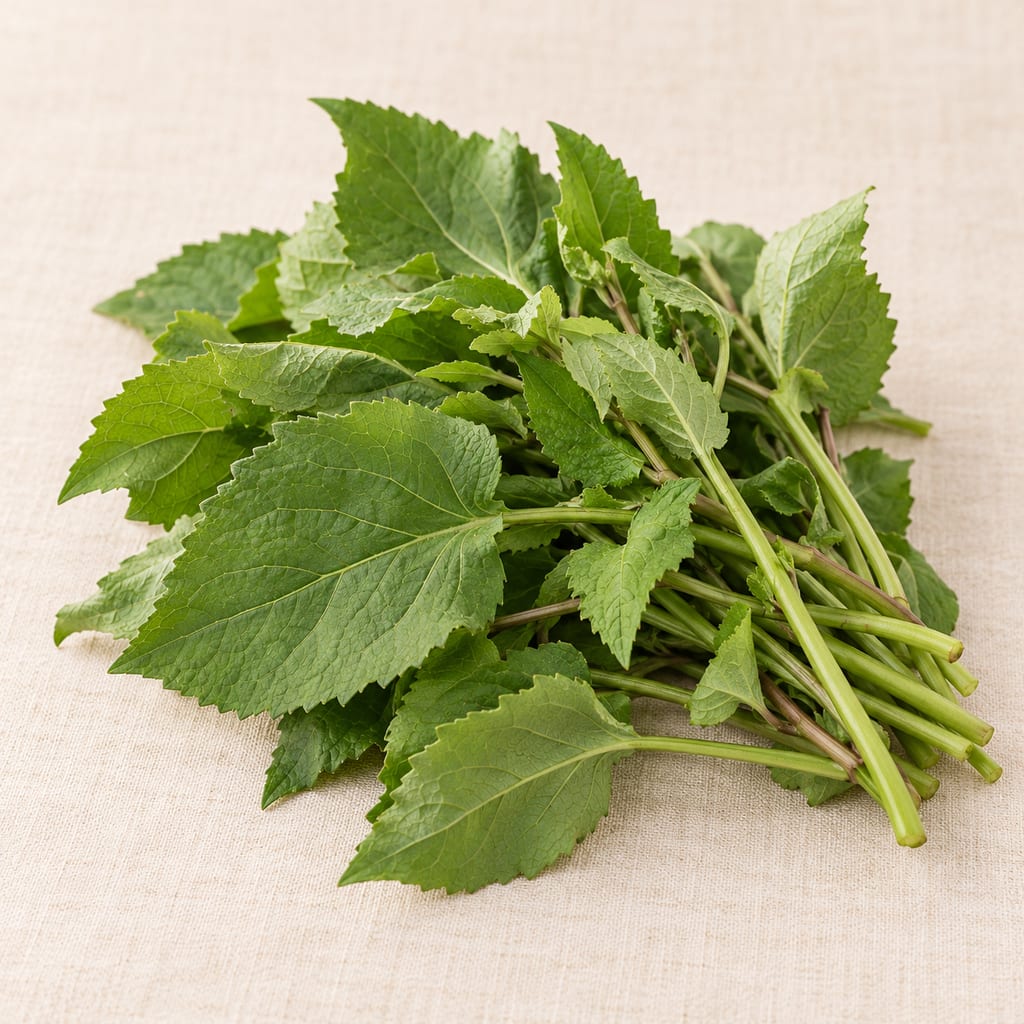
Name and scope
The Korean Rural Development Administration (RDA) crop page names 참취 and prints Aster scaber Thunb. Kew's record accepts A. scaber Thunb. and lists Korea in its East Asian range. Kew also distinguishes the later homonym A. scaber Elliott, which it places under Symphyotrichum undulatum. The shared Latin epithet alone does not make those names the same taxon.
This article follows the Korean crop page's 참취 mapping. The broader word 취나물 is not treated as a guaranteed species identification for every market or gathered plant.
Sources for this section
A regional food account
The RDA dictionary lists a dish called 참취오곡쌈밥 and attributes the entry to Chungcheongbuk-do. It describes five-grain rice mixed with sesame oil, shaped and wrapped in briefly blanched 참취 leaves, with ssamjang served alongside. The same entry calls 참취's young shoots 취나물. This is a named food account, not a complete measured recipe: it supplies no quantities, yield, full sequence or storage guidance.
A separate RDA crop page identifies tender leaves and stems around stem elongation as the harvested crop parts. The dish entry does not establish the origin of the food or the identity of any particular specimen.
Sources for this section
Crop calendar and field guidance
The RDA page lists spring sowing in March–April and autumn sowing in September–October. It gives ordinary harvest from late April to early June, an early-crop window from early April to mid-May, and a forced-crop window from January to February. It reports seed germination at 15°C and a 15–25°C nursery range. These are figures in a Korean extension crop profile; the page shows no trial design or basis for treating them as universal tolerance limits.
The same profile describes humus-rich sandy loam, humus soil or clay loam, pH 5.5–6.5 and a 30–50 cm soil depth. It names seed boxes or 105-cell plug trays, 30–50% shade and periodic watering. Its transplant section gives 100 cm beds with 20 cm between plants, while a separate dense-planting line gives 30 × 10 cm. The page does not explain how those spacing contexts relate, so they remain distinct source statements.
The crop profile warns that drought and excess wetness can damage plants, and associates heat with wilting, rosetting and poor above-ground growth. It links waterlogging with weak below-ground growth and root rot. It does not describe a greenhouse structure or specify household container dimensions.
Sources for this section
Balcony context and unresolved growing questions
An RDA 2017 balcony-garden model includes chamchwi among several leafy mountain vegetables in a shared three-tier, 0.5 m² planting arrangement. The model lists 12 cm pots and a potting substrate for its mixed planting. It does not isolate chamchwi performance, specify a chamchwi pot depth, or report a species-specific yield; those shared dimensions should not be read as a crop prescription.
The inspected records do not establish a named hardiness scheme, frost or heat tolerance boundary, photoperiod response, container production protocol, greenhouse regime, or locally validated harvest interval beyond the RDA calendar.
Sources for this section
Food and storage limits
The RDA crop page states that harvested material may be rapidly frozen at −20°C, but gives no duration, package, thawing method or validation. That isolated postharvest statement is not a household preservation procedure. The named rice-wrap account likewise does not provide a complete preparation method or food-safety endpoint.
Sources for this section
Research gaps
The RDA rice-wrap entry lacks quantities, yield, complete preparation sequence and storage details; no executable recipe is presented.
The RDA crop page does not reconcile its 100 cm bed / 20 cm spacing with its separate 30 × 10 cm dense-planting line.
No species-specific household container or greenhouse method, hardiness scheme, or experimentally established frost, heat or photoperiod boundary was verified.
The balcony model is multi-crop and does not report isolated chamchwi growth or yield.
A common food name or this article does not identify a gathered plant or establish its safety.
Research status
The underlying plant account received a partial source review. Its review scope is described in the original plant article.
Sources for this section
Places
Unknown
Relationship not established · Place not establishedThe available research does not establish a single origin for this ingredient.
Community
No community contributions have been published for this entry yet.
Share what you made
Sign in to contribute. Published comments and photos are free to read.
Sources
Royal Botanic Gardens, KewIngredient research
Aster scaber Thunb. | Plants of the World OnlineCited in: Name and scope; Research gaps
Rural Development Administration, Republic of Korea; NongsaroIngredient research
채소 - 참취: 생육과정(주요농작업)Cited in: Name and scope; A regional food account; Crop calendar and field guidance; Balcony context and unresolved growing questions; Food and storage limits; Research gaps
Rural Development Administration, Republic of Korea; NongsaroIngredient research
농업용어사전: 참취 / 참취오곡쌈밥Cited in: Name and scope; A regional food account; Food and storage limits; Research gaps
Rural Development Administration; Jang Yuna, Urban Agriculture DivisionIngredient research
1인 가구 베란다 텃밭재배를 위한 건강 나물, 샐러드 텃밭 모델Cited in: Balcony context and unresolved growing questions; Research gaps
FermenteaResearch provenance
Chamchwi: Korean crop and food records for Aster scaber: original plant researchCited in: Research status