
Spices and aromatics
Common daisy flowers and leaves
Bellis perennis has Danish reports of leaves in salads and flowers used candied, as garnish and in cabbage dishes. A Colorado extension list names the petals as a garnish or salad ingredient. The accounts differ on heating and do not provide a complete recipe or safety limit.
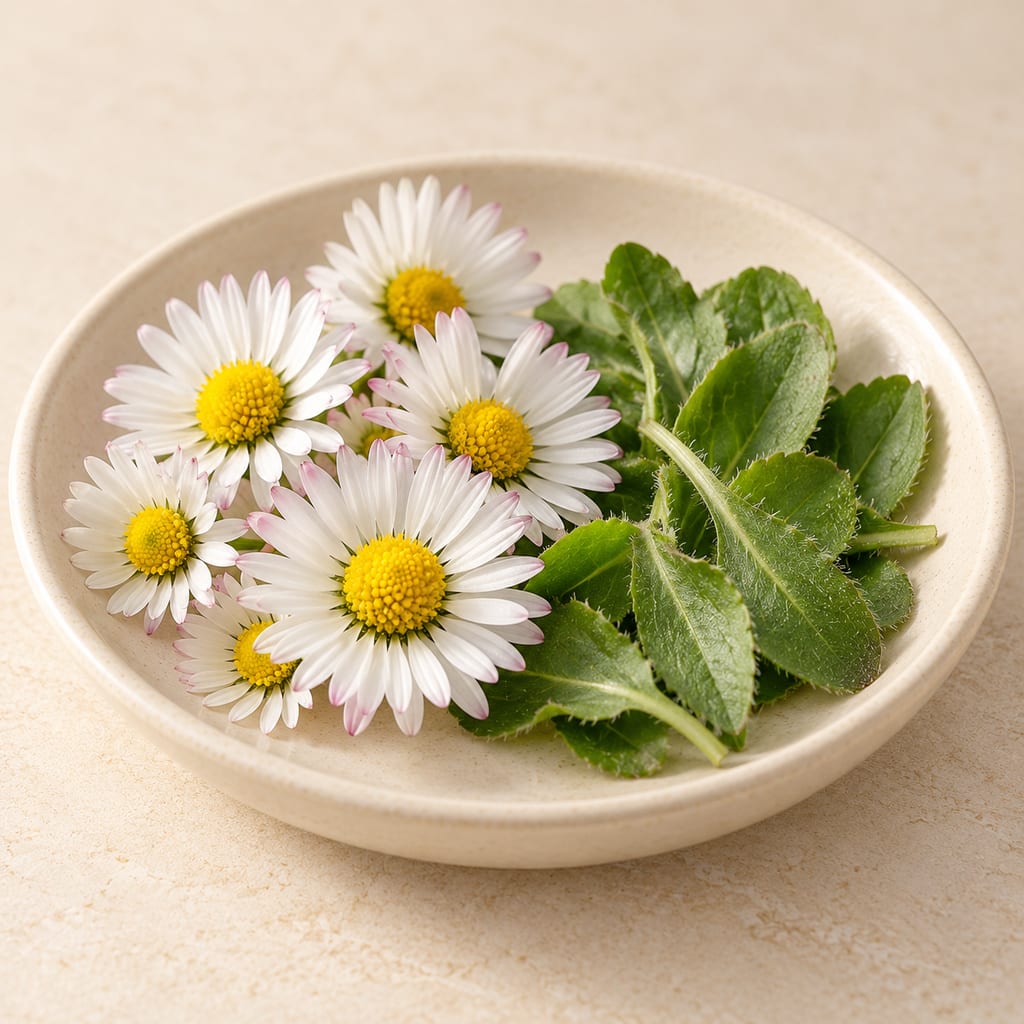
The daisy described here
Kew accepts Bellis perennis L. in the daisy family Asteraceae. The Danish food authority names it tusindfryd; the RHS profile also records names including common gowan and the Welsh llygad y dydd. This article concerns that species, rather than every plant called a daisy.
Kew records the species as a temperate perennial native from Madeira and Europe through the Mediterranean and Central Asia. The Danish authority reports it across Denmark, with flowers during the frost-free period from March to October. These range and season statements are regional records, not a garden forecast for every location.
Food uses reported in Denmark and Colorado
The Danish authority reports leaves in salads and flowers used candied, as edible decoration and in cabbage dishes, with use reports from Eastern Europe and Italy. Colorado State University Extension lists Bellis perennis petals for garnish or salads. VILD MAD describes the whole plant as edible in its Danish foraging account and gives salad and dessert examples.
The sources do not agree on heat use: the Danish authority reports candied flowers and cabbage dishes, while VILD MAD advises keeping Bellis raw. These are reported uses, not a tested comparison. None of the inspected accounts provides a complete measured recipe.
Sources for this section
What the garden sources say
The RHS profile describes a low, evergreen rosette with spoon-shaped leaves and small yellow-centred white flowers that may be pink-tinged. It lists full sun or partial shade; chalk, clay, loam or sand; and moist but well-drained or well-drained soil. It places the profile in all three broad pH categories and assigns RHS UK hardiness H7, which the RHS defines as the severest European continental climates below −20°C. H7 is a scheme category, not a measured survival threshold.
The RHS says to grow in well-drained soil, deadhead to reduce self-seeding and propagate by seed or division after flowering. Colorado State Extension describes the species as a cool-weather flower that prefers full sun and moist soil. These are garden-profile statements; no food-yield trial, container production schedule or greenhouse protocol was found.
Sources for this section
Evidence limits
The Danish authority says it knows of no poisoning reports from people or animals consuming the listed leaves and flowers. That statement is not a quantified safety study or a guarantee for an individual plant. The same authority warns generally that cut flowers may not have been grown for food and may carry pesticide residues. VILD MAD offers visual descriptions, but neither source establishes a field-identification service or permission to gather from a particular site.
Sources for this section
Research gaps
No complete Bellis-specific recipe with amounts, yield, full steps, endpoint and storage was verified.
Food-use sources differ on whether to heat the plant; no controlled preparation comparison or food-safety endpoint resolves that difference.
No quantitative serving or toxicology limit, food-storage period, or comprehensive local collection-permission review was established.
RHS and extension garden conditions do not establish edible crop yield, productive container settings or greenhouse requirements.
Research status
The underlying plant account received a partial source review. Its review scope is described in the original plant article.
Sources for this section
Places
Unknown
Relationship not established · Place not establishedThe available research does not establish a single origin for this ingredient.
Community
No community contributions have been published for this entry yet.
Share what you made
Sign in to contribute. Published comments and photos are free to read.
Sources
Royal Botanic Gardens, KewIngredient research
Bellis perennis L. | Plants of the World OnlineCited in: The daisy described here; Research gaps
Royal Horticultural SocietyIngredient research
Bellis perennis | daisyCited in: The daisy described here; What the garden sources say; Research gaps
Danish Veterinary and Food Administration (Fødevarestyrelsen)Ingredient research
Almindelig tusindfryd (blad og blomst)Cited in: The daisy described here; Food uses reported in Denmark and Colorado; Evidence limits; Research gaps
Danish Veterinary and Food Administration (Fødevarestyrelsen)Ingredient research
Blomster: slik og bagværkCited in: Evidence limits; Research gaps
Colorado State University ExtensionIngredient research
Edible FlowersCited in: Food uses reported in Denmark and Colorado; What the garden sources say; Research gaps
VILD MADIngredient research
BellisCited in: Food uses reported in Denmark and Colorado; Evidence limits; Research gaps
FermenteaResearch provenance
Daisy: leaves and flowers in reported food uses: original plant researchCited in: Research status