
Substrates
Black jack greens
Zambian food references name Bidens pilosa as black jack and report leaves in local food records. A household study also recorded a genus-level Bidens group, but its vouchers and collection statistics cannot be assigned to this species.
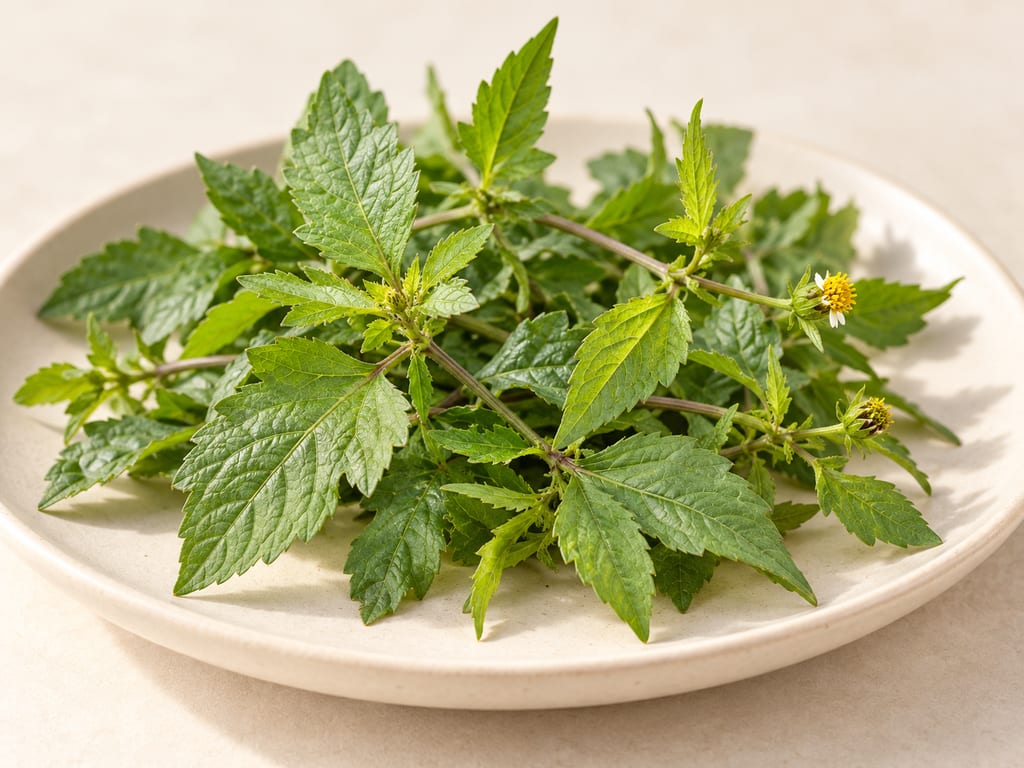
Name and Zambia source context
Kew accepts Bidens pilosa L. in the daisy family, Asteraceae, and records it as introduced in Zambia. The NFNC report glossary maps “black jack” to B. pilosa, and its food table gives the name Kanunka (B). The CTDT/Oxfam Zambia entry also lists kanunka for B. pilosa, without a language or district. These entries document names in publications; they are not a field identification method.
Daum and colleagues’ results prose names both B. pilosa and B. schimperi. Their table, however, lists Bidens sp. and vouchers 22258 and 22261; it does not map either voucher to either species. The aggregate percentages in that row therefore remain genus-level evidence.
Sources for this section
- Bidens pilosa L., Plants of the World Online →
- The Common Zambian Foodstuff, Ethenicity, Preparation and Nutrient Composition of Selected Foods Research Report (title as printed on 2007 cover) →
- One hundred local food plants to improve nutrition: Species botany, local knowledge, and nutritional qualities →
- Edible weeds and food and nutrition security in the face of the herbicide revolution. A case study from Zambia (author-uploaded preprint) →
Food parts and reported preparation
The NFNC report’s entry under Black Jack / Bidens pilosa describes dried leaves pounded and cooked in water for a few minutes, with pounded groundnuts or makowa seeds as optional additions. The brief description gives no amount, yield, cleaning method, or independently validated cooking or storage endpoint. The fresh-leaf boiling text immediately above that entry is headed Mpoko, a tree-leaf item, and is not attributed here to Bidens.
The CTDT/Oxfam Zambia row lists leaves and boiled, fried or stir-fried, and dried categories. Its broader species account discusses young shoots and leaves in fresh, stew, and dried-powder uses, but that general passage does not establish that every preparation is a Zambia-specific local method. Neither source validates safe preparation or preservation.
Household study and limits of the figures
The Hohenheim working paper describes fieldwork in Eastern and Southern Province during the 2018–19 rainy-season period. Its Table 2 reports Bidens sp. vouchers 22258 and 22261; for that combined genus-level row it gives 64% collected, 52% preserved, and 0% cultivated in the current season (n=157). It does not assign those figures to B. pilosa or B. schimperi individually. The paper reports some respondents blanching edible weeds before sun-drying, but this observation is not a validated preservation procedure.
The 2022 peer-reviewed article is the final publication of this study. Its publisher record and indexed text were accessible, but the direct full text was not. The source detail about voucher resolution and table percentages in this article comes from the full 2021 author-uploaded preprint, not a claimed independent inspection of the final article’s complete table.
Growing evidence and unanswered questions
Kew’s introduced status describes distribution, not crop value or invasive-risk assessment. The CTDT/Oxfam country row labels B. pilosa semi-domesticated and lists agricultural field, home-garden, forest, and other settings; it supplies no trial methods or plot measurements. Daum and colleagues’ survey concerns use and collection rather than an agronomic treatment trial. The available Zambian sources do not establish a species-specific sowing schedule, productive climate or soil limits, container method, greenhouse regime, yield, or harvest interval.
The sources identify food reports but do not establish how a particular plant should be distinguished from other Bidens or confirm that a gathered specimen is suitable to eat. They also do not provide a validated fresh-leaf recipe, drying control, storage duration, or species-specific food-hazard assessment.
Sources for this section
- Bidens pilosa L., Plants of the World Online →
- One hundred local food plants to improve nutrition: Species botany, local knowledge, and nutritional qualities →
- Edible weeds and food and nutrition security in the face of the herbicide revolution. A case study from Zambia (author-uploaded preprint) →
- Edible weeds and food and nutrition security in the face of the herbicide revolution. A case study from Zambia →
Research gaps
The study vouchers 22258 and 22261 are recorded as Bidens sp.; no voucher-to-species crosswalk was found.
The 2022 final journal full text was not accessible directly; full methods and voucher-table review used the 2021 author-uploaded preprint.
The source reports do not establish a species-specific Zambia crop trial, yield, container or protected-growing method.
The NFNC fresh-leaf boiling passage belongs to the preceding Mpoko item; the Bidens entry itself describes dried leaves. A complete source-batched fresh-leaf method was not established.
No validated food-safety, blanching, drying, shelf-life, or gathered-specimen identification endpoint was established.
Sources for this section
- Bidens pilosa L., Plants of the World Online →
- The Common Zambian Foodstuff, Ethenicity, Preparation and Nutrient Composition of Selected Foods Research Report (title as printed on 2007 cover) →
- One hundred local food plants to improve nutrition: Species botany, local knowledge, and nutritional qualities →
- Edible weeds and food and nutrition security in the face of the herbicide revolution. A case study from Zambia (author-uploaded preprint) →
- Edible weeds and food and nutrition security in the face of the herbicide revolution. A case study from Zambia →
Research status
The underlying plant account received a partial source review. Its review scope is described in the original plant article.
Sources for this section
Places
Unknown
Relationship not established · Place not establishedThe available research does not establish a single origin for this ingredient.
Community
No community contributions have been published for this entry yet.
Share what you made
Sign in to contribute. Published comments and photos are free to read.
Sources
Royal Botanic Gardens, KewIngredient research
Bidens pilosa L., Plants of the World OnlineCited in: Name and Zambia source context; Growing evidence and unanswered questions; Research gaps
National Food and Nutrition Commission, Ministry of Health, and University of Zambia, School of Agricultural SciencesIngredient research
The Common Zambian Foodstuff, Ethenicity, Preparation and Nutrient Composition of Selected Foods Research Report (title as printed on 2007 cover)Cited in: Name and Zambia source context; Food parts and reported preparation; Research gaps
Oxfam Novib; Zambia row compiled with Community Technology Development TrustIngredient research
One hundred local food plants to improve nutrition: Species botany, local knowledge, and nutritional qualitiesCited in: Name and Zambia source context; Food parts and reported preparation; Growing evidence and unanswered questions; Research gaps
Author-uploaded preprint hosted by ResearchGateIngredient research
Edible weeds and food and nutrition security in the face of the herbicide revolution. A case study from Zambia (author-uploaded preprint)Cited in: Name and Zambia source context; Household study and limits of the figures; Growing evidence and unanswered questions; Research gaps
International Journal of Agricultural Sustainability, Taylor & FrancisIngredient research
Edible weeds and food and nutrition security in the face of the herbicide revolution. A case study from ZambiaCited in: Household study and limits of the figures; Growing evidence and unanswered questions; Research gaps
FermenteaResearch provenance
Black jack (Bidens pilosa): original plant researchCited in: Research status