
Substrates
Good King Henry greens
Kew accepts Blitum bonus-henricus, a European perennial also called Good King Henry. RHS guidance describes edible spinach-like leaves and UK garden cultivation, while a Dutch botanical-garden account records a historical shoot-blanching practice. Neither source supplies a complete recipe or a safe serving threshold.
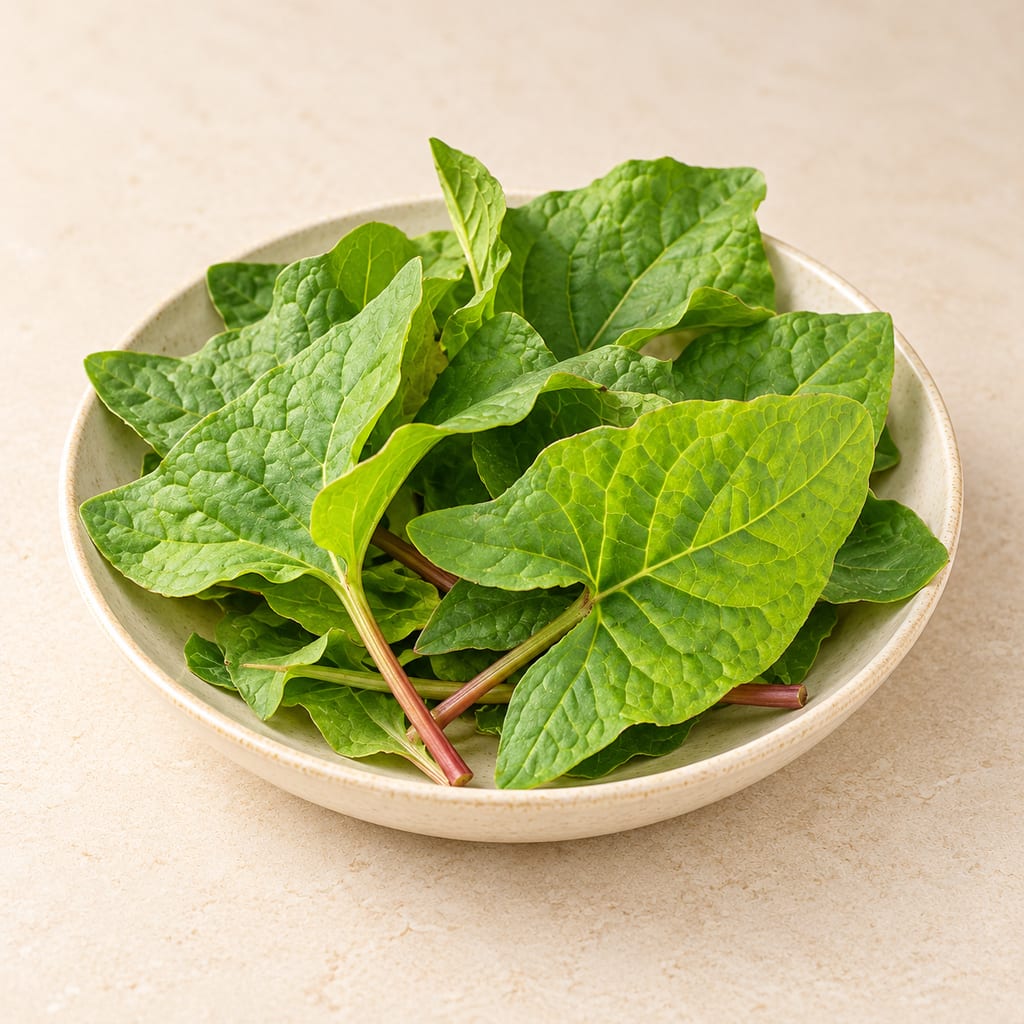
The plant behind the name
Kew accepts Blitum bonus-henricus (L.) Rchb. and lists Chenopodium bonus-henricus L. as a synonym. It describes the plant as a temperate perennial native to Europe. The current RHS profile says it is not native to Great Britain or Ireland and gives its plant range as Central and Southern Europe (mountains), consistent with Kew's listing of it as introduced in Britain and Ireland. The name Good King Henry is used for this plant, but common labels such as goosefoot and fat hen also apply to other plants and do not establish identity.
Sources for this section
Leaves and reported food uses
The RHS profile describes the leaves as spinach-like and edible raw or cooked. An account from the Netherlands Botanical Gardens Association (NVBT) calls this a Dutch “forgotten vegetable”: it describes spring sowing followed by covering shoots the next spring to blanch them, and says the pale shoots could be eaten steamed or raw in salads. These are source-reported uses, not a complete recipe or a crop schedule. NVBT also cautions against eating too many leaves uncooked, but gives no quantity or explanation.
Sources for this section
Growing in the RHS UK context
The RHS assigns Good King Henry H5 in its UK hardiness scheme, whose H5 band is −15 to −10°C. This is a horticultural category, not a measured survival limit for every plant or site. Its profile lists chalk, clay, loam and sand; acid, alkaline or neutral pH; and well-drained or moist-but-well-drained soil. The profile lists full shade and partial shade, while the cultivation narrative recommends a sunny or semi-shaded position and fertile, well-drained soil. The RHS recommends seed propagation, patio and container planting, light picking in the first year, and later harvesting as needed; it gives no pot dimensions or expected yield.
Sources for this section
Food and evidence limits
A PubMed abstract for a food-composition paper reports oxalate analysis of leaves, stems and buds, and a short boiling treatment in the tested material. The full article could not be inspected, so the abstract does not provide a basis here for a safe amount, a household treatment rule or a complete recipe. No harvest identification guide, storage duration, greenhouse schedule or measured container yield was established.
Sources for this section
Research gaps
No complete species-specific recipe with quantities, yield, ordered preparation, endpoint and storage was verified.
NVBT cautions against eating too many uncooked leaves and the oxalate paper abstract reports composition data, but no safe quantity or preparation-specific assessment is available; the paper's full text was inaccessible.
The RHS H5 rating is a UK hardiness category rather than a measured survival threshold. Heat limits, greenhouse production, container dimensions and productive yield remain unreported in the inspected sources.
No identification key, site-specific collection permission or current country-level conservation assessment was established.
Research status
The underlying plant account received a partial source review. Its review scope is described in the original plant article.
Sources for this section
Places
Unknown
Relationship not established · Place not establishedThe available research does not establish a single origin for this ingredient.
Community
No community contributions have been published for this entry yet.
Share what you made
Sign in to contribute. Published comments and photos are free to read.
Sources
Royal Botanic Gardens, Kew, Plants of the World OnlineIngredient research
Blitum bonus-henricus (L.) Rchb.Cited in: The plant behind the name; Research gaps
Royal Horticultural SocietyIngredient research
Blitum bonus-henricus detailsCited in: The plant behind the name; Leaves and reported food uses; Growing in the RHS UK context; Research gaps
Netherlands Botanical Gardens Association (NVBT)Ingredient research
Blitum bonus-henricusCited in: Leaves and reported food uses; Research gaps
Foods (MDPI); PubMed recordIngredient research
Oxalate Content of the Herb Good-King-Henry, Blitum Bonus-Henricus (Foods, 2015)Cited in: Food and evidence limits; Research gaps
FermenteaResearch provenance
Good King Henry: leafy food and garden guidance: original plant researchCited in: Research status