
Substrates
Bathua greens (Chenopodium album)
Chenopodium album is a widespread annual with documented leafy-vegetable use in parts of India. Cultivated bathua trials and food-composition experiments describe particular plants and samples, not a universal foraging or safety method.
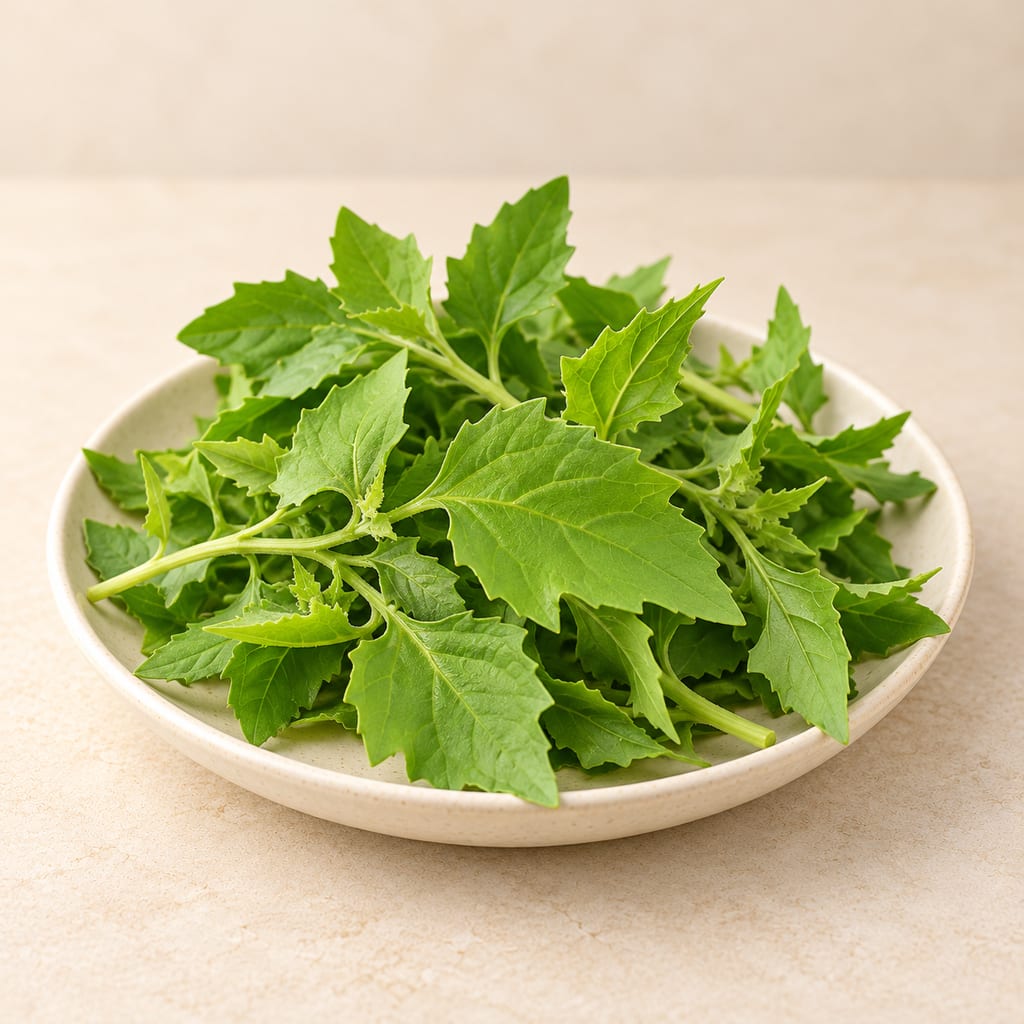
Species and names
Kew accepts Chenopodium album L. as an annual whose native range extends from temperate regions to the Indian subcontinent. The ICAR-IIVR paper uses the name leafy chenopod and records bathua and several other Indian regional names, including vastuka, lunak and paruppukkirai. Common names vary by place; these names do not make every goosefoot, quinoa or related Chenopodium species the same food plant.
RHS describes C. album as a fast-growing, branching plant with mealy leaf undersides and tightly clustered green flowers. Those profile details are not an identification key. A familiar name or visual resemblance is not enough to establish a plant’s identity or suitability for eating.
Documented food contexts
The ICAR-IIVR paper reports leaves cooked as saag and served with dal, puri or paratha in Indian contexts. It focuses on cultivated leafy genotypes developed and evaluated at Varanasi. These descriptions record food context; they are not complete recipes or proof that every local use under the name bathua uses the same species and plant material.
A New Zealand food-composition study examined leaves identified as fat hen, C. album, and measured oxalate in raw and cooked samples. Its abstract reports lower total oxalate concentrations per unit of dry matter in its boiled and wok-cooked samples than in raw leaves. The wok samples also absorbed oil, affecting the comparison. Those results describe laboratory measurements from tested samples. They do not set a safe serving, establish a complete removal endpoint or validate a cooking method for every plant, dish or person.
What the Varanasi crop study measured
ICAR-IIVR compared named cultivated material, including the released variety Pusa Bathua-1, at its Varanasi research farm. The paper describes five consecutive years of observations dated 2013–2018. The paper reports mid-October sowing, silt-loam soil at pH 7.3 and five or six marketable cuttings during the crop period. It measured plant height at 40 and 160 days after sowing and reports genotype-specific biomass and leaf-composition results.
This is evidence about named cultivated material at one research site under uniform agronomic practices, which the paper does not fully specify. It does not provide a transferable home-garden calendar, container dimensions, greenhouse protocol or general yield promise. The paper also describes the species as a weed in many crop settings, so field occurrence is not itself a cultivation recommendation.
Cooking study limits
The oxalate paper compares measured fractions in a particular raw sample and prepared samples. Its experimental cooking batches included about 200 g leaves boiled with 400 mL water, and a separate wok treatment pairing about 200 g leaves with 200 mL canola oil. The paper reports analytical outcomes for those batches; those measurements are not recommended household recipe controls.
The study does not establish a safe dose, universal detoxification result, storage limit or nitrate content. It cannot support a claim that a cooking treatment makes any gathered plant safe. The reported saag and meal pairings likewise do not supply a complete source-batched recipe with validated storage guidance.
Research gaps
No complete, fully inspected regional bathua recipe with ingredients, ordered method, yield and storage evidence was established.
No universal identification method or link between every local common name and a verified specimen was established.
The Varanasi trial does not define a home container, greenhouse or protected-cropping protocol; its inputs and site-specific results should not be generalized.
The oxalate study does not give a safe serving, complete toxin-removal endpoint or nitrate measurements.
Sources for this section
- Chenopodium album L. | Plants of the World Online →
- Chenopodium album | RHS Plant Profile →
- Morpho-chemical characteristics of cultivated genotypes of leafy chenopod (Chenopodium album L.) developed at ICAR-IIVR, Varanasi, Uttar Pradesh →
- Oxalate Contents of Raw, Boiled, Wok-Fried and Pesto and Juice Made from Fat Hen (Chenopodium album) Leaves →
Research status
The underlying plant account received a partial source review. Its review scope is described in the original plant article.
Sources for this section
Places
Unknown
Relationship not established · Place not establishedThe available research does not establish a single origin for this ingredient.
Community
No community contributions have been published for this entry yet.
Share what you made
Sign in to contribute. Published comments and photos are free to read.
Sources
Royal Botanic Gardens, KewIngredient research
Chenopodium album L. | Plants of the World OnlineCited in: Species and names; Research gaps
Royal Horticultural SocietyIngredient research
Chenopodium album | RHS Plant ProfileCited in: Species and names; Research gaps
Vegetable Science / ICAR-Indian Institute of Vegetable ResearchIngredient research
Morpho-chemical characteristics of cultivated genotypes of leafy chenopod (Chenopodium album L.) developed at ICAR-IIVR, Varanasi, Uttar PradeshCited in: Species and names; Documented food contexts; What the Varanasi crop study measured; Research gaps
Foods via PubMed CentralIngredient research
Oxalate Contents of Raw, Boiled, Wok-Fried and Pesto and Juice Made from Fat Hen (Chenopodium album) LeavesCited in: Documented food contexts; Cooking study limits; Research gaps
FermenteaResearch provenance
Bathua and other food contexts for Chenopodium album: original plant researchCited in: Research status