
Substrates
Creeping thistle greens
Creeping thistle is a widespread, spreading perennial with one detailed Alberta leaf-puree account and older food reports summarized by a U.S. Forest Service review.
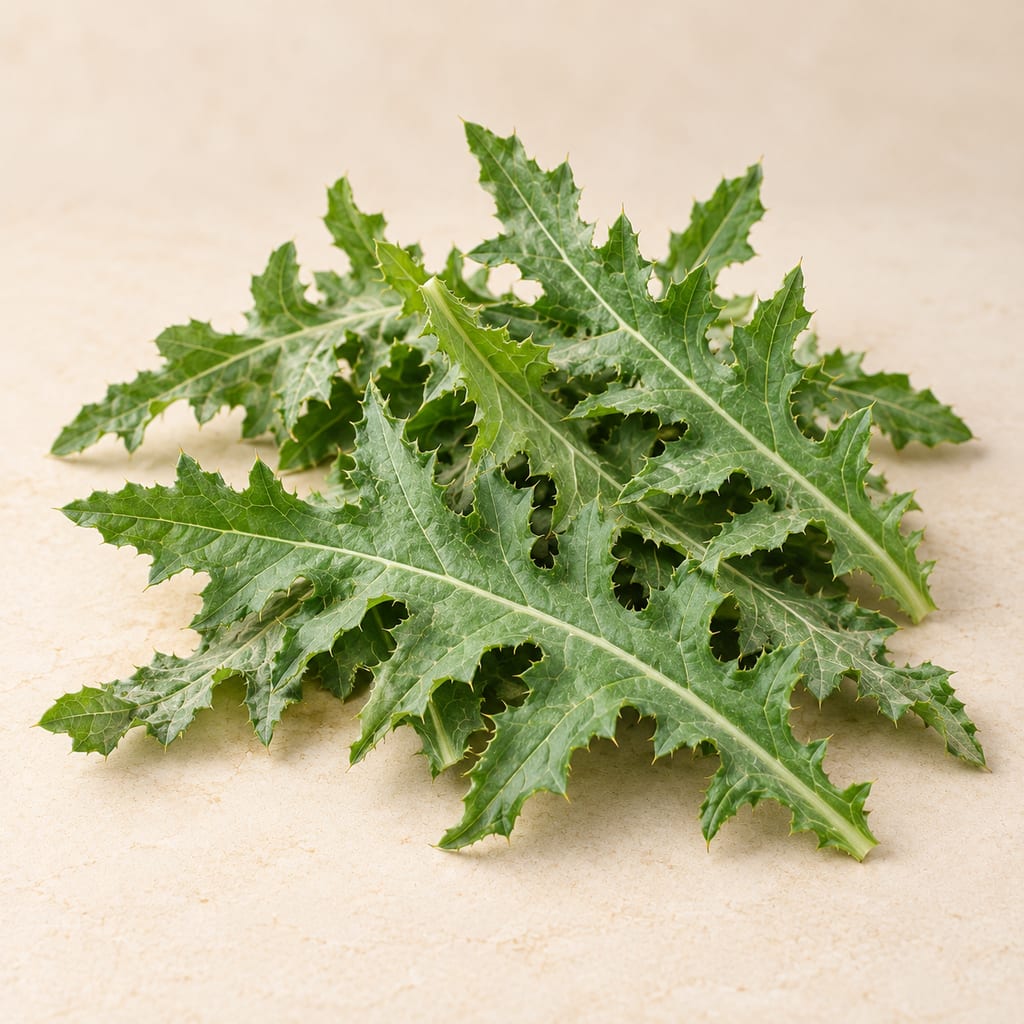
Species and names
Kew accepts Cirsium arvense (L.) Scop. in the daisy family, Asteraceae. Its native-range field describes temperate Eurasia and north-western Africa; the U.S. Forest Service review gives a narrower account centred on south-eastern Europe and the eastern Mediterranean and describes North American populations as introduced. The Alberta food paper prints the name Cirsium arvense L. and uses the common name Canada thistle. That source context is not a specimen identification.
The Forest Service review notes variation in leaf form and past infraspecific treatments. RHS and Ontario use common names including creeping, field, Californian and Canada thistle. Those names do not distinguish this species from other thistles, including spear thistle, or establish the identity of a gathered plant.
Sources for this section
Food history and geography
A Forest Service literature review cites older reports that early-spring roots and shoots were eaten in Russia and by Indigenous peoples in North America. It does not name the communities or provide their source-language accounts or preparation details. The same review repeats an older warning that roots may be emetic; it does not establish a dose or safe preparation.
Kevin Timoney describes his own leaf-gathering and puree practice in central Alberta. He reports favorable leaves in partial shade at forest edges and describes choosing leaves before full flowering. This is one author’s regional account, not evidence that the practice is traditional throughout Alberta or across the species’ range.
The Alberta leaf-puree account
Timoney’s paper describes gathering leaves, sorting and rinsing them, boiling them for about five minutes after the water returns to a boil, cooling and draining them, then pureeing until the fibres are no longer apparent. He reports one field-to-freezer batch of about 2.9 kg net puree packed into ten freezer bags over roughly two hours. He lists soup, dips, spreads, sauces, bread, omelettes and cooked greens as possible uses, and gives an unmeasured soup variation. These are the author’s account, not a tested recipe or a safe-foraging procedure.
The paper describes leaves as the gathered plant part for this method. It gives no measured soup ingredients, freezer temperature, storage duration or validated food-safety endpoint. The Forest Service’s separate historical root and shoot summary should not be combined with Timoney’s leaf-only preparation.
Growing and ecological context
RHS describes creeping thistle in a UK garden context and assigns its H7 category for plants hardy in the severest European continental climates below −20°C. This is a garden-scheme category, not a measured frost-survival threshold for a food crop. The Forest Service review describes sunny open habitats, broad soil occurrence, seasonal and temperature responses, and poor establishment in waterlogged or poorly aerated soils. Timoney’s partial-shade leaf observations refer to central Alberta. These ecology and garden descriptions do not establish a productive food-crop threshold, container method or greenhouse regime.
The sources describe reproduction by seed and creeping roots, with fragments able to reshoot. RHS, Ontario and the Forest Service discuss spreading and weed impacts in their respective settings. Legal status and control obligations vary by jurisdiction; this account is not pesticide guidance or a planting recommendation.
Research gaps
No independently inspected original source establishes the older Russia or Indigenous North American root and shoot reports, named communities or their complete preparation methods.
The Alberta paper gives no measured soup formula, storage conditions or validated endpoint; the separate root caution is secondary and does not define safe preparation.
No field key or verified specimen links common names to a particular plant; this article does not guide wild collection.
RHS and ecological sources do not establish food-crop yield, container dimensions, irrigation, greenhouse settings or a universal harvest calendar.
No current jurisdiction-by-jurisdiction legal, site-permission or pesticide-residue assessment was completed.
Sources for this section
Research status
The underlying plant account received a partial source review. Its review scope is described in the original plant article.
Sources for this section
Places
Unknown
Relationship not established · Place not establishedThe available research does not establish a single origin for this ingredient.
Community
No community contributions have been published for this entry yet.
Share what you made
Sign in to contribute. Published comments and photos are free to read.
Sources
Royal Botanic Gardens, KewIngredient research
Cirsium arvense (L.) Scop. | Plants of the World OnlineCited in: Species and names; Research gaps
Royal Horticultural SocietyIngredient research
Cirsium arvense | RHS Plant ProfileCited in: Species and names; Growing and ecological context; Research gaps
U.S. Department of Agriculture, Forest Service, Fire Effects Information SystemIngredient research
Cirsium arvense, Canada thistle | Species ReviewCited in: Species and names; Food history and geography; The Alberta leaf-puree account; Growing and ecological context; Research gaps
Alberta Native Plant CouncilIngredient research
The Holy Grail of Wild Foods? How to Gather, Prepare, and Enjoy Eating Canada ThistleCited in: Species and names; Food history and geography; The Alberta leaf-puree account; Growing and ecological context; Research gaps
Government of OntarioIngredient research
Canada Thistle | Weed Identification Guide for Ontario CropsCited in: Species and names; Growing and ecological context; Research gaps
FermenteaResearch provenance
Creeping thistle and its food accounts: original plant researchCited in: Research status