
Substrates
Jute mallow leaves
Jute mallow is documented in Kenyan, Egyptian and Malawian food and crop sources. Its preparation and growing evidence remains specific to each source.
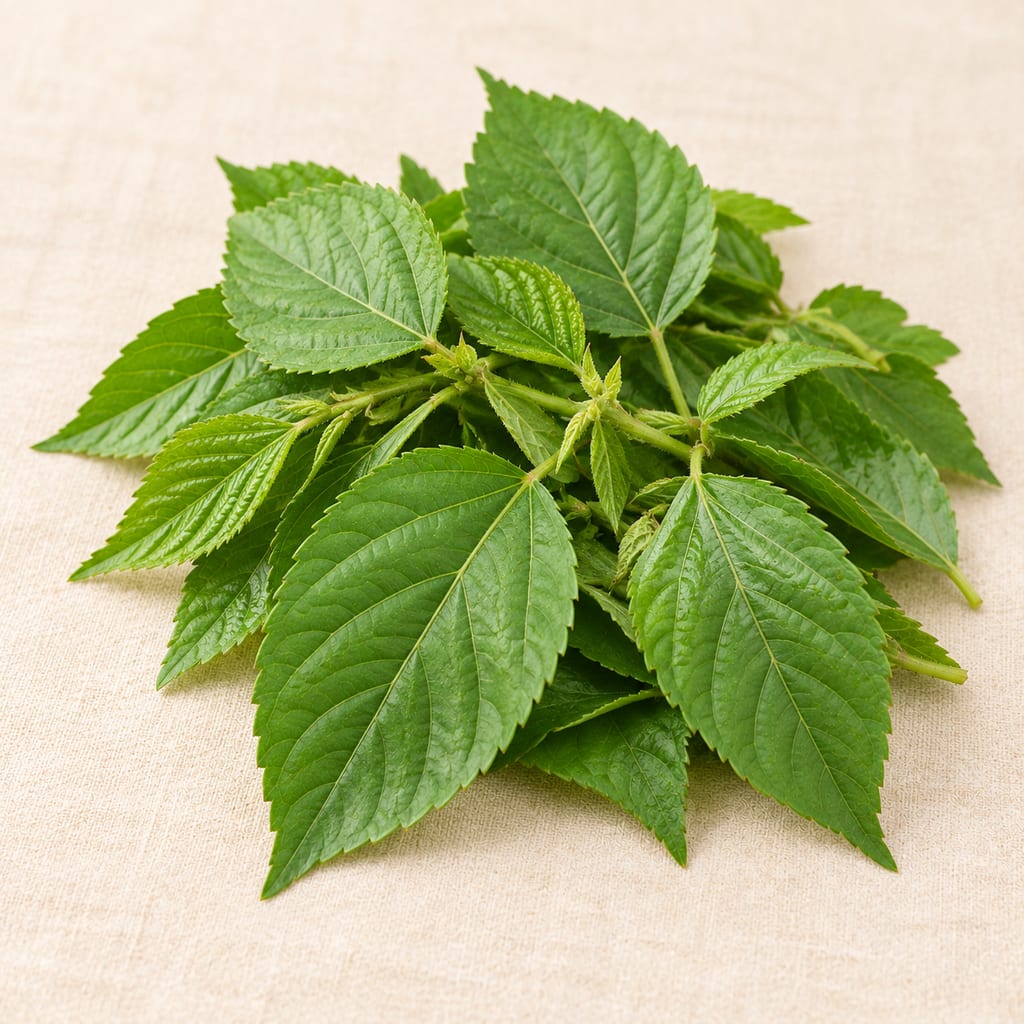
Name and regional context
Kew’s Plants of the World Online accepts Corchorus olitorius L. and describes it as an annual of tropical and subtropical Old World regions. South Africa’s Agricultural Research Council lists “Corchorus spp (Gushe)” in its indigenous-crops programme; that genus-level label is not evidence that every named crop or market vegetable is C. olitorius. The HORTINLEA manual and the Chuka University proceedings item each name C. olitorius directly.
The HORTINLEA manual records Kenyan names including Mrenda (Swahili), Apoth (Luo), and Murere (Luhya and Kalenjin). It also lists English names such as Egyptian spinach, bush okra and West African sorrel. These names are regionally situated and may cover more than one crop identity in everyday use; the scientific name should remain attached to species-specific claims.
An Egyptian field paper names four molokhia landraces collected from northern, southern and western Egypt and grown at an Al-Azhar University experimental field in Cairo. It reports sowing on 1 May 2006 in 2 m² plots and a first harvest 50 days later; this is a single dated experiment, not a present-day Egyptian calendar.
The central Malawi study lists C. olitorius as Jew’s mallow among indigenous vegetables grown, but its local-name table rows are not linked to binomials. An indexed excerpt from the B4FN report associates Denje with C. olitorius and leaves; the linked full report returned 404, so this remains an indexed excerpt that has not been directly checked against the report rather than a general Denje crosswalk.
Sources for this section
- Corchorus olitorius L., Plants of the World Online →
- Indigenous / Traditional African Leafy Vegetables →
- Production and Marketing of African Indigenous Leafy Vegetables: Training Manual for Extension Officers and Practitioners →
- Characterization of Four Molokhia (Corchorus olitorius) Landraces by Morphology and Chemistry →
- Leveraging on Indigenous Vegetables for Climate Change Adaptation in Central Malawi: Exploring Opportunities and Challenges →
- Assessment on Availability of African Indigenous Leafy Vegetables in Malawi and Zambia →
- Assessment on Availability of African Indigenous Leafy Vegetables in Malawi and Zambia — Supplementary Table 2 excerpt →
Food uses and texture
The HORTINLEA manual describes leaves and tender stems boiled, stir-fried, or prepared as juice, stew or soup. It characterizes the cooked leaf mass as sticky or mucilaginous and notes that other vegetables may be combined with it to soften or balance that texture. These are source-reported preparation forms, not complete recipes with quantities or cooking times.
A Chuka University household survey in Kakamega County reports jute mallow eaten alongside African nightshade and amaranth. The repository abstract also reports that some surveyed households sun-dried, fermented, or used both preservation approaches. The abstract gives survey-level results, not a reproducible method; it explicitly says viability and safety require further investigation. Its reported seven-day fermentation duration and dried-product shelf-life estimate are not household safety limits.
A 2004 Egyptian food-habits table lists Jew's mallow (Corchorus olitorius) as cooked and dried, not raw. A Bibliotheca Alexandrina newsletter calls molokhia a traditional national dish in Egypt and describes chopped leaves as mucilaginous. Its article includes an incomplete soup example: it lists ½ kg of leaves but no stock amount or yield, and the method mentions butter before later saying to fry the garlic and coriander in oil. This is one descriptive account, not a reproducible recipe. One contributor's oral-history account recalls Cairo household practice and a disagreement with her Alexandrian mother-in-law about preferred boiling and texture; it is an individual family account, not a national standard.
The Malawi chapter names C. olitorius among vegetables grown but does not give a species-specific edible part or preparation in its results. The indexed B4FN excerpt links Denje and leaves to C. olitorius, but the original table could not be checked directly and provides no complete method here. Maseko and colleagues’ table lists C. gynandra and C. monophylla separately and prints “Cochorus trilocularis” as a separate entry; that printed name is not evidence for C. olitorius food use. The 2017 Maseko correction remains a subscription preview, while the full 2018 correction concerns funding and licence information and does not report a food-table change.
Sources for this section
- Production and Marketing of African Indigenous Leafy Vegetables: Training Manual for Extension Officers and Practitioners →
- The Utilization and Preservation Practices of Jute Mallow (Corchorus olitorius) in Western Kenya →
- Molokhia →
- Food habits of the Egyptians: newly emerging trends →
- An Oral History of Mouloukhiya from Egypt, Palestine, Tunisia and Japan →
- Food habits of the Egyptians: newly emerging trends — author-uploaded full-text access copy →
- Leveraging on Indigenous Vegetables for Climate Change Adaptation in Central Malawi: Exploring Opportunities and Challenges →
- Children and Wild Foods in the Context of Deforestation in Rural Malawi →
- Correction to: Children and Wild Foods in the Context of Deforestation in Rural Malawi →
- Correction to: Children and Wild Foods in the Context of Deforestation in Rural Malawi →
- Assessment on Availability of African Indigenous Leafy Vegetables in Malawi and Zambia →
- Assessment on Availability of African Indigenous Leafy Vegetables in Malawi and Zambia — Supplementary Table 2 excerpt →
Growing context
The HORTINLEA manual describes jute mallow as suited to hot conditions, able to tolerate brief drought and high rainfall, and capable of coping with some flooding, while reporting poor growth in cold conditions. It recommends planting near the rainy-season onset in its Kenyan training context. These source statements concern production context; drought survival or tolerance does not mean water stress supports continued leaf yield.
South Africa’s Agricultural Research Council lists C. olitorius among species included in its planting-date research, and describes broader work on planting methods, water use and nutrient requirements for indigenous vegetables. The ARC page also says information on optimum planting and harvesting systems remains limited. The available sources do not establish a universal calendar, household container guidance, greenhouse controls, or a single climate range transferable across regions.
In the 2006 Cairo experiment, three named landraces (Behira, Sohag and Falahy) were cut again 25 days after the first harvest; the Saidy landrace did not regrow after its first cut. The authors suggest cutting height as a possible explanation, not a tested cause. The paper does not report plot soil, pH, irrigation, weather, frost response, or container or greenhouse production. These results should not be converted into a general growing schedule or pruning instruction.
The central Malawi participatory study lists C. olitorius among vegetables grown by its 84 surveyed households, but reports cultivation and water practices at the overall indigenous-vegetable level rather than as a jute-mallow calendar, yield or irrigation trial. A World Vegetable Center/Genesys dataset describes 112 C. olitorius accessions and 16 traits evaluated at Tengeru, Arusha, Tanzania; some accessions have Malawi provenance. The dataset page gives no evaluation dates or detailed methods, and Malawi origin does not establish Malawi crop performance.
Sources for this section
- Indigenous / Traditional African Leafy Vegetables →
- Production and Marketing of African Indigenous Leafy Vegetables: Training Manual for Extension Officers and Practitioners →
- Characterization of Four Molokhia (Corchorus olitorius) Landraces by Morphology and Chemistry →
- Leveraging on Indigenous Vegetables for Climate Change Adaptation in Central Malawi: Exploring Opportunities and Challenges →
- Characterization data of jute mallow accessions in Tengeru Arusha (Tanzania) →
Harvest, preservation and remaining limits
The HORTINLEA manual describes harvesting by cutting terminal shoots to encourage lateral growth. The Chuka survey abstract reports preservation practices among households in one county and seasonality as a supply concern. Because its abstract does not provide the methods, measured product conditions or safety validation, the reported drying and fermentation practices are context for further research rather than instructions.
The reviewed material leaves open how specific household methods affect quality and safety, how preservation outcomes vary by season and community, and what storage conditions are suitable. It also does not provide validated food-safety limits, a household shelf life for fresh leaves, or detailed container and protected-culture production evidence.
The Cairo trial's harvest intervals describe only those four landraces and that 2006 site-season. No validated preservation endpoint, shelf life or food-safety control is established for these leaves.
The indexed Denje/leaf excerpt does not supply a directly inspected household preparation or storage endpoint. The Malawi survey and accession records add no validated preservation control, fresh-leaf shelf life, or productive container and greenhouse method.
Sources for this section
- Indigenous / Traditional African Leafy Vegetables →
- Production and Marketing of African Indigenous Leafy Vegetables: Training Manual for Extension Officers and Practitioners →
- The Utilization and Preservation Practices of Jute Mallow (Corchorus olitorius) in Western Kenya →
- Characterization of Four Molokhia (Corchorus olitorius) Landraces by Morphology and Chemistry →
- Molokhia →
- Food habits of the Egyptians: newly emerging trends →
- Food habits of the Egyptians: newly emerging trends — author-uploaded full-text access copy →
- Leveraging on Indigenous Vegetables for Climate Change Adaptation in Central Malawi: Exploring Opportunities and Challenges →
- Assessment on Availability of African Indigenous Leafy Vegetables in Malawi and Zambia →
- Assessment on Availability of African Indigenous Leafy Vegetables in Malawi and Zambia — Supplementary Table 2 excerpt →
- Characterization data of jute mallow accessions in Tengeru Arusha (Tanzania) →
Research gaps
The HORTINLEA manual’s numeric cultivation table was not independently visually rechecked in this publication pass; no numeric table values are repeated here.
The Chuka University full paper methods were not independently reopened; its repository abstract is the evidence level for reported household preservation practices.
No validated household drying or fermentation method, preservation safety endpoint, or fresh-leaf storage life was established.
Container and greenhouse production conditions, transferable regional calendars and species-specific local yield controls remain unestablished in the reviewed sources.
The 2006 Cairo landrace trial reports sowing and harvest dates but no weather, soil, pH, water, frost or household/container conditions; it does not establish a current Egyptian cultivation calendar.
The Bibliotheca Alexandrina cooking example omits stock quantity and yield, and gives inconsistent butter/oil wording; no complete, tested or safety-validated household method is established.
Hassan-Wassef's full article was read through an author-uploaded copy because the official WHO PDF fetch failed; the table is not a current prevalence estimate.
Egyptian regional evidence is partial; the article does not establish national food practice or ancient-origin history.
The central Malawi chapter does not link its local-name table rows to binomials; the B4FN Denje/leaf association is from an indexed excerpt because the original report PDF was unavailable.
The Malawi chapter’s species list does not provide a C. olitorius-specific edible part, preparation, yield, cultivation calendar or irrigation response.
The WorldVeg characterization data concern evaluation at Tengeru, Tanzania; the landing page omits evaluation dates and detailed methods, so Malawi passport provenance is not Malawi performance evidence.
Maseko’s printed “Cochorus trilocularis” row is not treated as C. olitorius; the 2017 correction text remains inaccessible and the 2018 correction does not report a change to Table 3.
Sources for this section
- Corchorus olitorius L., Plants of the World Online →
- Indigenous / Traditional African Leafy Vegetables →
- Production and Marketing of African Indigenous Leafy Vegetables: Training Manual for Extension Officers and Practitioners →
- The Utilization and Preservation Practices of Jute Mallow (Corchorus olitorius) in Western Kenya →
- Characterization of Four Molokhia (Corchorus olitorius) Landraces by Morphology and Chemistry →
- Molokhia →
- Food habits of the Egyptians: newly emerging trends →
- An Oral History of Mouloukhiya from Egypt, Palestine, Tunisia and Japan →
- Food habits of the Egyptians: newly emerging trends — author-uploaded full-text access copy →
- Leveraging on Indigenous Vegetables for Climate Change Adaptation in Central Malawi: Exploring Opportunities and Challenges →
- Children and Wild Foods in the Context of Deforestation in Rural Malawi →
- Correction to: Children and Wild Foods in the Context of Deforestation in Rural Malawi →
- Correction to: Children and Wild Foods in the Context of Deforestation in Rural Malawi →
- Assessment on Availability of African Indigenous Leafy Vegetables in Malawi and Zambia →
- Assessment on Availability of African Indigenous Leafy Vegetables in Malawi and Zambia — Supplementary Table 2 excerpt →
- Characterization data of jute mallow accessions in Tengeru Arusha (Tanzania) →
Research status
The underlying plant account received a partial source review. Its review scope is described in the original plant article.
Sources for this section
Places
Unknown
Relationship not established · Place not establishedThe available research does not establish a single origin for this ingredient.
Community
No community contributions have been published for this entry yet.
Share what you made
Sign in to contribute. Published comments and photos are free to read.
Sources
Royal Botanic Gardens, KewIngredient research
Corchorus olitorius L., Plants of the World OnlineCited in: Name and regional context; Research gaps
Agricultural Research Council, South AfricaIngredient research
Indigenous / Traditional African Leafy VegetablesCited in: Name and regional context; Growing context; Harvest, preservation and remaining limits; Research gaps
Humboldt-Universität zu Berlin, Seminar für Ländliche EntwicklungIngredient research
Production and Marketing of African Indigenous Leafy Vegetables: Training Manual for Extension Officers and PractitionersCited in: Name and regional context; Food uses and texture; Growing context; Harvest, preservation and remaining limits; Research gaps
Chuka UniversityIngredient research
The Utilization and Preservation Practices of Jute Mallow (Corchorus olitorius) in Western KenyaCited in: Food uses and texture; Harvest, preservation and remaining limits; Research gaps
Alaa Al-Din Helaly, Abd El-Baset A. Alkharpotly, Emad Mady and Lyle E. Craker; Journal of Medicinally Active Plants 5(2), 1–6 (recommended citation 2016; issue cover October 2017); Aswan University-hosted full textIngredient research
Characterization of Four Molokhia (Corchorus olitorius) Landraces by Morphology and ChemistryCited in: Name and regional context; Growing context; Harvest, preservation and remaining limits; Research gaps
Bibliotheca Alexandrina, Alex-Med newsletter, August–October 2009, p. 19Ingredient research
MolokhiaCited in: Food uses and texture; Harvest, preservation and remaining limits; Research gaps
World Health Organization, Eastern Mediterranean Health Journal 10(6):898–915 (2004)Ingredient research
Food habits of the Egyptians: newly emerging trendsCited in: Food uses and texture; Harvest, preservation and remaining limits; Research gaps
Nevine Abraham, Fadi Kattan, Boutheina Bensalem and Ryoko Sekiguchi; The Markaz ReviewIngredient research
An Oral History of Mouloukhiya from Egypt, Palestine, Tunisia and JapanCited in: Food uses and texture; Research gaps
H. Hassan-Wassef; author-uploaded full-text copy of Eastern Mediterranean Health Journal 10(6):898–915 (2004)Ingredient research
Food habits of the Egyptians: newly emerging trends — author-uploaded full-text access copyCited in: Food uses and texture; Harvest, preservation and remaining limits; Research gaps
Springer NatureIngredient research
Leveraging on Indigenous Vegetables for Climate Change Adaptation in Central Malawi: Exploring Opportunities and ChallengesCited in: Name and regional context; Food uses and texture; Growing context; Harvest, preservation and remaining limits; Research gaps
Springer Nature, Human EcologyIngredient research
Children and Wild Foods in the Context of Deforestation in Rural MalawiCited in: Food uses and texture; Research gaps
Springer Nature, Human EcologyIngredient research
Correction to: Children and Wild Foods in the Context of Deforestation in Rural MalawiCited in: Food uses and texture; Research gaps
Springer Nature, Human EcologyIngredient research
Correction to: Children and Wild Foods in the Context of Deforestation in Rural MalawiCited in: Food uses and texture; Research gaps
Catholic Relief Services, Southern Africa Regional Office; Biodiversity for Food and NutritionIngredient research
Assessment on Availability of African Indigenous Leafy Vegetables in Malawi and ZambiaCited in: Name and regional context; Food uses and texture; Harvest, preservation and remaining limits; Research gaps
Catholic Relief Services, Southern Africa Regional Office; Biodiversity for Food and NutritionIngredient research
Assessment on Availability of African Indigenous Leafy Vegetables in Malawi and Zambia — Supplementary Table 2 excerptCited in: Name and regional context; Food uses and texture; Harvest, preservation and remaining limits; Research gaps
World Vegetable Center / Genesys PGRIngredient research
Characterization data of jute mallow accessions in Tengeru Arusha (Tanzania)Cited in: Growing context; Harvest, preservation and remaining limits; Research gaps
FermenteaResearch provenance
Jute mallow (Corchorus olitorius): original plant researchCited in: Research status