
Substrates
Kenikir leaves
Kenikir is a leafy Cosmos caudatus vegetable documented in Indonesia; sources describe raw and cooked use, while a shared name with C. sulphureus leaves identification uncertain.
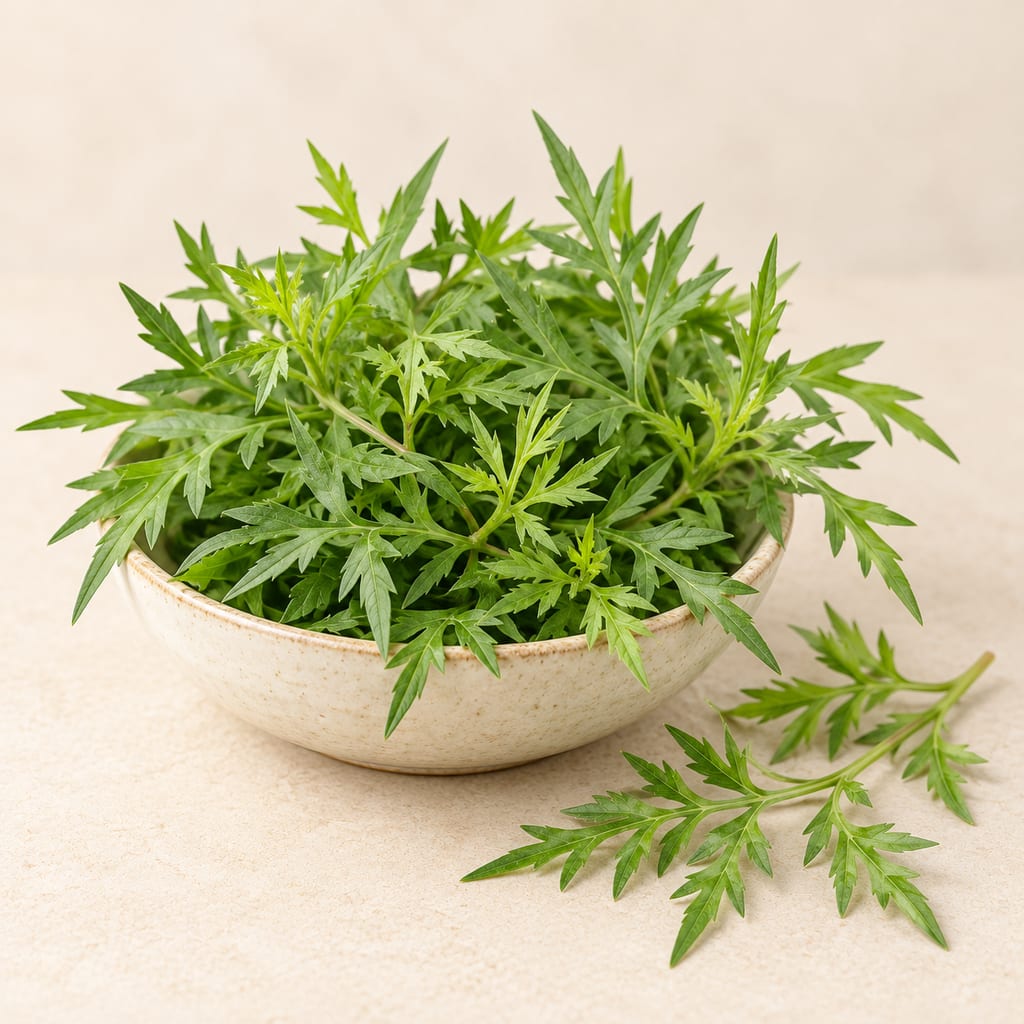
Accepted name and common-name limits
Kew accepts Cosmos caudatus Kunth and lists Bidens caudata and Bidens artemisiifolia var. caudata among its synonyms. Kew separately accepts C. sulphureus Cav. PROSEA says the two species can resemble one another vegetatively and records randa midang as a shared West Java name. The paper’s species label and the IPB profile identify kenikir as C. caudatus, but a common name or resemblance alone cannot identify a market bundle or garden plant. The IPB profile lists kenikir for Central Java, ulam raja as Malay and pelampong for Malaysia; those names are not all treated as Indonesian regional names.
Range and regional food reports
Kew describes C. caudatus as native from Mexico to southern tropical America and lists Java and Sumatra among introduced areas. PROSEA documents leaves and young tops eaten raw or cooked in Indonesia and Malaysia, including a coconut-sauce-and-chili context. In selected West Java communities, Santosa and colleagues report kenikir leaves served raw with sambal or slightly boiled, including gado-gado. Their description of “indigenous vegetables” is a local crop category, not evidence that the species is biologically native to Indonesia. These are food-use accounts, not complete recipes or safety assessments.
Cultivation observations in West Java
Santosa and colleagues describe kenikir intercropped with other vegetables at named West Java sites; some farmers grew it as a main crop. Their field account gives seedbeds raised for one to two weeks, example spacing around 25 × 25 cm, manure use and first harvest of leaves, young shoots and inflorescences six to eight weeks after planting. These observations are specific to farms in the study. The authors collected no kenikir agronomic data in Citalahab because farmers there were unfamiliar with it. The timing and spacing are not a household or greenhouse prescription.
Sources for this section
Separate handbook and extension descriptions
PROSEA describes sunny sites with a not-too-humid atmosphere and fertile, pervious soil. It reports seed propagation, transplanting seedlings at about three weeks, 25–30 cm square spacing, first leaf harvest after about six weeks and later harvests about every three weeks in its regional production account. Its longer possible harvest span differs from the West Java growers who stopped within six months; these accounts should not be combined into one yield or lifespan promise. The IPB profile separately describes full sun, fertile clay soil with drainage and cultivation up to about 700 m, while summarizing prior seed-growing work rather than reporting a controlled container trial.
Handling and unresolved growing questions
PROSEA says cosmos wilts easily and should be marketed soon after harvest. The West Java study reports that kenikir leaves deteriorated more readily than genjer and several other vegetables in its handling observations; neither source gives a household storage duration. The sources do not establish frost survival, numeric heat, humidity, water or pH limits, container performance, heated or unheated greenhouse conditions, or a universal planting calendar. PROSEA warns of resemblance and a shared common name with C. sulphureus; its achene description is not a public field-identification key. No local invasive-status check, voucher review or food-safety endpoint is included here.
Research status
The underlying plant account received a partial source review. Its review scope is described in the original plant article.
Sources for this section
Places
Unknown
Relationship not established · Place not establishedThe available research does not establish a single origin for this ingredient.
Community
No community contributions have been published for this entry yet.
Share what you made
Sign in to contribute. Published comments and photos are free to read.
Sources
Royal Botanic Gardens, KewIngredient research
Cosmos caudatus Kunth | Plants of the World OnlineCited in: Accepted name and common-name limits; Range and regional food reports
Royal Botanic Gardens, KewIngredient research
Cosmos sulphureus Cav. | Plants of the World OnlineCited in: Accepted name and common-name limits; Handling and unresolved growing questions
M.H. van den Bergh; PROSEA Handbook 8: Vegetables; PROSEA FoundationIngredient research
Cosmos caudatus (PROSEA)Cited in: Accepted name and common-name limits; Range and regional food reports; Separate handbook and extension descriptions; Handling and unresolved growing questions
Edi Santosa, Utami Prawati, Sobir, Yoko Mine and Nobuo Sugiyama; Jurnal Hortikultura Indonesia 6(3):125–134 (2015)Ingredient research
Agronomy, Utilization and Economics of Indigenous Vegetables in West Java, IndonesiaCited in: Accepted name and common-name limits; Range and regional food reports; Cultivation observations in West Java; Separate handbook and extension descriptions; Handling and unresolved growing questions
Pusat Kajian Hortikultura Tropika, Institut Pertanian BogorIngredient research
Kenikir (Cosmos caudatus Kunth.)Cited in: Accepted name and common-name limits; Separate handbook and extension descriptions