
Substrates
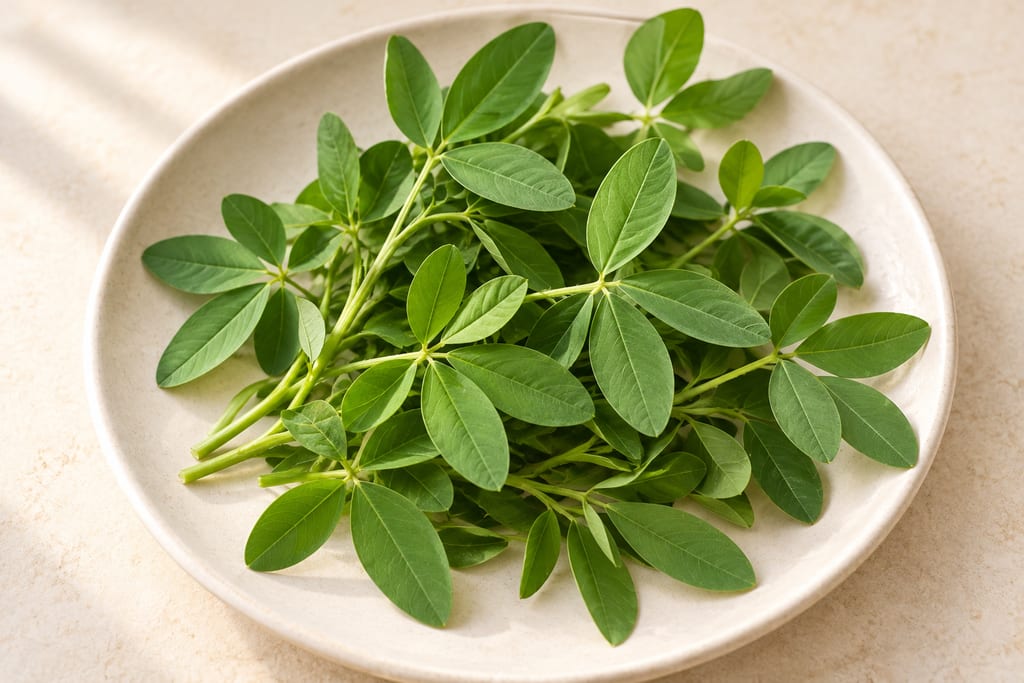
Chipilín greens
Kew accepts Crotalaria longirostrata. Guatemalan ICTA sources describe leaves, stems and tender shoots in cooked foods, while a community study reports market purchase of chipilín that was absent from the sampled village. Similar names and source-reported hazards do not provide a plant-identification or preparation-safety rule.
Accepted name and regional labels
Kew accepts Crotalaria longirostrata Hook. & Arn., a subshrub native from Mexico to Central America, including Guatemala. ICTA lists Chipilín and Chipilín de comer, and records Chop beside Huehuetenango and Tcap-in beside Jacaltenango. It says chipilín derives from Nahuatl but does not assign languages to Chop or Tcap-in. A related taxonomic thesis records some vernacular overlap among Crotalaria species; shared labels do not make C. longirostrata, C. pumila and C. mollicula synonyms.
Sources for this section
Reported food parts and preparations
The ICTA catalogue describes leaves, stems, tender shoots, buds and flowers in food uses. Its examples include tamales, soups and cooked greens; it also describes flowers cooked with garlic as tea. The 2013 ICTA/MAGA book has source-batched entries for chipilín tamales, rice and soup. It lists C. pumila and C. vitellina as possible substitutions in its recipes, while describing them as separate plant names. These accounts do not establish that all plant parts or similarly named market plants are interchangeable.
A market-mediated account from Alta Verapaz
A study in Sotzil, Alta Verapaz, describes a predominantly Maya Q’eqchi’ community and includes chipilín among reported foods. Its text says the plant was not found in the village and was bought at the municipal market from neighboring municipalities. The article does not provide a Q’eqchi’ translation, voucher, food part or preparation specific to chipilín. This is one village and market context, not evidence of local growth or a national consumption pattern.
Habitat and limits of growing information
The ICTA catalogue reports the species in wet or dry scrub, rocky slopes, pine and oak woodland, fields and gardens, and says it occurs both wild and cultivated. Its altitude statement of 2,300 metres or less describes reported occurrence, not a productive growing threshold. The inspected sources do not give a species-specific crop trial, planting calendar, hardiness scheme, measured pH or light requirement, or an irrigation comparison. They also provide no productive container or greenhouse trial.
Source-reported cautions and unresolved questions
The ICTA catalogue cautiously reports drowsiness after eating chipilín and suggests, without identifying a tested compound, a possible relation to alkaloids in some Crotalaria species. It also says roots are considered toxic and refers to historical poison use. The sources do not give a dose, identify risk by plant part, or establish a cooking method that changes risk. These reported cautions do not support a home detoxification procedure or a safety claim. The catalogue also reports forest-associated populations declining with forest removal, but no current legal status or collection permission was checked.
Sources for this section
Research gaps
The Sotzil account provides no voucher, plant part, preparation or local Q’eqchi’ name for chipilín; its full-text inspection is carried from the dossier rather than newly reopened in this pass.
The place labels Chop and Tcap-in are not assigned languages in the inspected ICTA text, and common names do not identify a food specimen.
The species-specific productive growing conditions remain open: no source here supplies a crop trial, seasonal calendar, pH, frost limit, irrigation schedule, productive pot or greenhouse result.
The ICTA hazard language gives no dose, confirmed compound, part-specific risk assessment or validated preparation endpoint.
No measured complete recipe, yield, storage period or preservation endpoint was established.
Sources for this section
- Crotalaria longirostrata Hook. & Arn. | Plants of the World Online →
- Catálogo de hortalizas nativas de Guatemala →
- Hortalizas nativas →
- Recetas de cocina a base de hortalizas nativas de Guatemala →
- Estudio etnobotánico de plantas alimenticias en aldea Sotzil, municipio de San Juan Chamelco, Alta Verapaz →
- Revisión taxonómica del género Crotalaria L. (Fabaceae) en el estado de Guerrero, México →
Research status
The underlying plant account received a partial source review. Its review scope is described in the original plant article.
Sources for this section
Places
Unknown
Relationship not established · Place not establishedThe available research does not establish a single origin for this ingredient.
Community
No community contributions have been published for this entry yet.
Share what you made
Sign in to contribute. Published comments and photos are free to read.
Sources
Royal Botanic Gardens, KewIngredient research
Crotalaria longirostrata Hook. & Arn. | Plants of the World OnlineCited in: Accepted name and regional labels; Habitat and limits of growing information; Research gaps
Instituto de Ciencia y Tecnología AgrícolasIngredient research
Catálogo de hortalizas nativas de GuatemalaCited in: Accepted name and regional labels; Reported food parts and preparations; Habitat and limits of growing information; Source-reported cautions and unresolved questions; Research gaps
Instituto de Ciencia y Tecnología AgrícolasIngredient research
Hortalizas nativasCited in: Accepted name and regional labels; Reported food parts and preparations; Source-reported cautions and unresolved questions; Research gaps
Instituto de Ciencia y Tecnología Agrícolas and Ministerio de Agricultura, Ganadería y AlimentaciónIngredient research
Recetas de cocina a base de hortalizas nativas de GuatemalaCited in: Accepted name and regional labels; Reported food parts and preparations; Research gaps
Revista Científica Avances en Ciencia y Docencia, Universidad de San Carlos de GuatemalaIngredient research
Estudio etnobotánico de plantas alimenticias en aldea Sotzil, municipio de San Juan Chamelco, Alta VerapazCited in: A market-mediated account from Alta Verapaz; Research gaps
Universidad Nacional Autónoma de México, Facultad de CienciasIngredient research
Revisión taxonómica del género Crotalaria L. (Fabaceae) en el estado de Guerrero, MéxicoCited in: Accepted name and regional labels; Research gaps
FermenteaResearch provenance
Chipilín in Guatemalan food and plant records: original plant researchCited in: Research status