
Substrates
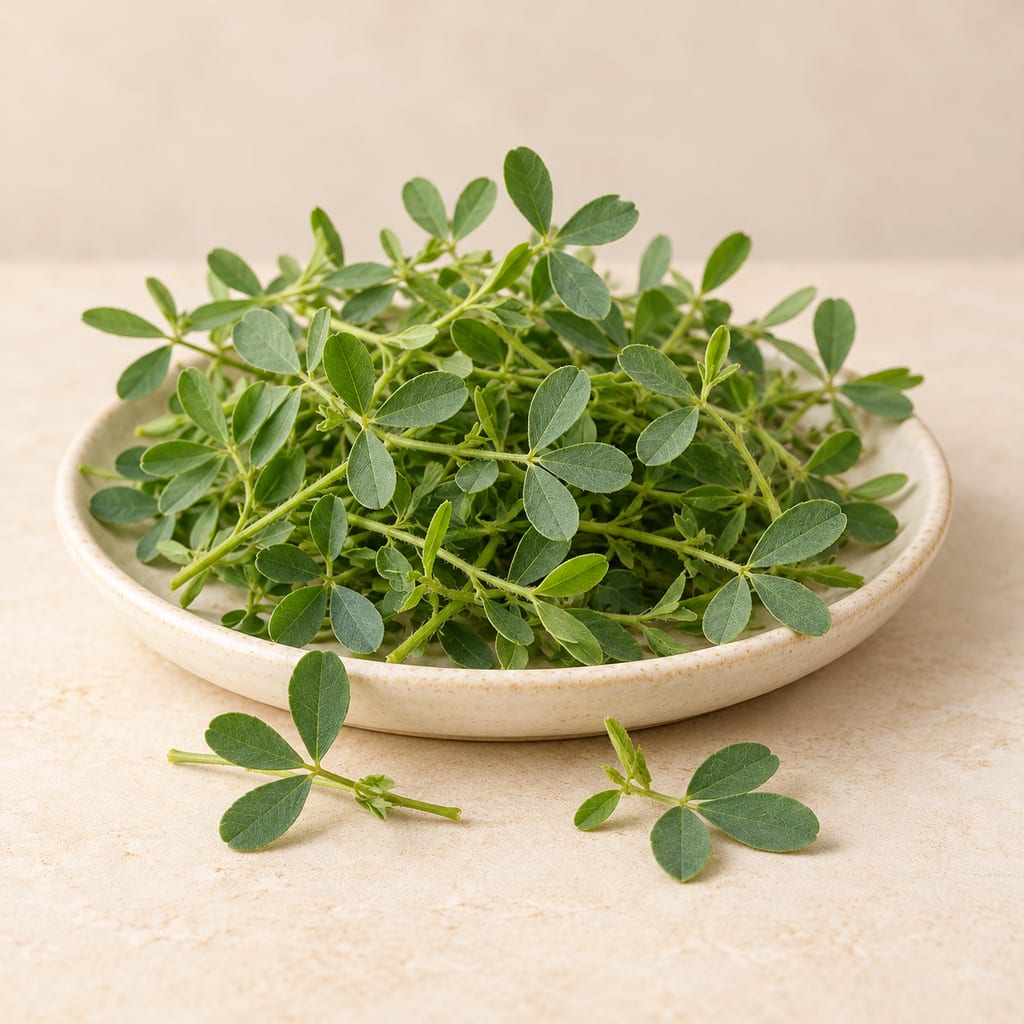
Chepil greens (Crotalaria pumila)
Oaxaca market and cultivation studies document chepil food uses and regional field growing practices. Other Crotalaria names and research contexts remain distinct.
Accepted name and local-name boundaries
Kew accepts Crotalaria pumila Ortega in Fabaceae. In the Central Valleys of Oaxaca, a cultivation study identifies the chepil it describes as C. pumila. A Guerrero taxonomic thesis reports “chipil” applied across C. mollicula, C. pumila and C. longirostrata, sometimes indistinctly. That regional name overlap does not make the species synonyms or make their food and safety evidence interchangeable.
Oaxaca food reports
A market study in Zaachila and Zimatlán records “Chepiles” as C. pumila and lists leaves and flowers. Vendors reported four food modes: cooked with black beans, cooked with rice, tamales, and espesado with corn dough. The authors describe chepil tamales in religious-festival contexts and report them sold in the studied markets. The paper does not provide a complete quantity-based method for these dishes.
Sources for this section
Regional growing context
The 2021 Oaxaca study describes spontaneous chepil in fields and disturbed vegetation during the rains and deliberate planting in irrigated plots to supply the dry-season market. Its two study municipalities are San Antonino Castillo Velasco and Santiago Apóstol, around 1,479–1,480 m. The paper gives a semi-warm subhumid summer-rain setting, 828.1 mm reported annual rainfall and a 20.7°C mean temperature. These describe those localities, not species-wide tolerances.
Sources for this section
Field practices reported by growers
The same Oaxaca paper describes flat irrigation tables about 120–150 cm wide and up to 50 m or longer, rows about 60–70 cm apart, and broadcast sowing of about 100 g chepil seed per 20 m table. It records manure or ammonium sulfate use and local weeding practices. These are reported regional field methods, not household instructions or a controlled comparison. No soil pH or container dimensions are given.
Sources for this section
Season and harvest observations
The Oaxaca study reports spontaneous rainy-season growth from May to September and irrigated production mainly during the dry-season market period, roughly September to April or May. It describes harvest from about two months. Some growers uproot plants; others cut and leave the root and about 5 cm of stem, reporting that plants can regrow for additional cuts. These are local producer accounts, not guaranteed yields or validated harvest intervals.
Sources for this section
Separate research is not edible-crop guidance
A 2004 paper abstract reports laboratory and greenhouse germination treatments, but its full text was unavailable in the recorded review. A 2024 greenhouse study used C. pumila for phytoremediation research in metal-contaminated soil. A Chapingo thesis measured spontaneous forage biomass in one Valley of Mexico site and season. None is an edible greenhouse growing guide or a household crop trial.
Sources for this section
- Effect of scarification and growing media on seed germination of Crotalaria pumila (Ort.) →
- Phytoremediation Potential of Crotalaria pumila (Fabaceae) in Soils Polluted with Heavy Metals: Evidence from Field and Controlled Experiments →
- Evaluación de leguminosas forrajeras anuales como complementarias a la producción de forraje →
Food and safety limits
A 1989 UNAM thesis analyzed dried, ground plant samples from Alcozauca and reports qualitative alkaloid screening and hemagglutination activity in an extract. The thesis interpreted its alkaloid-screen results as not indicating considerable risk in view of the other reagents, but this was a historical laboratory interpretation, not a human exposure assessment. The authors also said fresh or steamed preparation effects needed further study. These tests do not establish a particular toxin, safe serving amount or validated cooking endpoint, and cannot be transferred to other Crotalaria species named as chipil.
What remains unresolved
No complete recipe batch, voucher-confirmed match for every vernacular food report, safe preparation endpoint, or validated food storage method was established. The reviewed sources do not provide productive container or edible greenhouse guidance, a named hardiness scheme, frost/heat limits or soil pH. The evidence covers selected Oaxaca, Guerrero and Valley of Mexico settings and does not represent all Mexican quelite practice.
Sources for this section
- Crotalaria pumila Ortega →
- Cultivo de quelites en los Valles Centrales de Oaxaca, México →
- Ethnobotany of food plants (quelites) sold in two traditional markets of Oaxaca, Mexico →
- Revisión taxonómica del género Crotalaria L. (Fabaceae) en el estado de Guerrero, México →
- Determinación de la composición nutricional y toxicológica de los quelites: Anoda cristata, Crotalaria pumila, Euphorbia graminea y Leucaena macrophylla →
- Phytoremediation Potential of Crotalaria pumila (Fabaceae) in Soils Polluted with Heavy Metals: Evidence from Field and Controlled Experiments →
- Evaluación de leguminosas forrajeras anuales como complementarias a la producción de forraje →
Research gaps
Market food modes do not provide a full recipe batch or validated preparation endpoint.
The broad chipil/chepil name applies to more than one Crotalaria species in reported Guerrero usage; not every food report is voucher-linked.
The 1989 lab screening does not identify a specific toxin or establish human risk, safe serving or preparation control.
No species-specific soil pH, household container design or edible protected-crop protocol was found; greenhouse phytoremediation and forage trials are different purposes.
No species-wide frost, heat or climate tolerance and no Mexico-wide coverage were established.
Sources for this section
- Crotalaria pumila Ortega →
- Cultivo de quelites en los Valles Centrales de Oaxaca, México →
- Ethnobotany of food plants (quelites) sold in two traditional markets of Oaxaca, Mexico →
- Revisión taxonómica del género Crotalaria L. (Fabaceae) en el estado de Guerrero, México →
- Determinación de la composición nutricional y toxicológica de los quelites: Anoda cristata, Crotalaria pumila, Euphorbia graminea y Leucaena macrophylla →
- Effect of scarification and growing media on seed germination of Crotalaria pumila (Ort.) →
- Phytoremediation Potential of Crotalaria pumila (Fabaceae) in Soils Polluted with Heavy Metals: Evidence from Field and Controlled Experiments →
- Evaluación de leguminosas forrajeras anuales como complementarias a la producción de forraje →
Research status
The underlying plant account received a partial source review. Its review scope is described in the original plant article.
Sources for this section
Places
Unknown
Relationship not established · Place not establishedThe available research does not establish a single origin for this ingredient.
Community
No community contributions have been published for this entry yet.
Share what you made
Sign in to contribute. Published comments and photos are free to read.
Sources
Royal Botanic Gardens, Kew, Plants of the World OnlineIngredient research
Crotalaria pumila OrtegaCited in: Accepted name and local-name boundaries; What remains unresolved; Research gaps
Francisco Basurto Peña; Etnobiología 19(3):89–102, 2021Ingredient research
Cultivo de quelites en los Valles Centrales de Oaxaca, MéxicoCited in: Accepted name and local-name boundaries; Regional growing context; Field practices reported by growers; Season and harvest observations; What remains unresolved; Research gaps
Manzanero-Medina et al.; South African Journal of Botany 130:215–223, 2020; DOI 10.1016/j.sajb.2020.01.002Ingredient research
Ethnobotany of food plants (quelites) sold in two traditional markets of Oaxaca, MexicoCited in: Oaxaca food reports; What remains unresolved; Research gaps
Edgar Ramírez Hernández; Universidad Nacional Autónoma de México, 2015Ingredient research
Revisión taxonómica del género Crotalaria L. (Fabaceae) en el estado de Guerrero, MéxicoCited in: Accepted name and local-name boundaries; Food and safety limits; What remains unresolved; Research gaps
Dulce Maria Ramos Mora; Universidad Nacional Autónoma de México, Facultad de Ciencias, 1989Ingredient research
Determinación de la composición nutricional y toxicológica de los quelites: Anoda cristata, Crotalaria pumila, Euphorbia graminea y Leucaena macrophyllaCited in: Food and safety limits; What remains unresolved; Research gaps
Roberto Lindig-Cisneros and Sabina I. Lara-Cabrera; Seed Science and Technology 32(1):231–234, 2004; DOI 10.15258/sst.2004.32.1.25Ingredient research
Effect of scarification and growing media on seed germination of Crotalaria pumila (Ort.)Cited in: Separate research is not edible-crop guidance; Research gaps
Santoyo-Martínez et al.; Plants 13(14):1947, 2024Ingredient research
Phytoremediation Potential of Crotalaria pumila (Fabaceae) in Soils Polluted with Heavy Metals: Evidence from Field and Controlled ExperimentsCited in: Separate research is not edible-crop guidance; What remains unresolved; Research gaps
Jesús Adán Martínez Zaragoza; Universidad Autónoma Chapingo, 2022Ingredient research
Evaluación de leguminosas forrajeras anuales como complementarias a la producción de forrajeCited in: Separate research is not edible-crop guidance; What remains unresolved; Research gaps