
Substrates
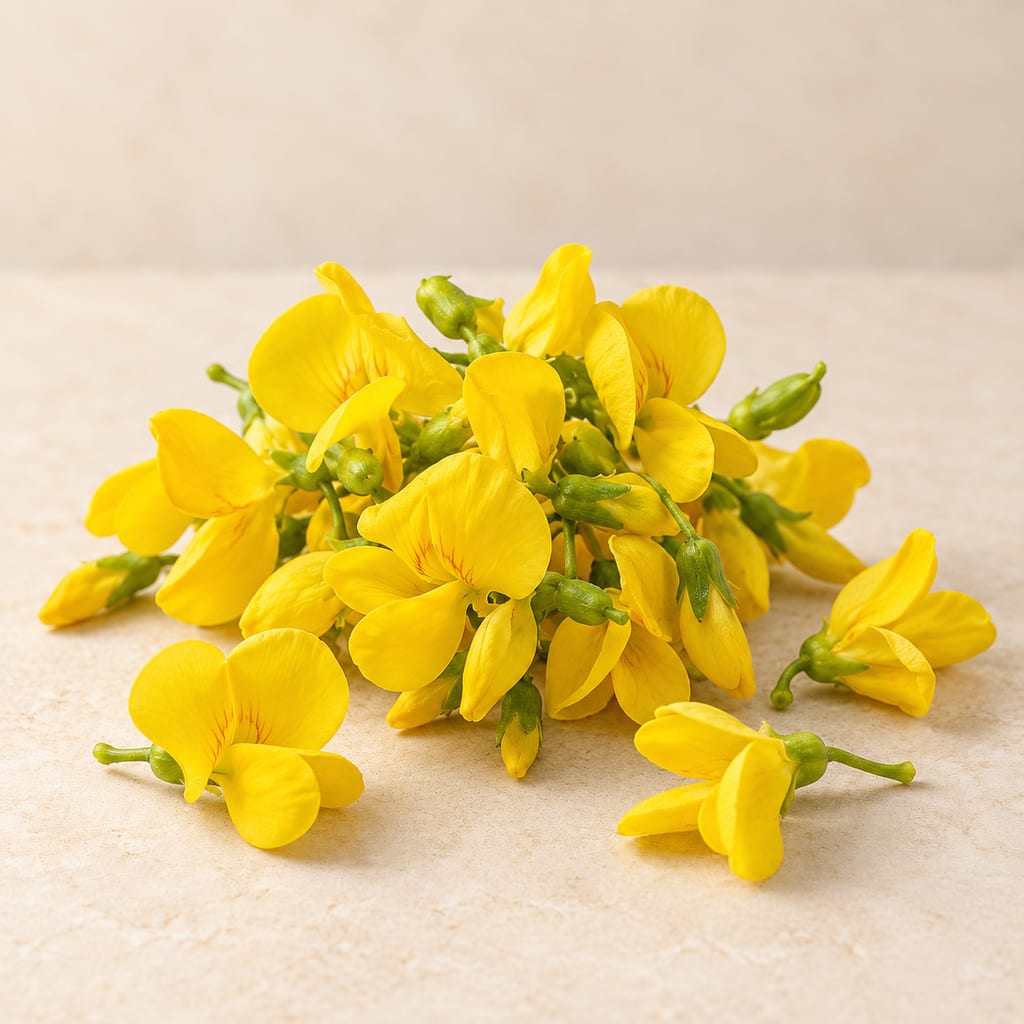
Diphysa americana flowers
Oaxaca market research documents food uses of Diphysa americana flowers. A separate Honduran Lenca table contains an unvouchered “Diphysa robiniodes” leaf row that remains a provisional crosswalk; forestry observations from Honduras and Guatemala do not confirm that food identity.
Names and taxon limits
Kew accepts Diphysa americana (Mill.) M.Sousa in Fabaceae and lists Diphysa robinioides as a heterotypic synonym. A 2001 Honduras table is text-extracted with the similar spelling “Diphysa robiniodes,” but no voucher or accession was located. The resemblance is not enough to confirm that row as D. americana. “Chipilín” is also used for Crotalaria longirostrata in a separate Honduran university proposal, so the common name alone cannot establish identity.
Sources for this section
- Diphysa americana (Mill.) M.Sousa | Plants of the World Online →
- Investigación: Biodiversidad y comunidades indígenas Lencas en Honduras. Informe final →
- Formulación de macarrones con harina de chipilín (Crotalaria longirostrata Hook. & Arn.) con aromas naturales como alimento aportador de micronutrientes →
Honduras Lenca table and Oaxaca food record
The Lenca report table records “Chipilín / Diphysa robiniodes / leaf / wild” for work associated with Goascotoro, Yamaranguila and Quebrada Honda in Intibucá. It does not separate that Diphysa row by community or assign a language to the name. The row’s printed locator is page 62; its image and author title-page details were not verified in this review, and the species crosswalk remains provisional.
Sources for this section
A distinct Oaxaca flower account
A 2020 study of the Zaachila and Zimatlán markets names D. americana and records Guachepil and other market-specific forms. Its Table 1 row is coded A, which the legend defines as flowers; it does not code leaves. The authors describe flowers collected and sold from December to April and used especially in Holy Week dishes. Table 4 records forest and home-garden habitat and tolerated/wild management in Oaxaca. These are regional flower observations, not confirmation of the Honduran leaf row or its season.
Sources for this section
Reported food contexts
The Oaxaca table codes D. americana flowers in contexts cooked with black beans, used in sauces, and covered with egg. These are food-use categories, not complete recipes with quantities, ordered steps, yield, cooking endpoint or storage instructions. The Honduran table gives no preparation method for its provisional leaf entry. No method is inferred between the regions or plant parts.
Growing and forestry observations
A Honduras Quesungual landscape study lists D. americana among common trees and shrubs and associates it with timber and mulch. Its Candelaria, Lempira study landscape is described at about 490–830 metres, 1,200–1,400 mm annual rainfall, 17–25 °C and shallow acidic soils below pH 5.1. These multi-land-use site values are not measured Diphysa crop requirements.
A separate 2003 Honduran forest report lists Diphysa robinioides or guachipilín in a timber context. That forestry record does not confirm the unvouchered Lenca food row.
Separate Guatemala forestry seed guidance
A 2021 Guatemala forest-seed guide gives a species-specific forestry account: fruit and seed collection around April–May with timing varying by climate and provenance, fresh seed preferred, no pretreatment reported, and mean germination reported near 80%. It includes nursery and seed-storage information. This is positive Guatemala forestry evidence, not Honduran edible-leaf production or a household growing protocol.
Sources for this section
Limits and unresolved evidence
No voucher-confirmed Honduras food specimen, Honduras edible-crop trial, Diphysa-specific container or greenhouse method, or local food harvest schedule was established. The Honduras and Oaxaca sources report different parts and remain separate. The forestry data do not establish a food process; none of the inspected food accounts gives a validated safety endpoint or storage duration.
Sources for this section
- Investigación: Biodiversidad y comunidades indígenas Lencas en Honduras. Informe final →
- Ethnobotany of food plants (quelites) sold in two traditional markets of Oaxaca, Mexico →
- Soil macrofauna in agricultural landscapes dominated by the Quesungual Slash-and-Mulch Agroforestry System, western Honduras →
- Guía técnica de frutos y semillas forestales, Módulo 1, Serie Técnica GT-046 →
- Estado de la diversidad biológica de los árboles y bosques de Honduras →
Research gaps
The Honduras Lenca row image, voucher/accession and exact accepted-taxon crosswalk remain unresolved; the current PDF fetch failed.
No language or community-specific Diphysa food attribution is established by the Lenca table.
The Oaxaca evidence concerns flowers only; no inference to the Honduras leaf row is justified.
The Guatemala forestry PDF could not be reopened in this pass; prior full inspection is retained in the dossier, but this article uses only bounded summary facts.
No Honduras food-crop growing protocol, soil response, irrigation, frost/heat tolerance, container or greenhouse evidence was established.
No complete recipe, validated food-safety process, serving amount or storage duration is available.
Sources for this section
- Diphysa americana (Mill.) M.Sousa | Plants of the World Online →
- Investigación: Biodiversidad y comunidades indígenas Lencas en Honduras. Informe final →
- Ethnobotany of food plants (quelites) sold in two traditional markets of Oaxaca, Mexico →
- Soil macrofauna in agricultural landscapes dominated by the Quesungual Slash-and-Mulch Agroforestry System, western Honduras →
- Guía técnica de frutos y semillas forestales, Módulo 1, Serie Técnica GT-046 →
- Estado de la diversidad biológica de los árboles y bosques de Honduras →
- Formulación de macarrones con harina de chipilín (Crotalaria longirostrata Hook. & Arn.) con aromas naturales como alimento aportador de micronutrientes →
Research status
The underlying plant account received a partial source review. Its review scope is described in the original plant article.
Places
Unknown
Relationship not established · Place not establishedThe available research does not establish a single origin for this ingredient.
Community
No community contributions have been published for this entry yet.
Share what you made
Sign in to contribute. Published comments and photos are free to read.
Sources
Royal Botanic Gardens, Kew, Plants of the World Online / World Checklist of Vascular PlantsIngredient research
Diphysa americana (Mill.) M.Sousa | Plants of the World OnlineCited in: Names and taxon limits; Research gaps
CREDIA repository; report prepared for the Instituto Hondureño de Antropología e Historia, 2001Ingredient research
Investigación: Biodiversidad y comunidades indígenas Lencas en Honduras. Informe finalCited in: Names and taxon limits; Honduras Lenca table and Oaxaca food record; Reported food contexts; Limits and unresolved evidence; Research gaps
Gladys Isabel Manzanero-Medina, Marco Antonio Vásquez-Dávila, Hermes Lustre-Sánchez and Aleyda Pérez-Herrera; South African Journal of Botany 130 (2020), 215–223; DOI 10.1016/j.sajb.2020.01.002; author-uploaded full textIngredient research
Ethnobotany of food plants (quelites) sold in two traditional markets of Oaxaca, MexicoCited in: A distinct Oaxaca flower account; Reported food contexts; Limits and unresolved evidence; Research gaps
Natasha Pauli, E. Barrios, A. J. Conacher and T. Oberthür; Applied Soil Ecology 47 (2011), 119–132; DOI 10.1016/j.apsoil.2010.11.005; readable author-version text mirrorIngredient research
Soil macrofauna in agricultural landscapes dominated by the Quesungual Slash-and-Mulch Agroforestry System, western HondurasCited in: Growing and forestry observations; Limits and unresolved evidence; Research gaps
Instituto Nacional de Bosques, Guatemala, 2021Ingredient research
Guía técnica de frutos y semillas forestales, Módulo 1, Serie Técnica GT-046Cited in: Separate Guatemala forestry seed guidance; Limits and unresolved evidence; Research gaps
Edgardo Padilla; FAO Forest Genetic Resources Working Paper FGR/51S, 2003Ingredient research
Estado de la diversidad biológica de los árboles y bosques de HondurasCited in: Growing and forestry observations; Limits and unresolved evidence; Research gaps
Londy Cristel Ramos Fúnez, Universidad Nacional de Agricultura thesis proposal, 2024Ingredient research
Formulación de macarrones con harina de chipilín (Crotalaria longirostrata Hook. & Arn.) con aromas naturales como alimento aportador de micronutrientesCited in: Names and taxon limits; Research gaps
FermenteaResearch provenance
Diphysa americana: Oaxaca flower use and a provisional Honduras leaf record: original plant researchCited in: Research status