
Substrates
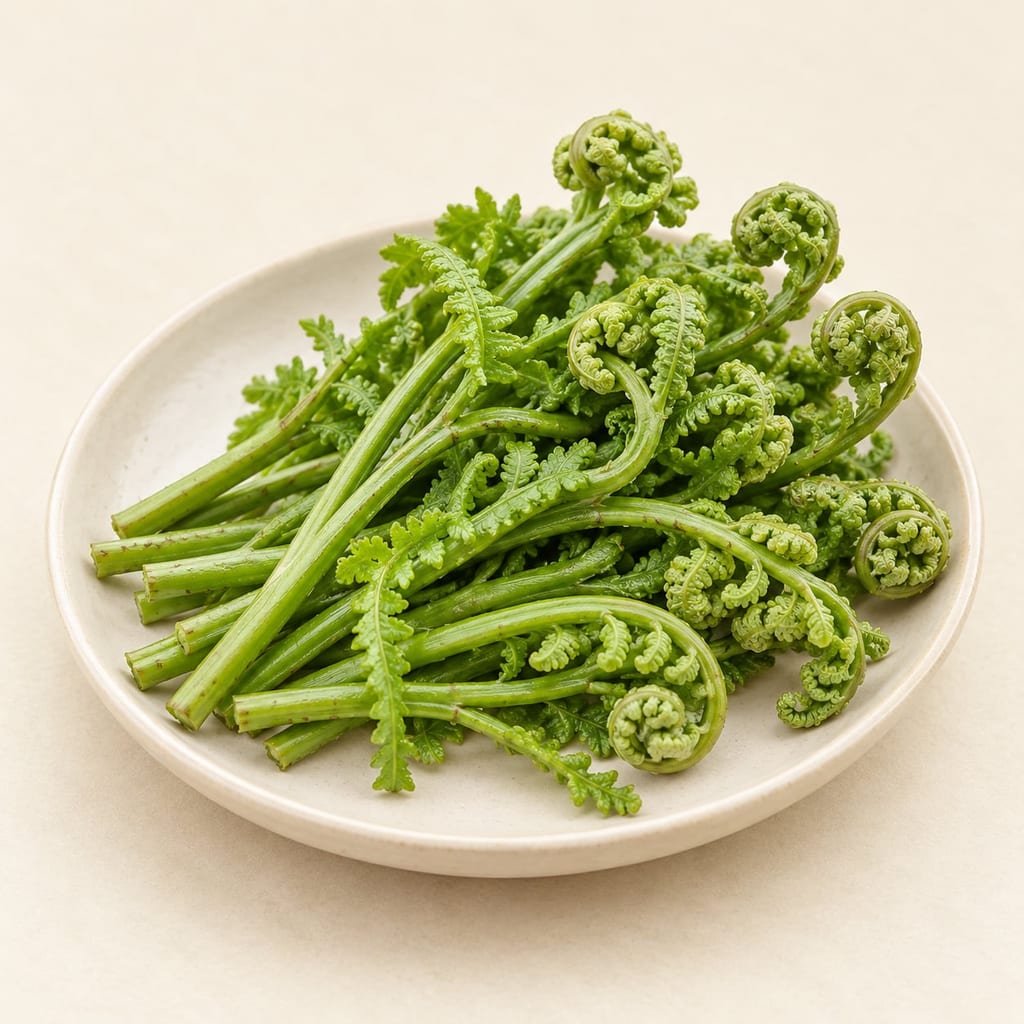
Pani niguro shoots
A wild fern recorded as a cooked young-shoot vegetable in one Gurung study in Nepal. Source-specific growing accounts describe wet, partly shaded habitats and propagation, but do not establish a household crop method.
Name and source boundaries
Kew accepts Diplazium esculentum (Retz.) Sw. and includes Nepal in its native range. Its classification field lists Aspleniaceae. The PLOS Table 1 row labels its specimen entry Athyriaceae, while PROSEA’s genus record header says Dryopteridaceae and discusses alternative family concepts. These source-specific classifications are reported without reconciling them. The PLOS row assigns the names Pani niguro and Lauta to collection KSD610; these labels do not identify every fern called niguro or edible fern.
A Nepal food-use record
A 2021 ethnobotanical study reports wild foods from Khilang, Parche and Sikles in Madi Rural Municipality, Kaski. Its Table 1 identifies D. esculentum as collection KSD610, gives Pani niguro as the common name and Lauta as the Gurung name, and records April–June harvest with young shoots used as vegetables. The article says specimens were deposited at Tribhuvan University Central Herbarium; the voucher was not independently checked here. This is one regional report, not a national calendar or specimen-identification guide.
Sources for this section
Food preparation in the sources
The PLOS discussion names D. esculentum among green plant parts mainly eaten after cooking, but supplies no recipe. PROSEA describes tender uncurling Diplazium leaves as boiled or steamed; that preparation statement is genus-level and is not tied to the Nepal collection KSD610. Neither source gives quantities, cooking time, temperature, storage or a food-safety endpoint.
Growing context
Kew describes the species as a perennial of the wet tropical biome. PROSEA places D. esculentum in open wet or swampy lowland and hill sites, often beside watercourses, usually with some shade but not in shady forest; its account gives elevations up to 1,100 m. The PLOS study area spans 1,400–4,000 m but does not report KSD610’s collection elevation, so those figures do not establish a contradictory specimen-level limit. PROSEA describes vegetative propagation from runners or rhizome pieces with buds and says planting needs wet conditions and shade during dry periods. These are handbook statements, not a Nepal home-growing protocol.
Harvest, cultivation study and limits
PROSEA says Diplazium plants may be harvested at two to three years from spores or possibly after six months from runners; the account does not make these Nepal trial results. It also reports that in parts of India, shade-dried young leaves retain better quality after rehydration than artificially dried leaves, without giving a moisture endpoint or safe storage duration. Mertz’s 1999 abstract describes a Sarawak study of D. esculentum and Stenochlaena palustris: shaded D. esculentum yield increased with fertilizer, while unshaded cultivation was described as infeasible under that study’s acid-sulphate soils and occasional dry spells. The full trial methods, rates and tables remain unavailable. No complete measured household recipe, validated preservation process, container trial or greenhouse method was established.
Research gaps
The deposited KSD610 voucher has not been independently re-examined; local names alone do not identify gathered ferns.
Mertz’s full methods and tables are gated, so treatment rates, yield figures, shade levels and trial design are unavailable.
No complete source-specific household recipe, food-process safety endpoint, storage life, mature container trial or greenhouse production method was found.
The April–June season is one Sikles Table 1 report, not a nationwide harvest calendar.
Sources for this section
- Diplazium esculentum (Retz.) Sw., Plants of the World Online →
- Foods from the wild: Local knowledge, use pattern and distribution in Western Nepal →
- Diplazium Swartz, PROSEA Handbook 15(2): Cryptogams: Ferns and fern allies →
- Cultivation potential of two edible ferns, Diplazium esculentum and Stenochlaena palustris →
Research status
The underlying plant account received a partial source review. Its review scope is described in the original plant article.
Sources for this section
Places
Unknown
Relationship not established · Place not establishedThe available research does not establish a single origin for this ingredient.
Community
No community contributions have been published for this entry yet.
Share what you made
Sign in to contribute. Published comments and photos are free to read.
Sources
Royal Botanic Gardens, KewIngredient research
Diplazium esculentum (Retz.) Sw., Plants of the World OnlineCited in: Name and source boundaries; Growing context; Research gaps
Khakurel, Uprety, Łuczaj and Rajbhandary, PLOS ONE 16(10), 2021Ingredient research
Foods from the wild: Local knowledge, use pattern and distribution in Western NepalCited in: Name and source boundaries; A Nepal food-use record; Food preparation in the sources; Growing context; Research gaps
P.H. Hovenkamp and Y. Umi Kalsom, PROSEA Foundation, 2003Ingredient research
Diplazium Swartz, PROSEA Handbook 15(2): Cryptogams: Ferns and fern alliesCited in: Name and source boundaries; Food preparation in the sources; Growing context; Harvest, cultivation study and limits; Research gaps
Ole Mertz, Tropical Agriculture 76(1), 1999Ingredient research
Cultivation potential of two edible ferns, Diplazium esculentum and Stenochlaena palustrisCited in: Harvest, cultivation study and limits; Research gaps
FermenteaResearch provenance
Pani niguro (Diplazium esculentum): original plant researchCited in: Research status