
Spices and aromatics
Kinh giới leaves
Vietnamese food and cultivation reports for kinh giới, with the limits of the inspected regional sources made explicit.
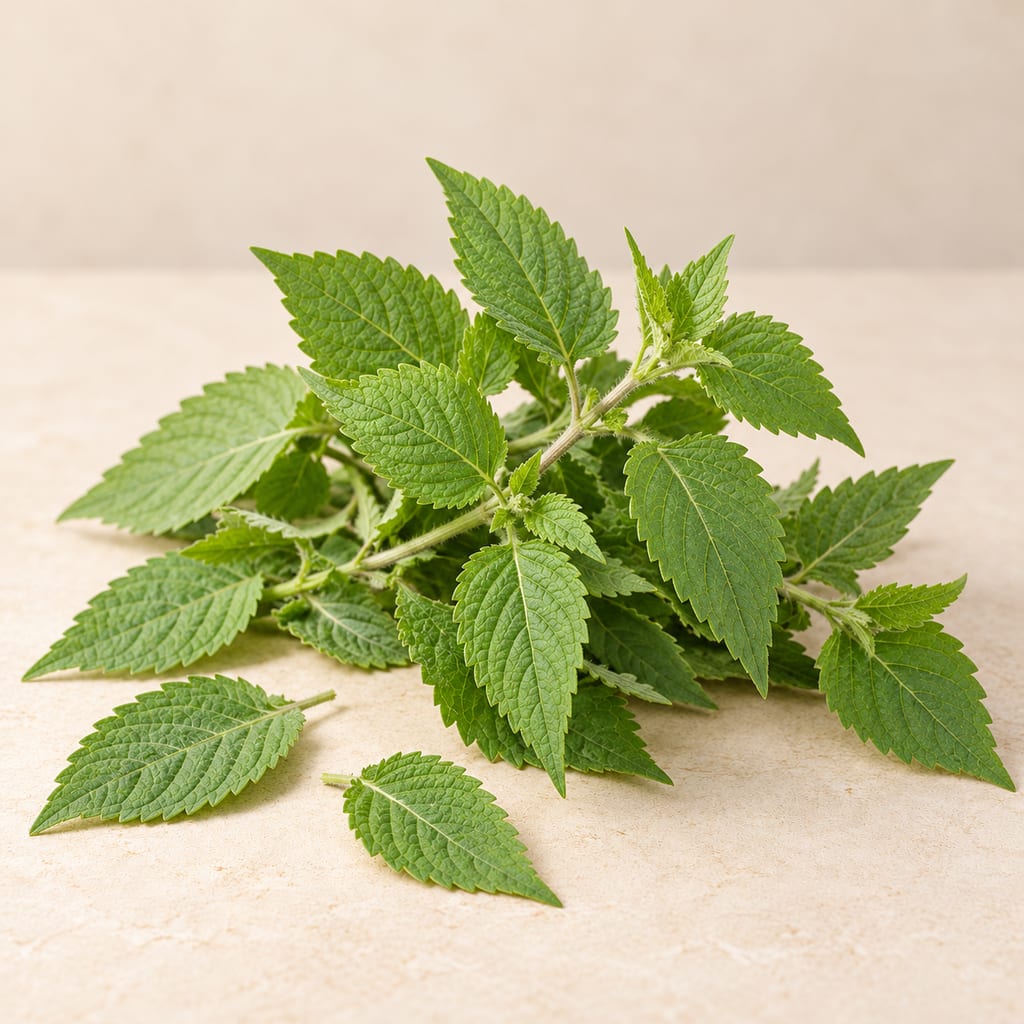
Name and Vietnamese context
Kew accepts Elsholtzia ciliata (Thunb.) Hyl. and records Vietnam within its native range. A Ho Chi Minh City cultivation manual prints an imperfect botanical spelling under kinh giới; its separate tía tô section names Perilla, so the two Vietnamese herbs are not treated as synonyms. A Hanoi-area herbarium label from 1888 records the plant as cultivated by the Mans as an aromatic plant. That specimen is a dated local record, not a complete account of food history or present practice.
Food use reported for the leaves
A 2023 Vietnamese university review reports that kinh giới leaves are eaten raw or cooked as seasoning. This is a secondary food-use report; the underlying book it cites was not inspected for this article. The city cultivation manual describes crop production rather than a dish. Neither source supplies a complete preparation with quantities, steps, yield, or storage, so this account does not turn the seasoning report into a recipe. The Vietnamese name is kept distinct from tía tô and from other herbs sold under broad translated names.
Cultivation reported by the Ho Chi Minh City manual
The city's manual says kinh giới can be planted year-round, with the beginning of the rainy season preferred. It describes seed sowing in a nursery and stem cuttings as alternative starts. Its seed-grown plants are transplanted at 25–30 days; for repeated cutting the manual gives wider spacing than for harvesting whole plants. For cuttings, it describes healthy 12–14 cm stems with three or four nodes, planted about two-thirds into the bed. These are the manual's field directions, not a validated household-pot method. The same document's general pH range of 5.0–7.0 applies to spice-vegetable soils broadly and is not a measured species-specific optimum.
Sources for this section
Harvest evidence and open questions
The manual says the first harvest may begin about 30 days after planting and gives later cutting intervals of 20–30 days according to growth and care. The university review's flowering and fruiting months are phenology reported through a cited book, not a planting calendar. The inspected sources do not establish a household container size, indoor light schedule, frost threshold, safe postharvest storage period, or complete dish method. Those details remain unresolved.
Research status
The underlying plant account received a partial source review. Its review scope is described in the original plant article.
Sources for this section
Places
Unknown
Relationship not established · Place not establishedThe available research does not establish a single origin for this ingredient.
Community
No community contributions have been published for this entry yet.
Share what you made
Sign in to contribute. Published comments and photos are free to read.
Sources
Royal Botanic Gardens, Kew, Plants of the World OnlineIngredient research
Elsholtzia ciliata (Thunb.) Hyl.Cited in: Name and Vietnamese context
Ho Chi Minh City Department of Science and TechnologyIngredient research
Kỹ thuật trồng rau gia vị an toànCited in: Name and Vietnamese context; Food use reported for the leaves; Cultivation reported by the Ho Chi Minh City manual; Harvest evidence and open questions
Muséum national d’Histoire naturelleIngredient research
Herbier Muséum national d’Histoire naturelle: P02979584Cited in: Name and Vietnamese context
Thủ Dầu Một University, 2023 conference proceedingsIngredient research
Tiềm năng của các hợp chất có hoạt tính sinh học trong cây kinh giới (Elsholtzia ciliata)Cited in: Food use reported for the leaves; Harvest evidence and open questions
FermenteaResearch provenance
Kinh giới (Elsholtzia ciliata): original plant researchCited in: Research status