
Substrates
Helencha greens
Bangladesh food and cultivation sources use several spellings and overlapping wetland names. This account distinguishes the accepted name from source labels and describes regional food reports and one waterlogged sack experiment without turning it into a household growing or cooking prescription.
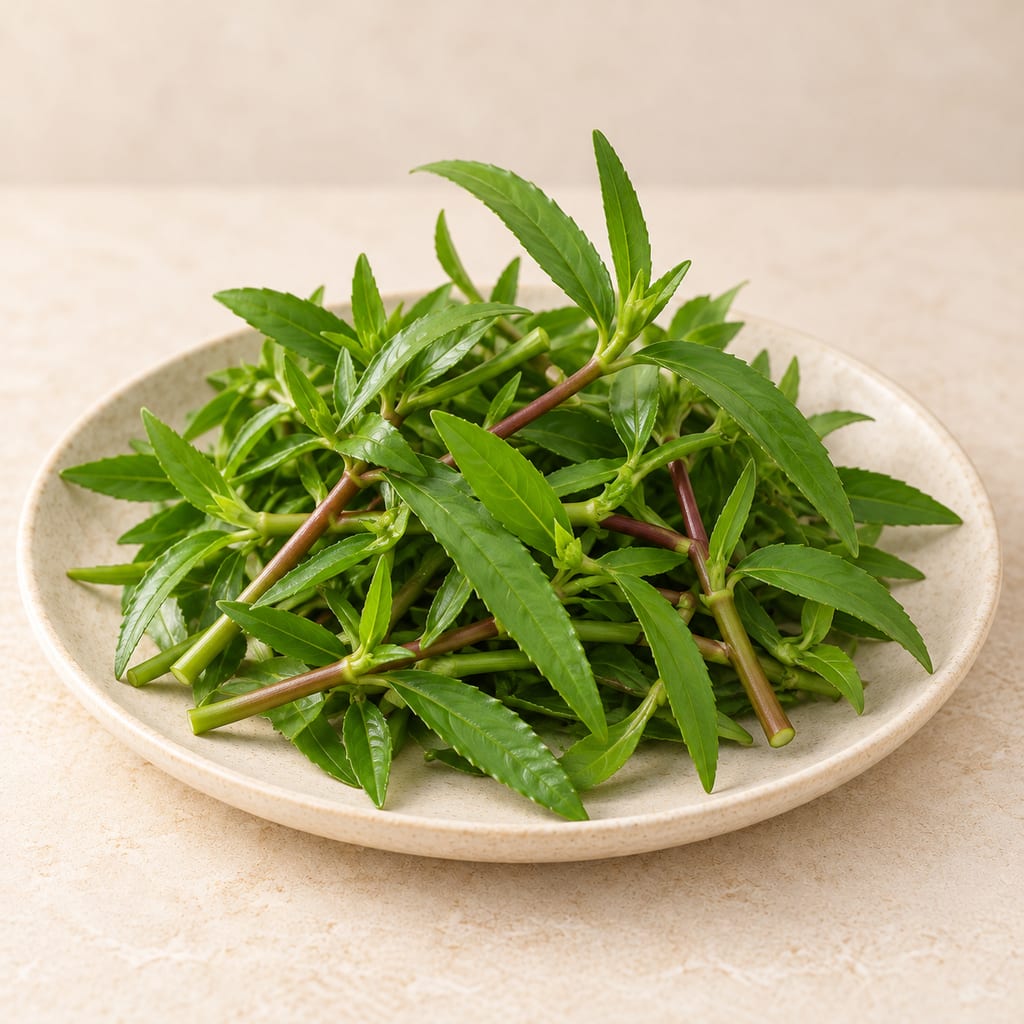
Accepted name and names in Bangladesh sources
Kew accepts Enydra fluctuans Lour. and includes Bangladesh in the species’ native range. Several Bangladesh food sources instead spell the name Enhydra fluctuans; the Feni aquatic-plant survey prints Enhydra fluctuens. Those spellings are retained as the sources give them. Kew lists Enhydra heloncha and E. hingcha among synonyms, but a familiar wetland name is not enough to identify a plant bundle.
The Feni survey labels Alternanthera philoxeroides as Helencha and a separate Enhydra fluctuens entry as Tititdata, marked medicinal and rare in that district survey. A northeast wetland synthesis applies helencha to both Enhydra and Alternanthera. These are source-specific name assignments; they do not establish that all plants sold or gathered as helencha are the same species.
Food reports from different places
In a 2010–2012 survey of four villages in Lalmonirhat and Nilphamari, Azam and colleagues recorded leaves called Hanchi shak as “fried with salt and then cooked.” The table does not provide quantities, a full sequence or storage details. A separate Rangamati article about the Chakma community records tender shoots called Dhan shak as cooked vegetables. Those leaf and shoot accounts come from distinct places and community contexts; they are not one standardized recipe.
The 2024 sack-growing paper identifies Helencha with its printed name Enhydra fluctuans for a cultivation comparison. That trial is agronomic evidence, not an additional recipe. The Feni survey’s differing Tititdata/Helencha labels show why vernacular names should stay tied to their individual sources.
Sources for this section
- Are Famine Food Plants Also Ethnomedicinal Plants? An Ethnomedicinal Appraisal of Famine Food Plants of Two Districts of Bangladesh →
- Wild edible vegetables used by the Chakma community of Rangamati Hill District Bangladesh →
- Preliminary taxonomic survey of aquatic plants of Feni district, Bangladesh →
- Organic Matter and Indigenous Vegetables in Sack under Waterlogged in Southwest Bangladesh →
What the growing studies measured
A 2024 experiment at Khulna University and Shyamnagar, Satkhira, grew 30-day seedlings or cuttings in supported mesh sacks placed in submerged or waterlogged conditions. The methods describe five replications and compare four organic-matter/soil mixtures. They define T1 as 75% organic matter and 25% soil; the Helencha results report 7.76 kg per sack for T1 and 4.07 kg for the control. This is one study in southwest Bangladesh, not a general soil-mixture target or a home-growing instruction.
The paper has reporting differences that matter when interpreting it: the abstract says Shyamnagar from September 2020 to May 2021, while the methods name both Khulna University and Shyamnagar and give September 2020 to June 2021. It prints sack dimensions as “90 cm × 60 com.” The methods also say fungicides and systemic insecticides were sprayed repeatedly when needed. The study does not establish a pesticide-free method, a safe growing-water criterion or a food-residue endpoint.
A 2018 Dhaka University study reports ex-situ culture of Enhydra fluctuans in an earthen bin from June 2011 to May 2012, but the consulted methods do not give the bin dimensions, water regime, substrate, yield or a reproducible home setup.
What remains unresolved
The reported cooking notes are incomplete and do not support an executable recipe. The cited growing evidence does not establish frost or heat limits, a cultivation pH target, home-container yields, greenhouse conditions, post-harvest storage duration or safe water and pesticide-residue criteria. The source-specific names also do not provide a field identification guide.
Sources for this section
- Are Famine Food Plants Also Ethnomedicinal Plants? An Ethnomedicinal Appraisal of Famine Food Plants of Two Districts of Bangladesh →
- Wild edible vegetables used by the Chakma community of Rangamati Hill District Bangladesh →
- Preliminary taxonomic survey of aquatic plants of Feni district, Bangladesh →
- Organic Matter and Indigenous Vegetables in Sack under Waterlogged in Southwest Bangladesh →
- Biochemical Composition of Some Selected Aquatic Macrophytes under Ex-situ Conditions →
Research gaps
No voucher-verified specimen establishes that every local Helencha, Hanchi or related name refers to Enydra fluctuans; the Feni survey and northeast synthesis also apply Helencha to Alternanthera.
The food reports provide short preparation descriptions but no complete quantities, ordered steps, yield, timing, endpoint or storage method.
The 2024 study reports pesticide applications and no food-safety endpoint; no validated water, residue or post-harvest limit was established.
The 2024 paper’s abstract and methods differ on sites and date range; it also prints a sack-dimension typo. These have not been resolved with the authors.
No source in this review establishes species-specific frost/heat thresholds, a garden pH target, home-container yield, greenhouse method, harvest-regrowth schedule or local collection permission.
Sources for this section
- Enydra fluctuans Lour. →
- Are Famine Food Plants Also Ethnomedicinal Plants? An Ethnomedicinal Appraisal of Famine Food Plants of Two Districts of Bangladesh →
- Wild edible vegetables used by the Chakma community of Rangamati Hill District Bangladesh →
- Preliminary taxonomic survey of aquatic plants of Feni district, Bangladesh →
- Wetland Specialist Study, Northeast Regional Water Management Plan, Bangladesh Flood Action Plan 6, Chapter 3 →
- Organic Matter and Indigenous Vegetables in Sack under Waterlogged in Southwest Bangladesh →
- Biochemical Composition of Some Selected Aquatic Macrophytes under Ex-situ Conditions →
Research status
The underlying plant account received a partial source review. Its review scope is described in the original plant article.
Sources for this section
Places
Unknown
Relationship not established · Place not establishedThe available research does not establish a single origin for this ingredient.
Community
No community contributions have been published for this entry yet.
Share what you made
Sign in to contribute. Published comments and photos are free to read.
Sources
Royal Botanic Gardens, Kew, Plants of the World OnlineIngredient research
Enydra fluctuans Lour.Cited in: Accepted name and names in Bangladesh sources; Research gaps
Fardous Mohammad Safiul Azam, Anup Biswas, Abdul Mannan, Nusrat Anik Afsana, Rownak Jahan and Mohammed Rahmatullah; Evidence-Based Complementary and Alternative Medicine (2014)Ingredient research
Are Famine Food Plants Also Ethnomedicinal Plants? An Ethnomedicinal Appraisal of Famine Food Plants of Two Districts of BangladeshCited in: Food reports from different places; What remains unresolved; Research gaps
Asim Kumar Paul, Syedul Alam, Md. Mujibor Rahman and AHM Jahangir Alam; Eco-friendly Agril. J. 9(04):22–26 (April 2016); author-uploaded full textIngredient research
Wild edible vegetables used by the Chakma community of Rangamati Hill District BangladeshCited in: Food reports from different places; What remains unresolved; Research gaps
Mohammad Zashim Uddin and Joton Chandra Pal; Bangladesh Journal of Plant Taxonomy 27(1):103–111 (June 2020)Ingredient research
Preliminary taxonomic survey of aquatic plants of Feni district, BangladeshCited in: Accepted name and names in Bangladesh sources; Food reports from different places; What remains unresolved; Research gaps
Archived public copy of the regional wetland studyIngredient research
Wetland Specialist Study, Northeast Regional Water Management Plan, Bangladesh Flood Action Plan 6, Chapter 3Cited in: Accepted name and names in Bangladesh sources; Research gaps
Shamima Nasrin et al.; Asian Journal of Soil Science and Plant Nutrition 10(3):153–161 (2024); author-uploaded full textIngredient research
Organic Matter and Indigenous Vegetables in Sack under Waterlogged in Southwest BangladeshCited in: Food reports from different places; What the growing studies measured; What remains unresolved; Research gaps
Md. Almujaddade Alfasane, Sharmin Kauser, Umme Fatema Shahjadee and Moniruzzaman Khondker; Journal of the Asiatic Society of Bangladesh, Science 44(1):53–60 (June 2018)Ingredient research
Biochemical Composition of Some Selected Aquatic Macrophytes under Ex-situ ConditionsCited in: What the growing studies measured; What remains unresolved; Research gaps
FermenteaResearch provenance
Helencha (Enydra fluctuans): original plant researchCited in: Research status