
Spices and aromatics
Meadowsweet flowers and leaves
Filipendula ulmaria is a rhizomatous perennial associated with damp European habitats. A UK account reports mead flavouring; a literature review attributes soup flavouring to leaves and wine or beer flavouring to flowers, without a complete household recipe or culinary amount.
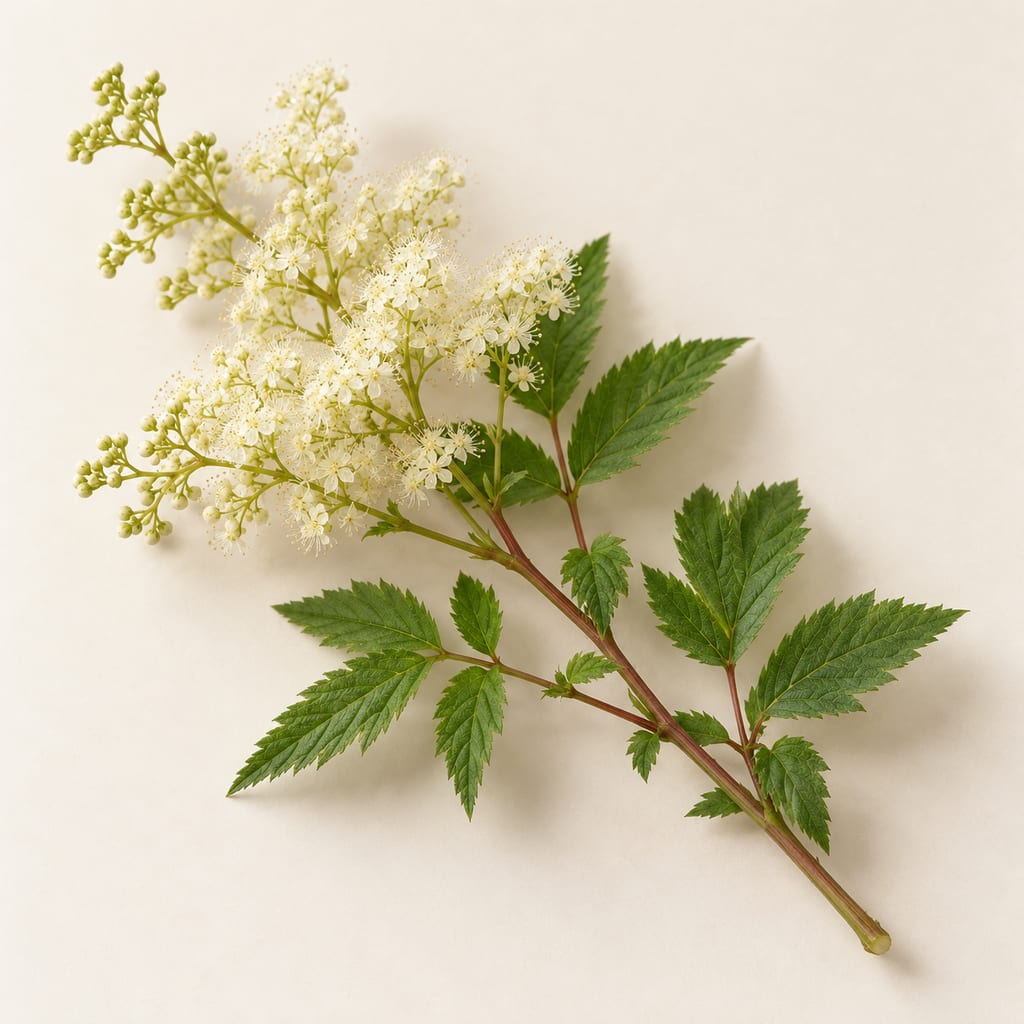
The plant and its names
Kew accepts Filipendula ulmaria (L.) Maxim. and lists Spiraea ulmaria as a synonym. The RHS profile describes a clump-forming perennial with divided, toothed leaves and fragrant cream-coloured flower clusters; it records a range across Europe and western Asia. The Woodland Trust describes meadowsweet in damp UK settings and distinguishes it from dropwort, Filipendula vulgaris, by comparing their fruits. That comparison is limited to the account and is not a field-identification guarantee.
Common names such as queen of the meadows and sweet hay appear in English-language accounts. A shared common name or flavouring tradition does not identify an individual plant or make reports for other Filipendula species interchangeable.
Food and flavouring reports
The Woodland Trust says meadowsweet has been used as a sweet flavouring and to flavour mead. A 2020 Food Chemistry review separately reports leaves used to aromatize soups and flowers used to aromatize wine and beer. Those are use reports, not measured recipes: the sources do not provide a combined batch, quantities, process endpoint, yield or storage period.
An EMA assessment report on the medicinal materials Filipendula ulmaria herba and flos quotes an older Council of Europe categorization of the herb as a food flavouring added in small quantities. The report gives no culinary amount. Within its assessment of medicinal preparations, EMA records salicylate hypersensitivity as a reason not to use the preparations and says use during pregnancy or lactation should be avoided because safety was not established. Those medicinal-use cautions do not quantify risk from food flavouring or establish a food dose, and the report is not evidence of therapeutic benefit.
Growing conditions in the RHS profile
The RHS recommends full sun or partial shade, clay or loam, acid, alkaline or neutral pH, and moist but well-drained or poorly drained soil. Its H6 category belongs to the RHS UK hardiness scheme, which defines H6 as −20 to −15°C and describes the category as hardy in all of the UK and northern Europe. This is a scheme classification rather than a measured survival threshold. The profile suggests spring seed sowing in containers or spring division; it gives no household pot dimensions or greenhouse settings.
The Woodland Trust describes damp habitats and summer flowering in the UK. These are regional observations, not a universal calendar or irrigation prescription.
Sources for this section
Limits of the available evidence
The sources support a bounded account of reported flavouring uses and UK garden conditions. They do not give a complete food method, a culinary quantity, a productive container or greenhouse protocol, a measured harvest or regrowth schedule, or a universal climate limit. The EMA report is a 2011 assessment of medicinal preparations; its cautions and statement about food flavouring are not current dietary guidance.
Research gaps
The mead, soup, wine and beer reports lack a complete species-specific household batch with quantities, ordered stages, endpoint, yield and storage guidance.
No source reviewed establishes a culinary dose or food-safety threshold; medicinal preparations and their cautions are a different evidence scope.
The RHS profile gives garden categories and propagation options but no productive container dimensions, greenhouse protocol, irrigation schedule, crop yield or harvest interval.
Flowering periods differ between regional UK accounts; no transferable calendar was established.
Sources for this section
- Filipendula ulmaria (L.) Maxim. | Plants of the World Online →
- Filipendula ulmaria | RHS Plant Profile →
- Meadowsweet (Filipendula ulmaria) →
- Scientific basis for the industrialization of traditionally used plants of the Rosaceae family →
- Assessment report on Filipendula ulmaria (L.) Maxim., herba and flos →
Research status
The underlying plant account received a partial source review. Its review scope is described in the original plant article.
Sources for this section
Places
Unknown
Relationship not established · Place not establishedThe available research does not establish a single origin for this ingredient.
Community
No community contributions have been published for this entry yet.
Share what you made
Sign in to contribute. Published comments and photos are free to read.
Sources
Royal Botanic Gardens, KewIngredient research
Filipendula ulmaria (L.) Maxim. | Plants of the World OnlineCited in: The plant and its names; Research gaps
Royal Horticultural SocietyIngredient research
Filipendula ulmaria | RHS Plant ProfileCited in: The plant and its names; Growing conditions in the RHS profile; Research gaps
Woodland TrustIngredient research
Meadowsweet (Filipendula ulmaria)Cited in: The plant and its names; Food and flavouring reports; Growing conditions in the RHS profile; Limits of the available evidence; Research gaps
Food Chemistry 330 (2020), 127197Ingredient research
Scientific basis for the industrialization of traditionally used plants of the Rosaceae familyCited in: Food and flavouring reports; Limits of the available evidence; Research gaps
European Medicines Agency, Committee on Herbal Medicinal ProductsIngredient research
Assessment report on Filipendula ulmaria (L.) Maxim., herba and flosCited in: Food and flavouring reports; Limits of the available evidence; Research gaps
FermenteaResearch provenance
Meadowsweet: fragrant flowers and leaves in regional food accounts: original plant researchCited in: Research status