
Spices and aromatics
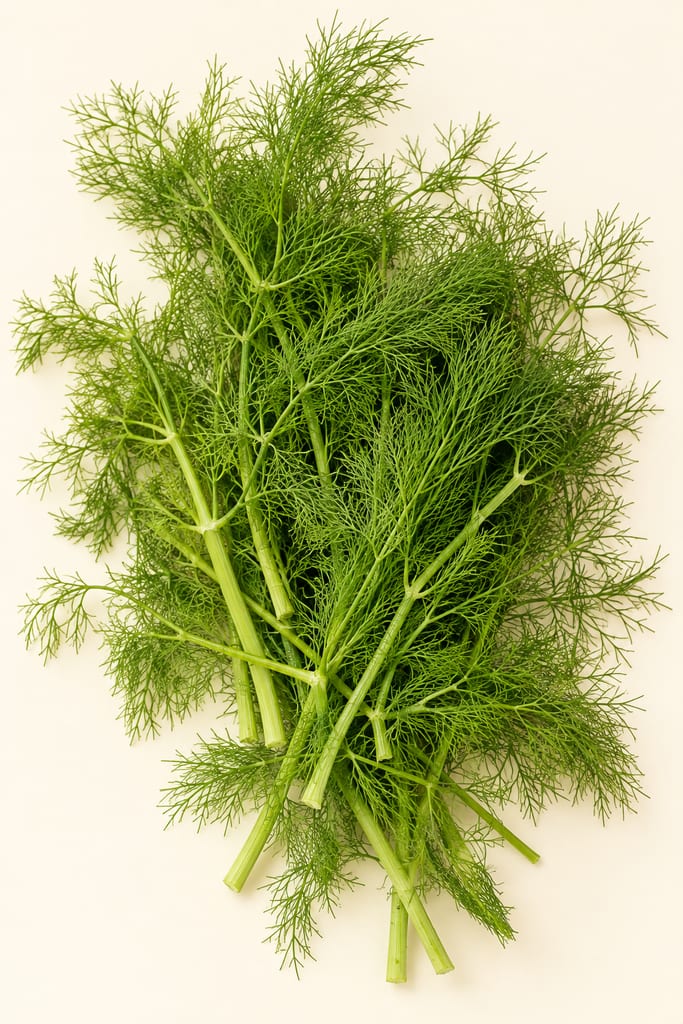
Fennel fronds
Moroccan and Tunisian sources describe fennel leaves, stems, fruits and bulb forms in different food contexts; one Tunisian folk label also pools fennel with dill.
Species and crop forms
Kew accepts Foeniculum vulgare Mill. and records Morocco and Tunisia within the species' native range. Culinary sources describe more than one crop form and plant part. The Tunisian germplasm study uses an older varietal framework that includes bulb fennel, var. azoricum; its mixed seed collection includes local, commercial and imported entries rather than one named home-garden cultivar. A fennel label alone does not identify a cultivar or tell whether a dish uses leaves, stems, fruits or a bulb.
Food reports from Morocco and Tunisia
In the Messiwa study in Morocco, the name Besbas is attached to F. vulgare. Participants used its leaves and tender stems as vegetables in couscous and its fruits to garnish and flavor bread and cakes. These are source-specific food uses, not a complete recipe with measured quantities or sequence.
In the central-Tunisia Sidi Bouzid study, the folk label besbes arbi covered spontaneous Foeniculum vulgare and Anethum graveolens. The authors state that key informants and focus-group participants did not distinguish wild fennel and dill as separate species, so the label's survey frequency and its table's combined young-leaf account for kneff, couscous, rice dishes and stuffed tripe cannot be assigned to fennel alone. The narrative explicitly reports that fennel leaves are often used for kneff and fennel seeds as a spice in bsissa. The study distinguishes besbes arbi from besbes souri, cultivated bulb fennel named as F. vulgare var. azoricum.
What the growing studies show
A Tunisian fennel germplasm study evaluated 62 entries at Chott Meriem in Sousse. It describes a semi-arid site with about 230 mm annual rainfall, an average temperature of 18.5°C and sandy-textured soil. Seedlings were raised in a nursery and transplanted to open fields for the 2015/16 and 2016/17 trials; the paper reports drip watering once or twice weekly depending on climatic conditions. These are site and research-practice details, not a universal irrigation schedule or household container protocol.
A separate study tested germination in 16 Tunisian populations under laboratory conditions using agar and Petri dishes. Most populations had their highest germination at 20°C in darkness, while the Beni Ayech provenance had a 25°C optimum; light reduced germination or inhibited it in some populations. These accession-specific lab results do not establish field emergence, mature-plant heat tolerance or a home sowing rule.
Limits of the available accounts
The Moroccan food report and the Tunisian ethnobotanical account do not give a complete measured household fennel batch with quantities, yield, ordered steps, timing and storage. They do not document a fennel fermentation or preservation method. The field and laboratory studies cannot fill those recipe gaps.
No source reviewed here establishes a universal frost, heat, humidity or daylength threshold, a home container size, or a heated or unheated greenhouse regime. The Chott Meriem field conditions, Tunisian germination accessions and named crop forms remain distinct evidence. The Moroccan oasis comparison is available here only as a publisher abstract; its methods and field details were not inspected.
Sources for this section
- Ethnobotanical study on wild edible plants traditionally used by Messiwa people, Morocco →
- Identification and frequency of consumption of wild edible plants over a year in central Tunisia: a mixed-methods approach →
- Value adding search among a selection of Tunisian fennel cultivars: Diversity assessment and selection among a local fennel germplasm →
- Effect of temperature and light on the germination of fennel: Foeniculum vulgare Mill →
- The effect of domestication on seed yield, essential oil yield and antioxidant activities of fennel seed grown in Moroccan oasis →
Research gaps
No source inspected here supplies a complete measured regional household recipe with amounts, yield, ordered steps, timing and storage.
The Sidi Bouzid besbes arbi account pools F. vulgare with Anethum graveolens; its frequency and food details cannot be separated by species from the inspected record.
No universal frost, heat, humidity or photoperiod threshold, home container protocol, or heated or unheated greenhouse guidance was established.
The Moroccan oasis paper remains abstract-only after the publisher page returned HTTP 403; full methods and results have not been checked.
Sources for this section
- Foeniculum vulgare Mill. →
- Ethnobotanical study on wild edible plants traditionally used by Messiwa people, Morocco →
- Identification and frequency of consumption of wild edible plants over a year in central Tunisia: a mixed-methods approach →
- Value adding search among a selection of Tunisian fennel cultivars: Diversity assessment and selection among a local fennel germplasm →
- Effect of temperature and light on the germination of fennel: Foeniculum vulgare Mill →
- The effect of domestication on seed yield, essential oil yield and antioxidant activities of fennel seed grown in Moroccan oasis →
Research status
The underlying plant account received a partial source review. Its review scope is described in the original plant article.
Sources for this section
Places
Unknown
Relationship not established · Place not establishedThe available research does not establish a single origin for this ingredient.
Community
No community contributions have been published for this entry yet.
Share what you made
Sign in to contribute. Published comments and photos are free to read.
Sources
Royal Botanic Gardens, Kew, Plants of the World OnlineIngredient research
Foeniculum vulgare Mill.Cited in: Species and crop forms; Research gaps
Ridwane Ghanimi et al., Journal of Ethnobiology and Ethnomedicine (2022)Ingredient research
Ethnobotanical study on wild edible plants traditionally used by Messiwa people, MoroccoCited in: Food reports from Morocco and Tunisia; Limits of the available accounts; Research gaps
Marie Claude Dop et al., Public Health Nutrition (2020)Ingredient research
Identification and frequency of consumption of wild edible plants over a year in central Tunisia: a mixed-methods approachCited in: Food reports from Morocco and Tunisia; Limits of the available accounts; Research gaps
Mounira Elbaz et al., Journal of Oasis Agriculture and Sustainable Development (2022)Ingredient research
Value adding search among a selection of Tunisian fennel cultivars: Diversity assessment and selection among a local fennel germplasmCited in: Species and crop forms; What the growing studies show; Limits of the available accounts; Research gaps
Marwa Khammassi et al., Journal of New Sciences, Agriculture and Biotechnology 90(5) (2022)Ingredient research
Effect of temperature and light on the germination of fennel: Foeniculum vulgare MillCited in: What the growing studies show; Limits of the available accounts; Research gaps
Abdellaoui et al., Journal of the Association of Arab Universities for Basic and Applied Sciences (2017)Ingredient research
The effect of domestication on seed yield, essential oil yield and antioxidant activities of fennel seed grown in Moroccan oasisCited in: Limits of the available accounts; Research gaps
FermenteaResearch provenance
Fennel (Foeniculum vulgare): original plant researchCited in: Research status