
Spices and aromatics
Guascas (Galinsoga parviflora)
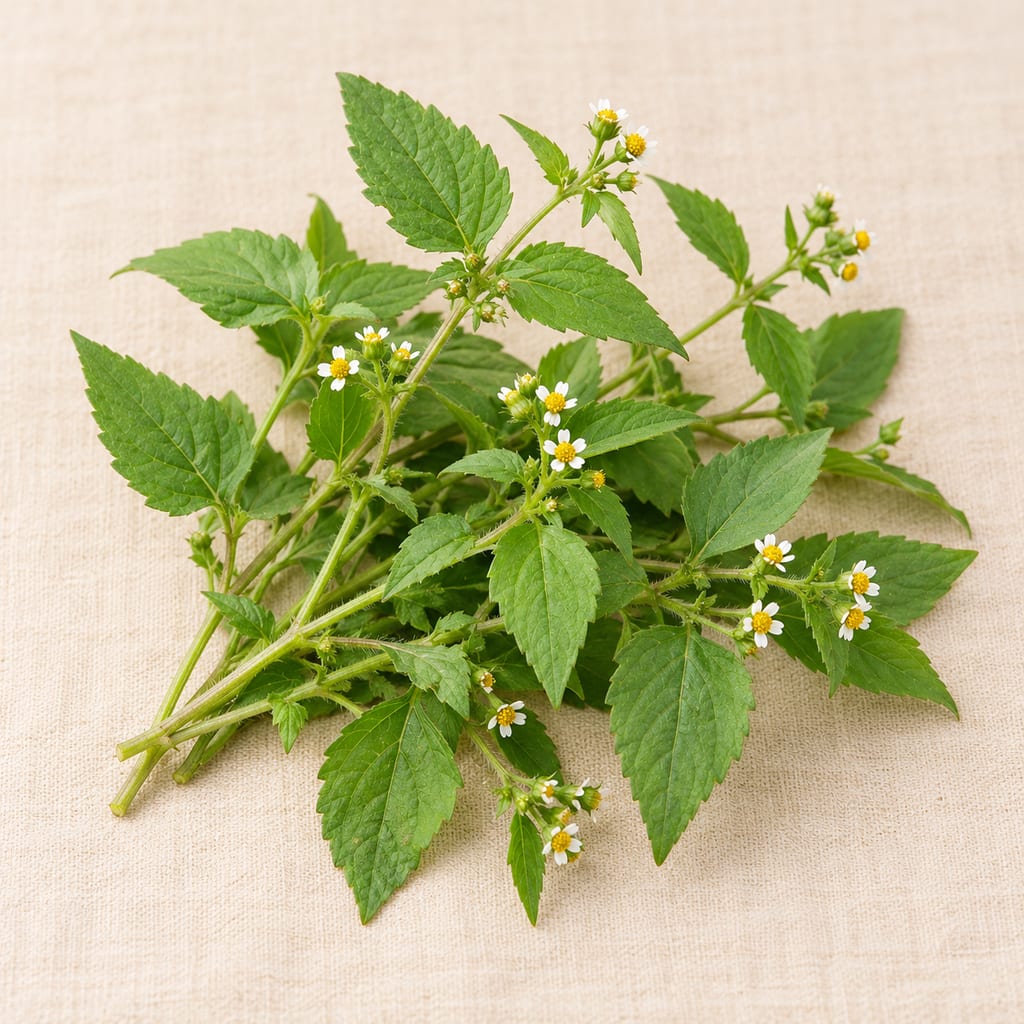
Bogotá-area community and botanical sources document Galinsoga parviflora as guascas and describe its use as an ajiaco seasoning. The plant’s common names, reported etymology and spontaneous growth are locally situated; the sources do not provide a complete recipe or a home-cultivation protocol.
A name documented in Bogotá
Kew’s Colombian Plants made accessible identifies Galinsoga parviflora Cav. as a summer annual in the sunflower family and records a native range in tropical America. Cornell’s weed profile distinguishes smallflower galinsoga, G. parviflora, from hairy galinsoga, G. quadriradiata. The Bogotá Botanical Garden’s common-name portal pairs guascas with G. parviflora, while the Muisca Council of Bosa and Botanical Garden publication also names the plant as guascas in its community account. A market or garden name by itself does not identify a specimen or distinguish related Galinsoga species.
The two Bogotá Botanical Garden sources preserve different explanations of the name: the portal attributes guasca to Quechua waskha, while the community publication gives a Muisca-language account. These published explanations are not reconciled here and neither is presented as settled linguistic history.
Sources for this section
- Galinsoga parviflora Cav., Colombian Plants made accessible →
- Plataforma de nombres comunes de las Plantas de Bogotá: Guascas – Galinsoga parviflora →
- Memorias, cultivos y sabores: (Agro)biodiversidad y agroecología desde los conocimientos ancestrales de la Comunidad Muisca de Bosa →
- Galinsogas: Weed Profiles →
Food use described by the community source
The 2023 publication produced with the Muisca Council of Bosa names leaves, flowers and stems as usable parts and records guascas as a seasoning for ajiaco. It also records animal feed uses. This is a source-attributed description of Bogotá-area knowledge, not a complete recipe, quantity recommendation or food-safety assessment.
The Bogotá common-name portal supplies a taxon-linked name and citations for the name/species association, but it does not provide a cooking method. Cornell’s discussion of soup use pertains to hairy galinsoga, G. quadriradiata, and is not transferred to G. parviflora. No medicinal benefit is claimed.
Growth context and limits of cultivation evidence
The Bogotá community publication describes the plant appearing spontaneously in cultivated spaces and between rows of kikuyu grass and garden crops. That account records a local growing context, not a cultivation trial or planting recommendation. Colombian Plants made accessible summarizes the species’ Colombian distribution, including Andean records; its database range is not a local sowing calendar.
Cornell describes both smallflower and hairy galinsoga as summer annual weeds in North American crop settings, including rapid seed production and management considerations. This is field weed ecology from another region, not guidance for producing edible leaves at home. The sources reviewed do not establish reliable germination schedules, productive temperature range, frost response, light or soil targets, watering, container dimensions, greenhouse conditions, or harvest timing for an edible crop of G. parviflora.
Preparation, identification and open questions
The documented use is seasoning in soup, but the inspected Bogotá community account does not provide ingredient amounts, a complete ordered preparation, yield, cooking endpoint or storage information. There is no basis here for turning the ajiaco reference into a procedure or for substituting another Galinsoga species based on a shared common name.
The sources do not assess specimen-level identity, contamination, safe collection locations, household storage or a validated food-safety method. A food-use record is not an identification key or a blanket statement that any plant called guascas is suitable to eat. A complete local recipe and locally grounded botanical and safety review remain open.
Research gaps
No complete species-specific ajiaco recipe with quantities, yield, timing, endpoints or storage was established.
The published Muisca and Quechua name-origin explanations conflict and have not been adjudicated with linguistic evidence.
No species-specific productive cultivation schedule, container method, greenhouse protocol or local harvest calendar was established; weed ecology is not substituted for crop guidance.
No field identification, harvest-site contamination or food-safety assessment was performed.
Sources for this section
- Galinsoga parviflora Cav., Colombian Plants made accessible →
- Plataforma de nombres comunes de las Plantas de Bogotá: Guascas – Galinsoga parviflora →
- Memorias, cultivos y sabores: (Agro)biodiversidad y agroecología desde los conocimientos ancestrales de la Comunidad Muisca de Bosa →
- Galinsogas: Weed Profiles →
Research status
The underlying plant account received a partial source review. Its review scope is described in the original plant article.
Sources for this section
Places
Unknown
Relationship not established · Place not establishedThe available research does not establish a single origin for this ingredient.
Community
No community contributions have been published for this entry yet.
Share what you made
Sign in to contribute. Published comments and photos are free to read.
Sources
Colombian Plants made accessibleIngredient research
Galinsoga parviflora Cav., Colombian Plants made accessibleCited in: A name documented in Bogotá; Growth context and limits of cultivation evidence; Research gaps
Jardín Botánico de Bogotá José Celestino MutisIngredient research
Plataforma de nombres comunes de las Plantas de Bogotá: Guascas – Galinsoga parvifloraCited in: A name documented in Bogotá; Food use described by the community source; Preparation, identification and open questions; Research gaps
Cabildo Indígena Muisca de Bosa and Jardín Botánico de Bogotá José Celestino MutisIngredient research
Memorias, cultivos y sabores: (Agro)biodiversidad y agroecología desde los conocimientos ancestrales de la Comunidad Muisca de BosaCited in: A name documented in Bogotá; Food use described by the community source; Growth context and limits of cultivation evidence; Preparation, identification and open questions; Research gaps
Cornell University College of Agriculture and Life SciencesIngredient research
Galinsogas: Weed ProfilesCited in: A name documented in Bogotá; Food use described by the community source; Growth context and limits of cultivation evidence; Preparation, identification and open questions; Research gaps
FermenteaResearch provenance
Guascas and Galinsoga parviflora: original plant researchCited in: Research status