
Spices and aromatics
Sweet woodruff (Galium odoratum)
Sweet woodruff (Galium odoratum), called Waldmeister in German, is described by BZfE as an aromatic herb for Maibowle, sauces, syrup and herb butter. Its coumarin content and growing conditions are not a validated recipe or universal safety limit.
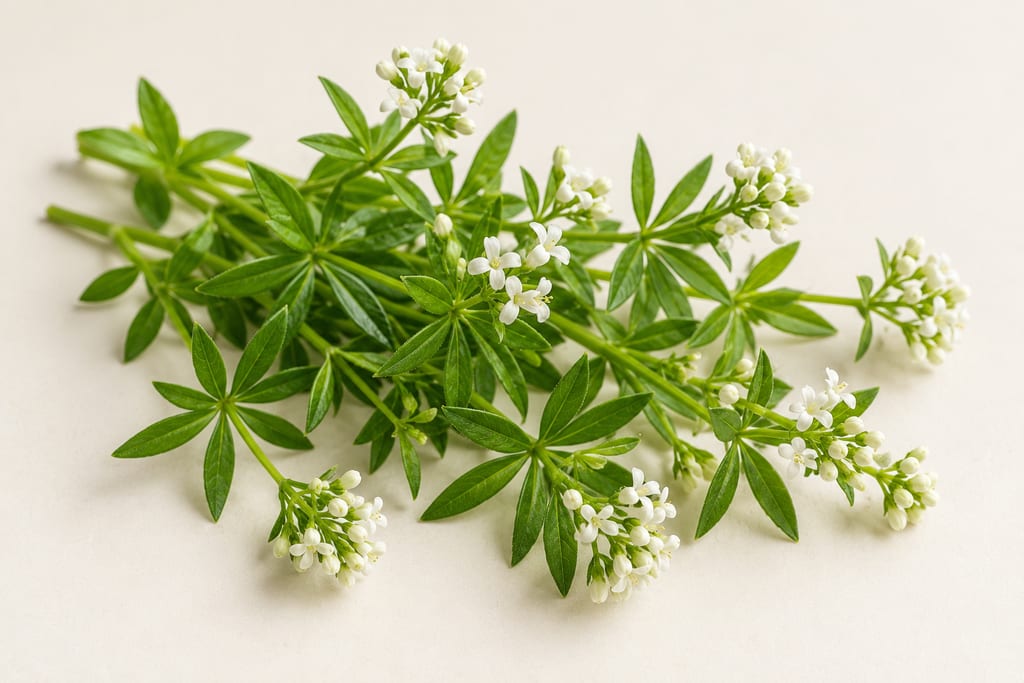
Identity and seasonal context
Kew accepts Galium odoratum (L.) Scop., a perennial native across temperate Eurasia and Algeria. The RHS lists sweet woodruff and the synonym Asperula odorata. BZfE uses the German common name Waldmeister for this species and describes it as a spring ingredient; this documents a contemporary German food context, not the first use or origin of the tradition.
Reported food uses
BZfE describes Waldmeister as an aromatic ingredient for Maibowle and sweets, with a spicy-sweet aroma and hay or vanilla notes. Its 2025 page describes a Maibowle with white wine and sparkling wine in a 2:1 ratio, as well as a non-alcoholic version using white grape or apple juice. It also lists sauce for desserts or fish, syrup for drinks and desserts, and herb butter for bread, vegetables and grilled food. The page describes an overnight-wilted bouquet, a one-hour infusion and removal of the herb, but does not give a total batch volume, serving yield or storage. These are attributed food descriptions, not a complete validated recipe.
Sources for this section
Cultivation evidence and source differences
The RHS profile assigns sweet woodruff H7 in its UK hardiness scheme, whose key describes that category as below −20°C. This is a profile rating, not a measured survival threshold or a guarantee of edible yield. The profile lists full sun or partial shade and moist, well-drained soil. Its growing narrative instead recommends moist soil in sun or dappled shade and says strong sun may scorch the leaves. Keep both parts of the RHS entry visible. RHS describes rhizomatous spread, a mat-forming habit and propagation by seed or rhizome division. BZfE describes woodland mats and a height up to 50 cm, while RHS gives stems to 30 cm; the pages do not resolve the difference. No container or greenhouse crop method is established.
Sources for this section
Coumarin and preparation limits
BZfE identifies coumarin as a main contributor to the aroma and warns that higher doses can cause nausea, headache and liver damage. It advises using no more than 3 g fresh herb per litre of liquid. That is BZfE’s consumer advice, not a measured or universally validated safety limit. BfR says coumarin occurs naturally in sweet woodruff and other plants; its broader risk discussion describes liver effects in particularly sensitive people in a medicinal context and sets a general tolerable daily intake. That general TDI cannot be converted into a woodruff serving or litre recommendation without a measured coumarin concentration and serving exposure. The indexed abstract of a 2025 analytical study says the researchers measured the compounds for 72 hours after harvest, with drying reaching completion at 48 hours, and reports coumarin decline during drying through sublimation. The abstract does not establish the effect of BZfE’s overnight wilting step, all wilting methods or a safety endpoint.
Open questions
The sources do not provide measured coumarin content for the BZfE beverage, a serving-level exposure estimate, or a complete Maibowle batch with total volume, yield and storage. The drying article was reviewed through its indexed abstract only; its full methods and results were not checked. RHS condition fields and its narrative differ on light, and its UK hardiness category is not an edible-crop trial. No regional yield, container or protected-growing protocol was found.
Research gaps
BZfE’s 3 g fresh herb/L advice is source-reported consumer guidance; no matched coumarin concentration, serving exposure or universal safety validation was established.
BfR’s general coumarin TDI is not converted into a sweet-woodruff amount per serving or litre.
The 2025 study was reviewed through its indexed abstract only; its 72-hour post-harvest measurements and 48-hour drying phase are not generalized to overnight wilting or every drying process.
The Maibowle account gives a wine ratio and BZfE separately advises a fresh-herb amount per litre, but lacks total batch volume, yield, serving count and storage guidance; it is not a complete validated recipe.
RHS profile and narrative differ on light; its H7 is a UK profile category, not a measured survival threshold. Container, greenhouse and productive-yield guidance remain open.
No earliest food attestation, transmission history or jurisdiction-specific gathering permission was established.
Sources for this section
- Galium odoratum (L.) Scop. | Plants of the World Online →
- Galium odoratum | RHS Plant Profile →
- Frühlingsbote Waldmeister →
- Fragen und Antworten zu Cumarin in Zimt und anderen Lebensmitteln →
- Comprehensive analysis of natural products of Galium odoratum (Rubiaceae), focusing on the formation of coumarin during the drying process →
Research status
The underlying plant account received a partial source review. Its review scope is described in the original plant article.
Sources for this section
Places
Unknown
Relationship not established · Place not establishedThe available research does not establish a single origin for this ingredient.
Community
No community contributions have been published for this entry yet.
Share what you made
Sign in to contribute. Published comments and photos are free to read.
Sources
Royal Botanic Gardens, KewIngredient research
Galium odoratum (L.) Scop. | Plants of the World OnlineCited in: Identity and seasonal context; Research gaps
Royal Horticultural SocietyIngredient research
Galium odoratum | RHS Plant ProfileCited in: Identity and seasonal context; Cultivation evidence and source differences; Open questions; Research gaps
Bundeszentrum für Ernährung; Heike KreutzIngredient research
Frühlingsbote WaldmeisterCited in: Identity and seasonal context; Reported food uses; Cultivation evidence and source differences; Coumarin and preparation limits; Open questions; Research gaps
German Federal Institute for Risk AssessmentIngredient research
Fragen und Antworten zu Cumarin in Zimt und anderen LebensmittelnCited in: Coumarin and preparation limits; Open questions; Research gaps
Phytochemistry 236 (2025); PubMed abstract record, U.S. National Library of MedicineIngredient research
Comprehensive analysis of natural products of Galium odoratum (Rubiaceae), focusing on the formation of coumarin during the drying processCited in: Coumarin and preparation limits; Open questions; Research gaps
FermenteaResearch provenance
Sweet woodruff: German Maibowle and cultivation evidence: original plant researchCited in: Research status