
Substrates
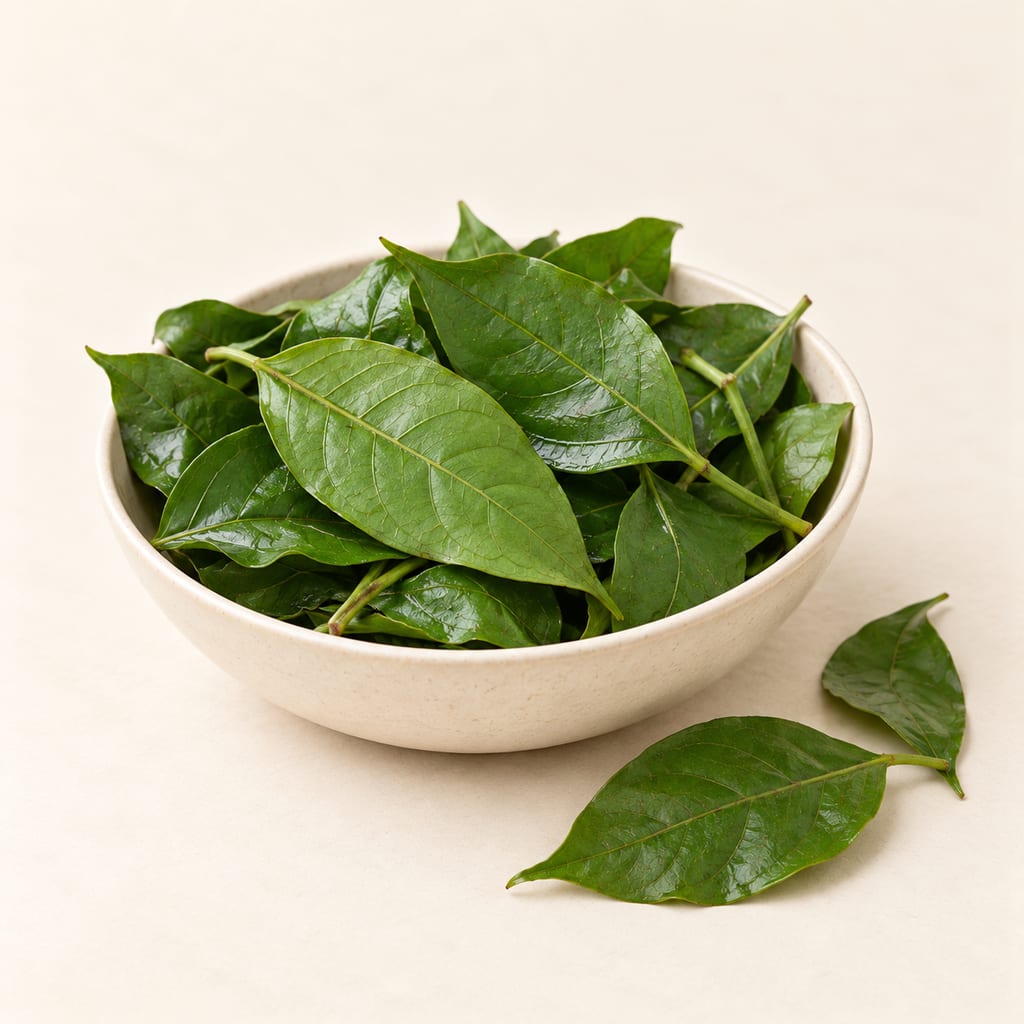
Gnetum africanum leaves
A source-linked account of Gnetum africanum as a climbing forest vegetable, with shared market names and paired-species food and cultivation reports clearly qualified.
Species identity and shared names
Kew accepts Gnetum africanum Welw. as a climbing plant native from West-Central Tropical Africa to Angola. It separately accepts Gnetum buchholzianum Engl., and PROTA maintains a separate account for that species. PROTA describes the two as similar and reports that their leaves are often mixed in trade. Eru, koko, okok, ukasi and afang are used for both species or for genus-level products in the inspected regional sources. These names do not verify that a market bundle is G. africanum.
Sources for this section
- Gnetum africanum Welw. →
- Gnetum africanum (PROTA) →
- Gnetum domestication for livelihood improvement and conservation →
- La collecte et l'analyse des données statistiques sur les produits forestiers non ligneux: une étude pilote au Cameroun, chapitre 4 →
- Gnetum buchholzianum Engl. →
- Gnetum buchholzianum (PROTA) →
Food context and reported parts
PROTA reports leaves of G. africanum and the similar G. buchholzianum as vegetables, commonly shredded and cooked with meat or fish or included in groundnut-based stew. It also reports occasional salad use, mixing with waterleaf to soften the texture, dried shredded leaves for later use, and seeds eaten in Cameroon and the Democratic Republic of Congo. Several of these food statements explicitly cover both species, so they are not presented as an exclusive G. africanum tradition or a recipe. The source gives no measured household quantities or safety endpoint.
Sources for this section
Names and foodways in Cameroon
A 2001 FAO field study records local names for Gnetum spp. in particular Cameroonian communities and markets, including kok, erux, hikok, ikiokio, kiwa, koko, ekoke, kôgè and mbiare. It describes leaves sold as whole stems or cut strips and tracks collection and trade at named sites. The study is genus-level, time-bounded and not a current national market survey. Its community names and commercial forms add foodway context but cannot identify a bundle to species.
Forest ecology and cultivated setting
PROTA places G. africanum in humid forest from sea level to about 1,200 m and reports a preference for high annual rainfall, with vines commonly climbing on understory and middle-storey trees. It describes the species as more frequent at primary-forest edges and in secondary forest than G. buchholzianum. In cultivation, PROTA reports a need for climbing support and says exposed plants perform poorly; the FAO domestication report likewise describes support and shade as part of agroforestry trials. These are tropical field and experimental contexts, not temperate outdoor or household greenhouse instructions.
Propagation and crop development
The PROTA account says seed propagation has been difficult in Cameroon trials and that seed may take a year or longer to germinate. It describes vegetative propagation from leafy stem cuttings, trimmed leaf blades, shaded nursery beds using well-decomposed sawdust or fine river sand, and transplanting rooted cuttings into sleeves or bamboo pots before field planting. The account reports field planting at the start of the rainy season, preferably beside a young tree or shrub. Its recommendations describe regional domestication work rather than a tested home-garden schedule. The FAO paper reports cuttings as easier to establish than seed in the Limbe Botanic Garden program, with supported plants performing better in its pilot farms.
Sources for this section
Harvesting, conservation and limits
PROTA reports first harvest several months after planting and describes controlled collection of side shoots as preferable to pulling whole vines from trees. Its early observations suggest repeated harvests can allow regrowth, but the report does not establish a universally applicable yield schedule. Kew links G. africanum to an IUCN Near Threatened category. FAO describes destructive harvesting pressure for both African Gnetum species and historical Cameroon permit rules; those legal statements are not current collection guidance. The reviewed sources do not establish frost tolerance, greenhouse conditions, container crop performance, household storage life or a validated raw-food safety process.
Research gaps
Shared trade names and mixed consignments do not establish whether a product is Gnetum africanum or G. buchholzianum; no specimen was examined.
The reported food uses are descriptive and often apply to both species; no validated preparation, contamination control, or storage life is established.
Climate, rainfall and propagation figures come from tropical forest and Cameroon cultivation accounts; frost, heat, household container and greenhouse tolerances remain unassessed.
The FAO Cameroon study dates from 2001 and its permit statements are historical; current country-specific collection rules were not checked.
A current, species-specific local cultivar or propagation trial and a complete source recipe were not reviewed.
Sources for this section
- Gnetum africanum Welw. →
- Gnetum africanum (PROTA) →
- Gnetum domestication for livelihood improvement and conservation →
- La collecte et l'analyse des données statistiques sur les produits forestiers non ligneux: une étude pilote au Cameroun, chapitre 4 →
- Gnetum buchholzianum Engl. →
- Gnetum buchholzianum (PROTA) →
Research status
The underlying plant account received a partial source review. Its review scope is described in the original plant article.
Sources for this section
Places
Unknown
Relationship not established · Place not establishedThe available research does not establish a single origin for this ingredient.
Community
No community contributions have been published for this entry yet.
Share what you made
Sign in to contribute. Published comments and photos are free to read.
Sources
Royal Botanic Gardens, Kew, Plants of the World OnlineIngredient research
Gnetum africanum Welw.Cited in: Species identity and shared names; Forest ecology and cultivated setting; Harvesting, conservation and limits; Research gaps
Plant Resources of Tropical Africa (PROTA), hosted by Pl@ntUse / Pl@ntNetIngredient research
Gnetum africanum (PROTA)Cited in: Species identity and shared names; Food context and reported parts; Forest ecology and cultivated setting; Propagation and crop development; Harvesting, conservation and limits; Research gaps
Food and Agriculture Organization of the United NationsIngredient research
Gnetum domestication for livelihood improvement and conservationCited in: Species identity and shared names; Forest ecology and cultivated setting; Propagation and crop development; Harvesting, conservation and limits; Research gaps
Food and Agriculture Organization of the United NationsIngredient research
La collecte et l'analyse des données statistiques sur les produits forestiers non ligneux: une étude pilote au Cameroun, chapitre 4Cited in: Species identity and shared names; Names and foodways in Cameroon; Research gaps
Royal Botanic Gardens, Kew, Plants of the World OnlineIngredient research
Gnetum buchholzianum Engl.Cited in: Species identity and shared names; Research gaps
Plant Resources of Tropical Africa (PROTA), hosted by Pl@ntUse / Pl@ntNetIngredient research
Gnetum buchholzianum (PROTA)Cited in: Species identity and shared names; Research gaps