
Spices and aromatics
Utazi leaves
Kew accepts Gongronemopsis latifolia and lists Gongronema latifolium as a synonym. Nigerian sources report Utazi leaf use and several context-specific propagation experiments; one recent polyhouse study contains unresolved reporting conflicts.
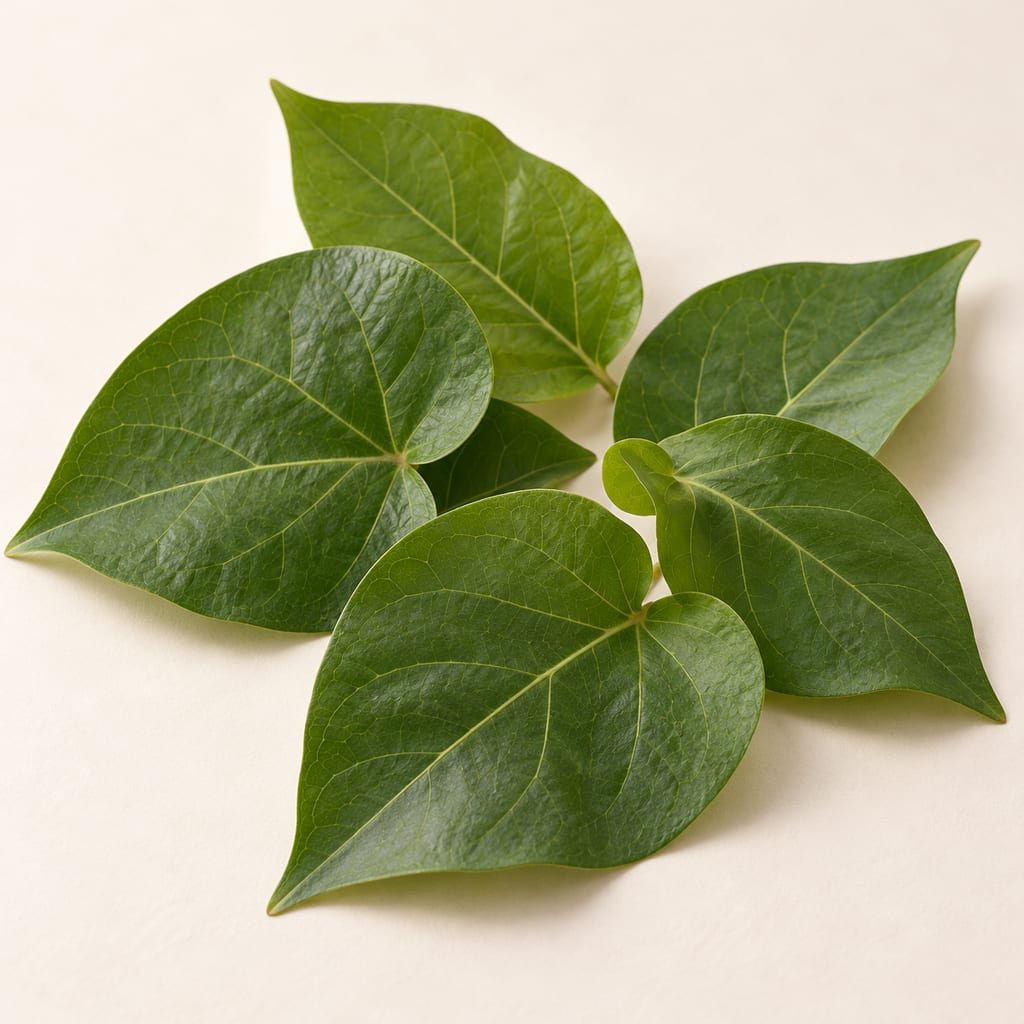
Accepted name and source-era names
Kew accepts Gongronemopsis latifolia (Benth.) S.Reuss, Liede & Meve and lists Gongronema latifolium Benth. as a homotypic synonym. The older name is retained when describing studies published under it; these records refer to one taxonomic concept, not two ingredients. Kew places the climber across western tropical Africa to western Tanzania and Zambia, including Nigeria.
Sources for this section
Food-use reports and their limits
Full 2013 and 2018 papers describe leaves under the source-era name as a vegetable or spice used in southeastern Nigerian soups, fresh-fish pepper soup and African salad, while citing earlier food literature in their introductions. The FAO/CINE table for four Igbo states reports “utazi” with soup use, but prints “Grongronema latifollis”; that malformed row is contextual evidence and not a verified taxonomic voucher. None of these passages supplies a complete measured household recipe.
Sources for this section
- Effect of different Growth Media on Foliage Production and Root Growth in Gongronema latifolia Benth Stem Cuttings →
- Effects of Different Growth Media on Vegetative Propagation of Gongronema latifolium in Delta State Capital Territory, Nigeria →
- The Igbo traditional food system documented in four states in Southern Nigeria, in Indigenous Peoples’ food systems →
Propagation studies in Nigeria
Three nursery studies report stem-cutting propagation, but their settings and comparisons differ. The 2006 Nsukka study used one forest-derived clone under 65 percent shade and compared sawdust, rice hull and topsoil; measured media pH values were 5.6, 5.8 and 6.1. The 2013 Choba study found sharp sand led its early rooting measures while sawdust-only cuttings produced no roots. The 2018 Asaba polybag study reported pH 6.7 for sandy soil, 5.7 for loam and 5.9 for clay, with rankings that varied by measured trait. These are trial-specific nursery results, not a single crop-wide soil or pH optimum.
Sources for this section
- Initiation and growth of shoots of Gongronema latifolia Benth stem cuttings in different rooting media →
- Effect of different Growth Media on Foliage Production and Root Growth in Gongronema latifolia Benth Stem Cuttings →
- Effects of Different Growth Media on Vegetative Propagation of Gongronema latifolium in Delta State Capital Territory, Nigeria →
A polyhouse study with unresolved figures
The UJET paper reports a June–August 2024 Owerri naturally ventilated polyhouse experiment using buried porous pots and cuttings. Its publisher page says the crops were watered daily in the methods, while its abstract reports a six-day “optimal” interval. The full paper also gives inconsistent water-use-efficiency values, water totals and significance wording, and does not clearly establish a marketable-yield mass. Those conflicts are retained as a research limitation; the paper cannot be turned into a home watering schedule or crop-control protocol.
What remains open
The available accounts do not establish a complete food preparation, serving amount, storage method or preparation-specific safety endpoint. Nursery bags and the specialized buried-pot polyhouse installation are not evidence of mature household-pot performance. No current conservation status or collection permission was established by this source set.
Sources for this section
- Initiation and growth of shoots of Gongronema latifolia Benth stem cuttings in different rooting media →
- Effect of different Growth Media on Foliage Production and Root Growth in Gongronema latifolia Benth Stem Cuttings →
- Effects of Different Growth Media on Vegetative Propagation of Gongronema latifolium in Delta State Capital Territory, Nigeria →
- Yield and Water Use of Gongronema latifolium (Utazi) under Porous Pot Sub-surface Irrigation in a Ventilated Polyhouse →
- The Igbo traditional food system documented in four states in Southern Nigeria, in Indigenous Peoples’ food systems →
Research gaps
Voucher-backed food research linking market or vernacular Utazi records to the accepted taxon.
Complete measured regional food preparations and food-specific handling, storage and hazard evidence.
Author clarification or corrected UJET values for daily versus six-day irrigation, water totals, WUE, significance and actual yield measurements.
Mature outdoor, container and protected-crop trials and current local conservation or collection rules.
Sources for this section
- Gongronemopsis latifolia (Benth.) S.Reuss, Liede & Meve →
- Gongronema latifolium Benth. →
- Initiation and growth of shoots of Gongronema latifolia Benth stem cuttings in different rooting media →
- Effect of different Growth Media on Foliage Production and Root Growth in Gongronema latifolia Benth Stem Cuttings →
- Effects of Different Growth Media on Vegetative Propagation of Gongronema latifolium in Delta State Capital Territory, Nigeria →
- Yield and Water Use of Gongronema latifolium (Utazi) under Porous Pot Sub-surface Irrigation in a Ventilated Polyhouse →
- The Igbo traditional food system documented in four states in Southern Nigeria, in Indigenous Peoples’ food systems →
Research status
The underlying plant account received a partial source review. Its review scope is described in the original plant article.
Sources for this section
Places
Unknown
Relationship not established · Place not establishedThe available research does not establish a single origin for this ingredient.
Community
No community contributions have been published for this entry yet.
Share what you made
Sign in to contribute. Published comments and photos are free to read.
Sources
Royal Botanic Gardens, Kew, Plants of the World OnlineIngredient research
Gongronemopsis latifolia (Benth.) S.Reuss, Liede & MeveCited in: Accepted name and source-era names; Research gaps
Royal Botanic Gardens, Kew, Plants of the World Online, synonym recordIngredient research
Gongronema latifolium Benth.Cited in: Accepted name and source-era names; Research gaps
African Journal of Biotechnology 5(5), 425–428, 2006Ingredient research
Initiation and growth of shoots of Gongronema latifolia Benth stem cuttings in different rooting mediaCited in: Propagation studies in Nigeria; What remains open; Research gaps
Greener Journal of Agricultural Sciences 3(3), 215–221, 2013Ingredient research
Effect of different Growth Media on Foliage Production and Root Growth in Gongronema latifolia Benth Stem CuttingsCited in: Food-use reports and their limits; Propagation studies in Nigeria; What remains open; Research gaps
Journal of Agriculture and Food Environment 5(1), 17–26, 2018Ingredient research
Effects of Different Growth Media on Vegetative Propagation of Gongronema latifolium in Delta State Capital Territory, NigeriaCited in: Food-use reports and their limits; Propagation studies in Nigeria; What remains open; Research gaps
Umudike Journal of Engineering and Technology 11(2), 35–42; article posted 2025, issue dated December 2025Ingredient research
Yield and Water Use of Gongronema latifolium (Utazi) under Porous Pot Sub-surface Irrigation in a Ventilated PolyhouseCited in: A polyhouse study with unresolved figures; What remains open; Research gaps
Food and Agriculture Organization of the United Nations and Centre for Indigenous Peoples’ Nutrition and Environment, 2009Ingredient research
The Igbo traditional food system documented in four states in Southern Nigeria, in Indigenous Peoples’ food systemsCited in: Food-use reports and their limits; What remains open; Research gaps
FermenteaResearch provenance
Utazi: Nigerian food accounts and cultivation studies: original plant researchCited in: Research status