
Substrates
Kenger (Gundelia tournefortii)
A descriptive account of several regional reports that use the name Kenger and related forms for Gundelia tournefortii, alongside changing taxonomy and limited cultivation evidence. The reports do not independently confirm every historical specimen or establish a Turkish growing method.
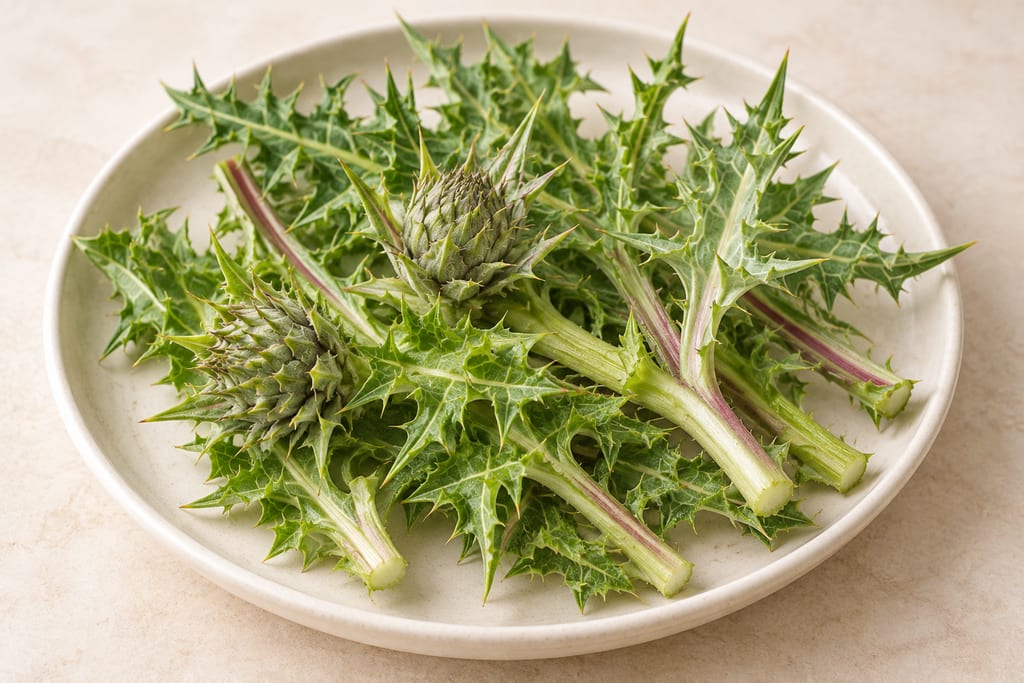
Taxonomy and names
Kew accepts Gundelia tournefortii L. in Asteraceae and lists Türkiye within its native range. The genus has been divided into multiple taxa in newer treatments; the 15- and 16-taxon counts cited in the sources describe publication-era classifications, not a current total. The Turkish food studies retain their own species names and vouchers, which were not re-examined here under the later taxonomy. “Kenger” or “Kengir” alone cannot confirm the identity of a plant or food sample.
Sources for this section
- Gundelia tournefortii L. | Plants of the World Online →
- Wild edible plant species used in the Ağrı province, eastern Turkey →
- Traditional knowledge of wild edible plants in Hasankeyf (Batman Province, Turkey) →
- Hakkâri İlinde Gıda Olarak Tüketilen Yabani Bitki ve Yabancı Ot Türlerinin Güncel Durumu →
- The use of Kenger (Gundelia tournefortii) in Local Culinary Culture and its Evaluation within the Framework of Zero Waste: The Çukurova Case →
- Gundelia (Compositae), from one to many species – an ignored diversity →
- Physiological and environmental control of seed germination timing in Mediterranean mountain populations of Gundelia tournefortii →
Regional food accounts
In Ağrı, the study row for G. tournefortii lists Kenger, voucher 04-30, and young leaves, shoots, latex, and seeds. The paper's prose also mentions roots and young stems or petioles, so the row and narrative do not give one identical part list. In Hasankeyf, the authors report G. tournefortii, voucher ISTE115369, and “Kereng (K)”; that paper defines K as Kurdish for its own account and describes fresh aerial parts and stems. A Hakkâri abstract lists Kenger/Kengir with G. tournefortii var. tournefortii, but does not map the individual terms to languages.
Food reports from Adana and Osmaniye
A Çukurova interview study conducted in Adana and Osmaniye in late 2024 reports local Kenger food uses involving several plant parts and says stems were the most consumed part among its respondents. The study is an account of interviews; it does not provide a separately rechecked specimen for every reported use. The findings should remain tied to that sample rather than treated as a single regional recipe or a general serving recommendation.
Changing taxonomy and identification limits
Vitek's treatment describes a long-standing broad G. tournefortii concept and recognizes 15 distinct taxa in its 2018 publication. A 2019-era count of 16 appears in the later seed paper. These counts reflect different source-era taxonomic frames. The authors' older Turkish determinations remain useful historical records, but no voucher redetermination is reported here. A 2024 review uses Kenger as a Turkish name at broad regional scale; it does not verify every local name or specimen.
Sources for this section
- Gundelia (Compositae), from one to many species – an ignored diversity →
- Physiological and environmental control of seed germination timing in Mediterranean mountain populations of Gundelia tournefortii →
- Gundelia tournefortii L. (Akkoub): a review of a valuable wild vegetable from Eastern Mediterranean →
What cultivation evidence supports
A 2022 germination study tested 13 seed lots collected in Lebanon's Shouf region in July and August 2019. At 15°C, intact woody fruit complexes averaged below 20% germination, while extracted fruits averaged about 50%; the study reports higher results with gibberellic acid and cold stratification under its laboratory conditions. The work concerns Lebanese seed lots, not a Turkish garden crop. A 2024 review says field germination and cultivation remain difficult and summarizes limited cultivation in Israel and Palestine and propagation work from several countries. A Sivas paper analyzes seed from a grower's garden, but is not a cultivation trial.
Sources for this section
Food and growing questions still open
The sources do not establish a Turkish crop schedule, named hardiness rating, frost or heat tolerance, soil or pH, irrigation, drainage, container method, or protected-crop settings. Turkish food studies describe seasonal wild use, not managed harvest or regrowth. The Hasankeyf account does not give one complete batch with quantities, ordered stages, yield, and a validated endpoint, so it is not an executable recipe. Reports of perceived decline or increased gathering effort are not a formal national conservation assessment or current legal determination.
Sources for this section
- Wild edible plant species used in the Ağrı province, eastern Turkey →
- Traditional knowledge of wild edible plants in Hasankeyf (Batman Province, Turkey) →
- Hakkâri İlinde Gıda Olarak Tüketilen Yabani Bitki ve Yabancı Ot Türlerinin Güncel Durumu →
- The use of Kenger (Gundelia tournefortii) in Local Culinary Culture and its Evaluation within the Framework of Zero Waste: The Çukurova Case →
- Gundelia tournefortii L. (Akkoub): a review of a valuable wild vegetable from Eastern Mediterranean →
Research gaps
Re-examine Turkish vouchers under a stated current taxonomic treatment before treating older names as confirmed post-split identifications.
Find a Turkish productive-cultivation study with methods and measured crop outcomes; current evidence does not provide a household growing protocol.
Clarify local language and plant-part attribution for Kenger and Kengir in each regional source rather than transferring meanings between studies.
Locate an attributed, complete regional food batch and its own preparation details; no safe-processing endpoint or storage life is established here.
Sources for this section
- Gundelia tournefortii L. | Plants of the World Online →
- Wild edible plant species used in the Ağrı province, eastern Turkey →
- Traditional knowledge of wild edible plants in Hasankeyf (Batman Province, Turkey) →
- Hakkâri İlinde Gıda Olarak Tüketilen Yabani Bitki ve Yabancı Ot Türlerinin Güncel Durumu →
- The use of Kenger (Gundelia tournefortii) in Local Culinary Culture and its Evaluation within the Framework of Zero Waste: The Çukurova Case →
- Gundelia (Compositae), from one to many species – an ignored diversity →
- Physiological and environmental control of seed germination timing in Mediterranean mountain populations of Gundelia tournefortii →
- Gundelia tournefortii L. (Akkoub): a review of a valuable wild vegetable from Eastern Mediterranean →
- Gundellia tournefortii Seeds as a New Source of Functional Food →
Research status
The underlying plant account received a partial source review. Its review scope is described in the original plant article.
Sources for this section
Places
Unknown
Relationship not established · Place not establishedThe available research does not establish a single origin for this ingredient.
Community
No community contributions have been published for this entry yet.
Share what you made
Sign in to contribute. Published comments and photos are free to read.
Sources
Royal Botanic Gardens, KewIngredient research
Gundelia tournefortii L. | Plants of the World OnlineCited in: Taxonomy and names; Research gaps
Anales del Jardín Botánico de MadridIngredient research
Wild edible plant species used in the Ağrı province, eastern TurkeyCited in: Taxonomy and names; Regional food accounts; Food and growing questions still open; Research gaps
Acta Societatis Botanicorum PoloniaeIngredient research
Traditional knowledge of wild edible plants in Hasankeyf (Batman Province, Turkey)Cited in: Taxonomy and names; Regional food accounts; Food and growing questions still open; Research gaps
European Journal of Science and TechnologyIngredient research
Hakkâri İlinde Gıda Olarak Tüketilen Yabani Bitki ve Yabancı Ot Türlerinin Güncel DurumuCited in: Taxonomy and names; Regional food accounts; Food and growing questions still open; Research gaps
Turkish Journal of Agriculture—Food Science and TechnologyIngredient research
The use of Kenger (Gundelia tournefortii) in Local Culinary Culture and its Evaluation within the Framework of Zero Waste: The Çukurova CaseCited in: Taxonomy and names; Food reports from Adana and Osmaniye; Food and growing questions still open; Research gaps
Flora MediterraneaIngredient research
Gundelia (Compositae), from one to many species – an ignored diversityCited in: Taxonomy and names; Changing taxonomy and identification limits; Research gaps
Plant Growth RegulationIngredient research
Physiological and environmental control of seed germination timing in Mediterranean mountain populations of Gundelia tournefortiiCited in: Taxonomy and names; Changing taxonomy and identification limits; What cultivation evidence supports; Research gaps
Genetic Resources and Crop EvolutionIngredient research
Gundelia tournefortii L. (Akkoub): a review of a valuable wild vegetable from Eastern MediterraneanCited in: Changing taxonomy and identification limits; What cultivation evidence supports; Food and growing questions still open; Research gaps
Turkish Journal of Agriculture—Food Science and TechnologyIngredient research
Gundellia tournefortii Seeds as a New Source of Functional FoodCited in: What cultivation evidence supports; Research gaps
FermenteaResearch provenance
Gundelia tournefortii: regional Turkish food reports and limits: original plant researchCited in: Research status