
Spices and aromatics
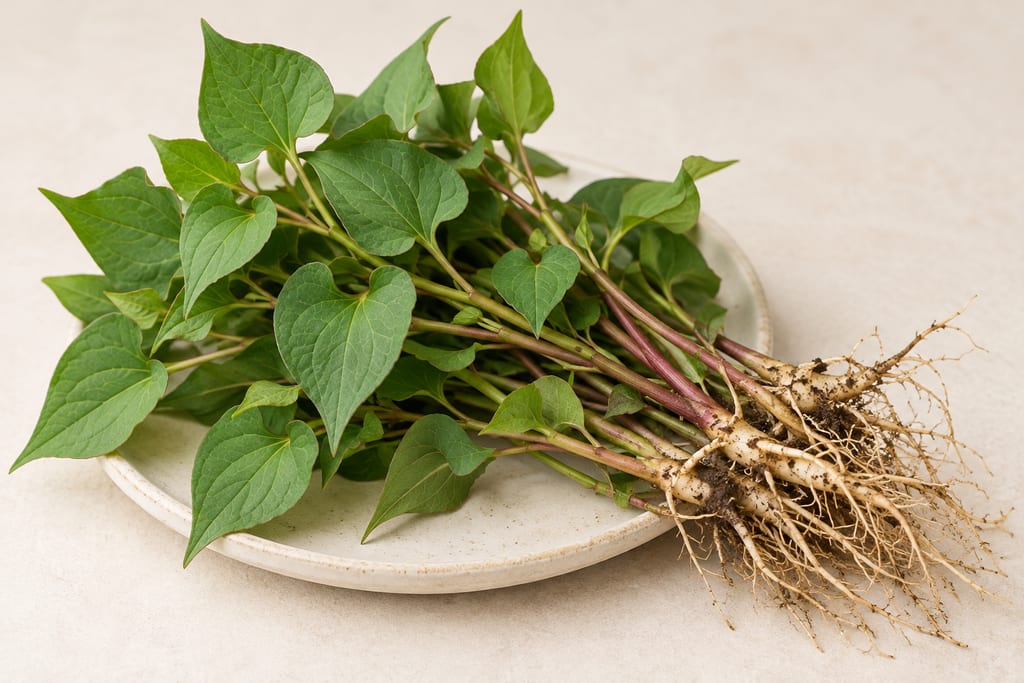
Houttuynia leaves and roots
A rhizomatous perennial with regional Chinese food records and separate UK, US and Japanese cultivation accounts. Reported parts and methods vary by source; the account is not a plant-identification or food-safety approval.
Names and food-use context
Kew accepts Houttuynia cordata Thunb. and describes two scent chemotypes associated with Japanese and Chinese material, as well as green and several colored ornamental cultivars. Those descriptions do not identify a food specimen or show that every ornamental form has been assessed as food.
Beijing University of Chinese Medicine’s museum records above-ground stems and leaves, and underground roots called zheergen, in Yunnan, Guizhou and Sichuan foodways. Reported dishes include stir-fries, cold dishes and soups. These common names do not establish the identity of a gathered plant or ornamental cultivar.
Sources for this section
Preparation descriptions
The museum’s cold-dressed leaf and root examples both include blanching before seasoning. Its leaf-and-egg example specifies 150 g fresh leaves and four eggs, cooked together until set. Several seasoning quantities, blanching duration, yields and storage instructions are not supplied. These are source-described food examples, not validated safety controls.
A separate 2025 survey of Taishan County, Guangdong, says Houttuynia roots are eaten raw in salads, used as a soup spice or brewed into traditional herbal tea. Its supplementary Table S3 instead lists the edible part as “Whole plant,” with categories Wv (wild vegetables), Sp (spices) and Ts (tea substitutes), and methods “Water-boiled; Stew soup; Cold toss.” The row records “Medical plant: Yes” and voucher ZSY-021. The article and table describe local ethnobotanical categories; their differing part descriptions do not establish that every part is used in each preparation or prove a medical effect.
The Beijing museum page places traditional and modern medicinal claims in a separate section after its food examples. Those claims are outside this article’s food evidence and are not presented as clinical effects.
Growing and spread
RHS lists sun or partial shade, clay/loam/sand, pH categories from acid to alkaline, and H6 in its UK hardiness scheme. H6 is a broad horticultural class, not a measured frost limit for each plant or a container guarantee. The RHS profile describes soil tolerance from dry to wet and warns that underground stems can spread extensively, especially in wet soils. It recommends containers to restrict spread but gives no dimensions or escape test.
North Carolina State Extension describes best growth in moist soil to 1–2 inches of shallow standing water and cautions that the plant does not tolerate drought. For landscape containment, it suggests a 1–2 US gallon container set into the ground or a bounded area. This is a regional garden recommendation, not a tested edible-crop system or guarantee that rhizomes cannot escape.
Kew describes the species as widespread and not threatened, while warning that it may become invasive where introduced because it spreads quickly and is difficult to control. This broad conservation account is not a local legal planting-status check.
Propagation and growing limits
RHS lists propagation by seed, spring division or semi-ripe basal cuttings. Japan’s National Institutes of Biomedical Innovation medicinal-crop account uses rhizomes; it describes planting in autumn or early spring, about 5 cm segments with at least 2–3 nodes, and roughly 40% shade from late May to mid-September. The account says water shortage can reduce yield and quality and harvest begins from the second year. These are Japanese field directions for medicinal dry material, not a home culinary schedule or food-safety process.
The sources do not establish a universal irrigation schedule, edible-leaf yield, greenhouse regime or locally tested rhizome barrier. The Japan and North Carolina measurements remain bounded to their own crop and garden contexts.
Sources for this section
Research gaps
No qualified specimen identification, cultivar/chemotype food assessment or toxic-lookalike review is recorded.
The museum page leaves some seasoning amounts, blanching duration and storage unspecified; it does not validate a food-safety process or set an edible-harvest schedule.
Quantitative heat/humidity limits, greenhouse protocols and locally tested containment remain gaps.
Sources for this section
- 药食两用的鱼腥草 →
- Houttuynia cordata →
- Houttuynia cordata Thunb., Plants of the World Online →
- Houttuynia cordata, Plant Toolbox →
- 植物体栽培及び植物の効率的生産法: ドクダミ →
- An ethnobotanical study on wild edible plants in Taishan County, Guangdong, China →
- Data Sheet 1: supplementary Tables S1–S3 for the Taishan County ethnobotanical study →
Research status
The underlying plant account received a partial source review. Its review scope is described in the original plant article.
Sources for this section
Places
Unknown
Relationship not established · Place not establishedThe available research does not establish a single origin for this ingredient.
Community
No community contributions have been published for this entry yet.
Share what you made
Sign in to contribute. Published comments and photos are free to read.
Sources
Beijing University of Chinese Medicine MuseumIngredient research
药食两用的鱼腥草Cited in: Names and food-use context; Preparation descriptions; Research gaps
Royal Horticultural SocietyIngredient research
Houttuynia cordataCited in: Growing and spread; Propagation and growing limits; Research gaps
Royal Botanic Gardens, KewIngredient research
Houttuynia cordata Thunb., Plants of the World OnlineCited in: Names and food-use context; Growing and spread; Research gaps
North Carolina State University ExtensionIngredient research
Houttuynia cordata, Plant ToolboxCited in: Growing and spread; Propagation and growing limits; Research gaps
National Institutes of Biomedical Innovation, Health and Nutrition, Research Center for Medicinal Plant ResourcesIngredient research
植物体栽培及び植物の効率的生産法: ドクダミCited in: Propagation and growing limits; Research gaps
Frontiers in Sustainable Food SystemsIngredient research
An ethnobotanical study on wild edible plants in Taishan County, Guangdong, ChinaCited in: Preparation descriptions; Research gaps
Frontiers FigshareIngredient research
Data Sheet 1: supplementary Tables S1–S3 for the Taishan County ethnobotanical studyCited in: Preparation descriptions; Research gaps
FermenteaResearch provenance
Houttuynia (Houttuynia cordata): original plant researchCited in: Research status