
Substrates
Mut’isu (Hypochaeris meyeniana)
Aymara food records from La Paz name flower buds, bracts and leaves of Hypochaeris meyeniana; the article's ash-processing prose and washing caption remain unresolved.
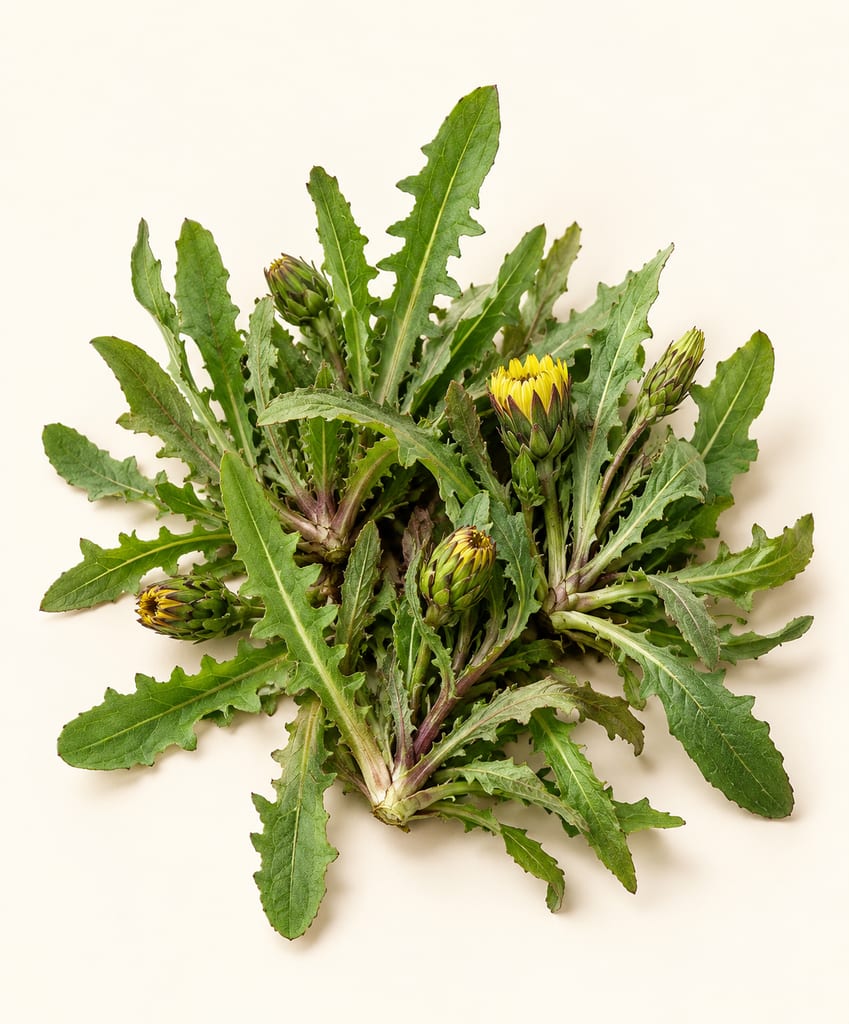
Accepted name and regional labels
Kew accepts Hypochaeris meyeniana (Walp.) Benth. & Hook.f. ex Griseb., a perennial native from Peru to northwest Argentina, including Bolivia. The 2026 Aymara study uses this accepted name in a regional account based primarily on communities in La Paz Department around Lake Titicaca.
The article associates mut’isu with a flower bud and its Figure 10 caption labels the plant pilli/jallu sik’i. The linked workbook records name forms by locality, including Jallu sik’i at Caycoma, Mut’iqallu at Cuntu Marca and Q’awsillu at Juppi Grande. The names are local, source-specific reports; they are not interchangeable synonyms or a way to identify a plant elsewhere.
Reported plant parts and use-report counts
The article reports 220 food-use entries and names flower buds or tender flowers, involucral bracts and leaves as food parts. It defines an entry as a coded use-report structured by taxon, part, preparation or process and informant. The count is not 220 independent people or meals.
The workbook codes additional parts and use categories. Those coding fields record how interview data were organized; they are not a preparation sequence or a universal mapping of local names to plant identity.
Processing statements do not form a method
The article's results paragraph says H. meyeniana is subjected to ash processing for detoxification. Its Figure 10 caption describes washing the plant called pilli/jallu sik’i for raw consumption. The linked workbook uses separate Wash and Ashes codes: the reviewed Coded Data FOOD rows carry Wash flags and no Ashes flags, while a separate aggregate sheet has a different Wash total and also no Ashes flags.
These statements and data do not resolve into one preparation account. The caption is not a tested procedure, and the article's wording does not establish an endpoint. This page does not recommend raw use, ash processing or a detoxification method.
Cultivation evidence and limits
Kew describes the species as growing primarily in a montane tropical biome. That is a broad range descriptor, not a growing instruction or temperature, soil, water or frost limit. The inspected Aymara article documents food knowledge but does not provide a species-specific productive cultivation method.
The sources reviewed here do not establish propagation, planting season, harvest or regrowth conditions, container growing, or heated or unheated greenhouse production for this species.
Counts and evidence still needed
The article and the workbook's coded-food sheet each report 220 entries for this taxon. A separate workbook aggregate reports 222. For processing, the article prose mentions ash use, its caption describes washing for raw consumption, the coded-food sheet has 14 Wash flags and no Ashes flags, and the aggregate sheet reports 12 Wash and no Ashes flags. The sources do not explain these differences.
The article says specimens were deposited at LPB, and the workbook lists code SCY-60 at Chijchi-Pacajes in 2004. This review did not match that code to an individual public herbarium record. No complete preparation batch, storage information, food-site quality assessment or safety endpoint is established in the inspected material.
Research gaps
The ash-processing prose, wash/raw-use caption and workbook codes remain unreconciled; no preparation or detoxification advice is provided.
The article and separate workbook aggregate disagree on 220 versus 222 entries, and raw versus aggregate Wash totals also differ.
No individual LPB record or post-collection determination was verified for workbook code SCY-60.
No species-specific productive cultivation, propagation, season, harvest, container or greenhouse method was established.
No complete preparation, storage or food-safety endpoint is available from this source set.
Research status
The underlying plant account received a partial source review. Its review scope is described in the original plant article.
Sources for this section
Places
Unknown
Relationship not established · Place not establishedThe available research does not establish a single origin for this ingredient.
Community
No community contributions have been published for this entry yet.
Share what you made
Sign in to contribute. Published comments and photos are free to read.
Sources
Royal Botanic Gardens, Kew, Plants of the World OnlineIngredient research
Hypochaeris meyeniana (Walp.) Benth. & Hook.f. ex Griseb.Cited in: Accepted name and regional labels; Cultivation evidence and limits; Research gaps
Cocarico, Rivera, Beck, Rivera-Obón and Obón, Frontiers in Nutrition 13 (2026)Ingredient research
From tradition to nutrition: wild and cultivated Aymara food plants as sustainable resources in the Andean neotropics of BoliviaCited in: Accepted name and regional labels; Reported plant parts and use-report counts; Processing statements do not form a method; Cultivation evidence and limits; Counts and evidence still needed; Research gaps
Diego Rivera-Obón, Aymara-Food public repository, file revision 6a45c323e0856b658da54f06f3519404970b68d8Ingredient research
Aymara-Food interview data workbook, AymaraFoodGit_16_4_26.xlsxCited in: Accepted name and regional labels; Reported plant parts and use-report counts; Processing statements do not form a method; Counts and evidence still needed; Research gaps
FermenteaResearch provenance
Hypochaeris meyeniana in Aymara food records: original plant researchCited in: Research status