
Substrates
Water spinach greens
Bangladesh sources document Kolmi or Kalmi leaves and tender shoots as vegetables, alongside soil-pot, waterlogged-sack, pond-tray and protected hydroponic experiments. A contemporary abstract reports BARI’s historical Gimakalmi release, but cultivar continuity is unresolved; food notes and cultivation results remain source- and study-specific.
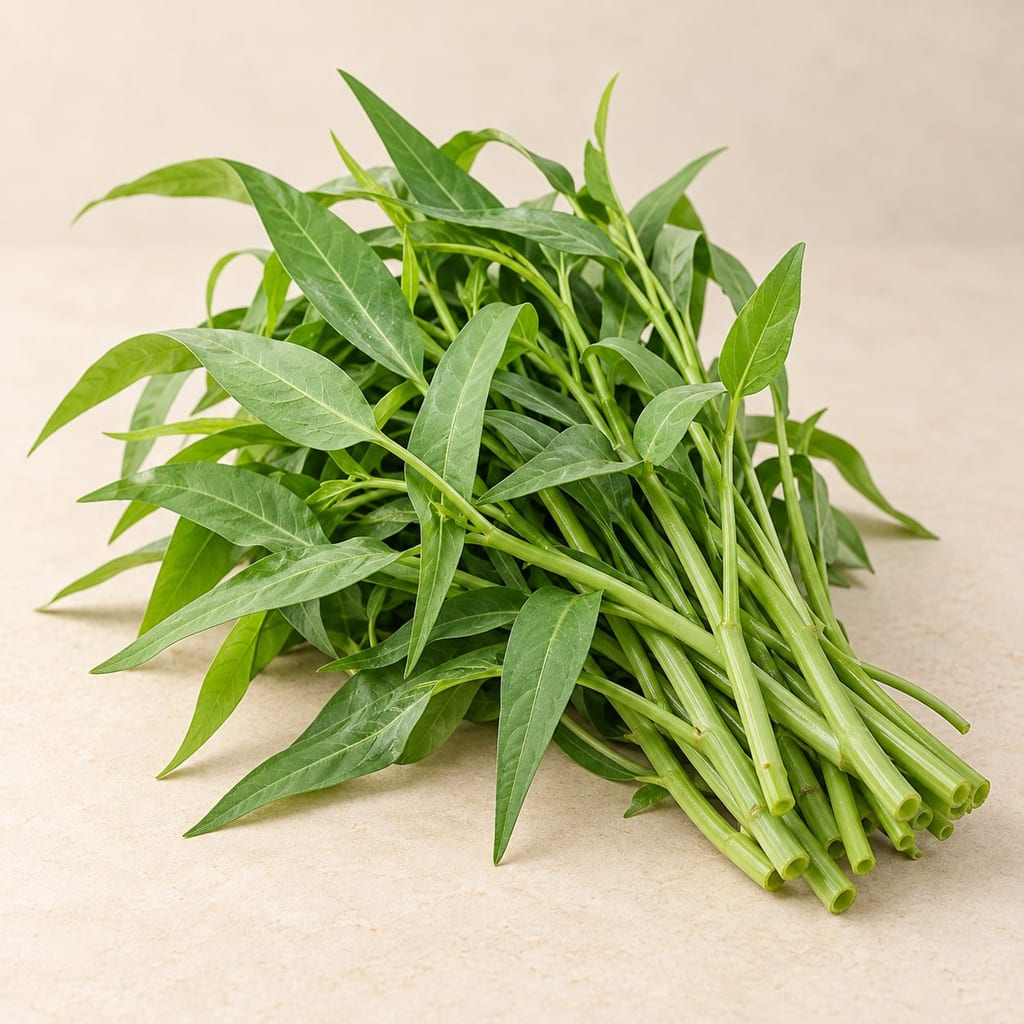
Name and regional food contexts
Kew accepts Ipomoea aquatica Forssk. and describes it as a climbing helophyte. Bangladesh sources associate it with Kolmi or Kalmi shak; the Rangamati study reports Hormuj shak for the Chakma community it surveyed. These are source-linked names, not a way to identify every market or wild plant.
Azam and colleagues’ 2010–2012 study of four villages in Lalmonirhat and Nilphamari records Kolmi leaves cut small and cooked with salt and water. A separate Rangamati article records tender Hormuj shoots cooked as vegetables in the named Chakma community sites. The Feni aquatic-flora survey lists Ipomoea aquatica as a common vegetable and an emergent surface creeper. These brief reports come from different places and do not give a complete recipe.
Sources for this section
- Ipomoea aquatica Forssk. →
- Are Famine Food Plants Also Ethnomedicinal Plants? An Ethnomedicinal Appraisal of Famine Food Plants of Two Districts of Bangladesh →
- Wild edible vegetables used by the Chakma community of Rangamati Hill District Bangladesh →
- Preliminary taxonomic survey of aquatic plants of Feni district, Bangladesh →
Soil-pot experiment
A 2019 Dhaka University experiment grew Kalmi in plastic pots containing 3 kg of a 1:1 acid-soil/calcareous-soil mixture. The authors selected the mix after incubation trials that maintained 70% moisture. About ten seeds collected from BADC were sown per pot in June 2016, then thinned to four plants after three to four days; plants were harvested at 42 days. In the three-replicate experiment, treatment T3 (12 t/ha vermicompost) produced 64 cm mean plant height, 35.09 t/ha fresh weight and 5.13 t/ha yield, compared with control values of 50 cm, 21.83 t/ha and 2.98 t/ha.
The reported post-harvest soil pH was 7.42 for T3 and 7.69 for the control. Those figures describe this experiment’s soil treatments; they are not an Ipomoea pH target or home fertilizer recommendation. The paper does not specify pot dimensions, light, crop temperature, post-sowing irrigation schedule, repeated-cut regrowth or greenhouse conditions.
Waterlogged sacks and pond trays
A 2024 southwest Bangladesh study transplanted 30-day seedlings or cuttings into supported mesh sacks placed in submerged or waterlogged conditions. Methods report five replications at Khulna University and Shyamnagar, Satkhira, from September 2020 to June 2021; the abstract instead names Shyamnagar alone and gives September 2020 to May 2021. T1 is defined in the factors list as 75% organic matter and 25% soil. For Kalmi, results prose gives 6.70 kg per sack under T1, while Table 1 gives 6.50 kg. Discussion text also mislabels the T1 ratio. The paper says fungicides and systemic insecticides were sprayed when needed. These figures describe a particular trial, not a home mixture or pesticide recommendation; no food-residue endpoint is reported.
In a 2015 Bangladesh Agricultural University study at Panchpy, Gafargaon, researchers used one stinging-catfish pond and one carp pond. Each pond had three floating plastic trays of 0.12 m²; four plastic bottles floated each tray, pond sediment lined each tray, and six Kolmi cuttings were planted per tray. Growth was measured about one month later. This design had one pond for each fish system, so the trays did not provide independent pond-level replication.
Table 2 reports water temperature of 28°C in both ponds; pH of 7.43 in the catfish pond and 7.73 in the carp pond; dissolved oxygen of 4 and 6 mg/L; nitrite of 0 in both; and ammonia of 0.05 and 0.02 mg/L. The paper’s methods say water measurements were taken before the experiment, while its results table describes means through the study period. These readings are not crop targets or safe-water criteria. The paper does not establish food safety for pond-grown vegetables.
Cultivar history and protected hydroponic reports
A 1993 HortScience proceedings abstract by BARI-affiliated authors reports that BARI released an erect kangkong line as Gimakalmi in 1983, then introduced AVRDC lines KG002 and KG003 for evaluation in 1991. The abstract reports leaf yields of 46.0 t/ha for KG002, 35.8 t/ha for Gimakalmi and 32.0 t/ha for KG003. It calls the crop Ipomoea reptans. The abstract does not give a release accession or full trial methods, and the name does not establish that this historical line is the same seed as later “BARI Gima Kalmi-1” or “BARI Gima Kolmi-1.”
BARI’s 2023–24 annual report describes a winter 2023–24 indoor LED hydroponic experiment at HRC/RARS Jamalpur using circulating nutrient solutions. It says the lab was protected but not controlled and lists 40 W and 20 W LED lights. For Kangkong identified as BARI Gima Kolmi-1, the report lists 15.3 edible leaves, 13.7 cm leaf length, 47.3 cm root length, 39 g whole-plant weight and 34 g edible-part weight. These are report-specific results, not home-growing targets. A separate Jashore passage lists kangkong among leafy crops demonstrated with NFT and DWC but gives no kangkong-specific result there.
What the records do not establish
The food sources do not supply quantities, yield, complete ordered cooking steps, timing, endpoint or storage. The growing studies do not establish a national sowing calendar, frost limit, greenhouse method, household container yield or safe water-quality standard. The 2024 sack paper’s site/date, yield and ratio differences remain unresolved; its reported pesticide applications should not be turned into advice. A 1993 BARI-affiliated abstract reports a 1983 line called Gimakalmi, while BARI’s 2023–24 report names BARI Gima Kolmi-1; the sources reviewed do not establish genetic continuity between those names or seed lots. A teacher-authored rooftop post also uses the label Gima Kalmi-1.
Sources for this section
- Are Famine Food Plants Also Ethnomedicinal Plants? An Ethnomedicinal Appraisal of Famine Food Plants of Two Districts of Bangladesh →
- Wild edible vegetables used by the Chakma community of Rangamati Hill District Bangladesh →
- Organic Matter and Indigenous Vegetables in Sack under Waterlogged in Southwest Bangladesh →
- An understanding on the feasibility of aquaponics in intensive aquaculture pond →
- কলমি শাক: roof garden and field-growing post →
- Kangkong — A Promising Summer Leafy Vegetable of Bangladesh →
- Bangladesh Agricultural Research Institute Annual Report 2023–24 →
Research gaps
No complete Bangladesh household recipe with amounts, ordered steps, yield, timing, endpoint and storage was found in the reviewed sources.
The 2019 pot results are one three-replicate experiment; they do not establish general container yields, a pH optimum, or a home fertilizer schedule.
The 2024 sack paper differs between abstract and methods on site and dates; Kalmi T1 yield differs between results prose and Table 1, and discussion text mislabels the ratio. Author clarification is unavailable.
The sack trial reports fungicide and systemic insecticide applications but no food residue or food-safety endpoint; no safe water or pond-grown produce criterion was established.
The BAU pond trial has one pond per fish-system treatment and a methods/table difference about when water parameters were measured; its results should not be treated as independent pond replication or consumer safety evidence.
No general frost/heat limits, household greenhouse protocol, growing-water schedule, post-harvest storage duration or local collection-permission determination was established.
No original BARI release notice, accession or genetic comparison links the 1983 Gimakalmi line to the “BARI Gima Kalmi-1” teacher-post label or “BARI Gima Kolmi-1” material in the 2023–24 report.
The BARI hydroponic annual-report passage gives selected outcomes but not a complete reproducible method; its protected, non-controlled lab is not a greenhouse or home-production protocol.
Sources for this section
- Ipomoea aquatica Forssk. →
- Are Famine Food Plants Also Ethnomedicinal Plants? An Ethnomedicinal Appraisal of Famine Food Plants of Two Districts of Bangladesh →
- Wild edible vegetables used by the Chakma community of Rangamati Hill District Bangladesh →
- Preliminary taxonomic survey of aquatic plants of Feni district, Bangladesh →
- Effects of vermicompost and compost on soil properties and growth and yield of Kalmi (Ipomoea aquatica Forsk.) in mixed soil →
- Organic Matter and Indigenous Vegetables in Sack under Waterlogged in Southwest Bangladesh →
- An understanding on the feasibility of aquaponics in intensive aquaculture pond →
- কলমি শাক: roof garden and field-growing post →
- Kangkong — A Promising Summer Leafy Vegetable of Bangladesh →
- Bangladesh Agricultural Research Institute Annual Report 2023–24 →
Research status
The underlying plant account received a partial source review. Its review scope is described in the original plant article.
Sources for this section
Places
Unknown
Relationship not established · Place not establishedThe available research does not establish a single origin for this ingredient.
Community
No community contributions have been published for this entry yet.
Share what you made
Sign in to contribute. Published comments and photos are free to read.
Sources
Royal Botanic Gardens, Kew, Plants of the World OnlineIngredient research
Ipomoea aquatica Forssk.Cited in: Name and regional food contexts; Research gaps
Fardous Mohammad Safiul Azam, Anup Biswas, Abdul Mannan, Nusrat Anik Afsana, Rownak Jahan and Mohammed Rahmatullah; Evidence-Based Complementary and Alternative Medicine (2014)Ingredient research
Are Famine Food Plants Also Ethnomedicinal Plants? An Ethnomedicinal Appraisal of Famine Food Plants of Two Districts of BangladeshCited in: Name and regional food contexts; What the records do not establish; Research gaps
Asim Kumar Paul, Syedul Alam, Md. Mujibor Rahman and AHM Jahangir Alam; Eco-friendly Agril. J. 9(04):22–26 (April 2016); author-uploaded full textIngredient research
Wild edible vegetables used by the Chakma community of Rangamati Hill District BangladeshCited in: Name and regional food contexts; What the records do not establish; Research gaps
Mohammad Zashim Uddin and Joton Chandra Pal; Bangladesh Journal of Plant Taxonomy 27(1):103–111 (June 2020)Ingredient research
Preliminary taxonomic survey of aquatic plants of Feni district, BangladeshCited in: Name and regional food contexts; Research gaps
Afroja Nasrin, Sayma Khanom and Shahid Akhtar Hossain; Dhaka University Journal of Biological Sciences 28(1):121–129 (January 2019); author-uploaded full textIngredient research
Effects of vermicompost and compost on soil properties and growth and yield of Kalmi (Ipomoea aquatica Forsk.) in mixed soilCited in: Soil-pot experiment; Research gaps
Shamima Nasrin et al.; Asian Journal of Soil Science and Plant Nutrition 10(3):153–161 (2024); author-uploaded full textIngredient research
Organic Matter and Indigenous Vegetables in Sack under Waterlogged in Southwest BangladeshCited in: Waterlogged sacks and pond trays; What the records do not establish; Research gaps
Partha Sarathi Das, M. Mahfujul Haque, M. Mehedi Alam, Shamima Akter and M. Ruhul Amin; Research in Agriculture, Livestock and Fisheries 2(1):143–150 (April 2015); Bangladesh Agricultural University authorsIngredient research
An understanding on the feasibility of aquaponics in intensive aquaculture pondCited in: Waterlogged sacks and pond trays; What the records do not establish; Research gaps
Fatema Khatun; Teachers Portal Bangladesh (2024)Ingredient research
কলমি শাক: roof garden and field-growing postCited in: What the records do not establish; Research gaps
Asit K. Sarkar, M. L. Chadha and A. K. M. Amzad Hossain; HortScience 28(5):522f–522 (May 1993), American Society for Horticultural Science; proceedings abstractIngredient research
Kangkong — A Promising Summer Leafy Vegetable of BangladeshCited in: Cultivar history and protected hydroponic reports; What the records do not establish; Research gaps
Bangladesh Agricultural Research Institute (BARI)Ingredient research
Bangladesh Agricultural Research Institute Annual Report 2023–24Cited in: Cultivar history and protected hydroponic reports; What the records do not establish; Research gaps
FermenteaResearch provenance
Kolmi shak (Ipomoea aquatica): original plant researchCited in: Research status