
Substrates
Genjer greens
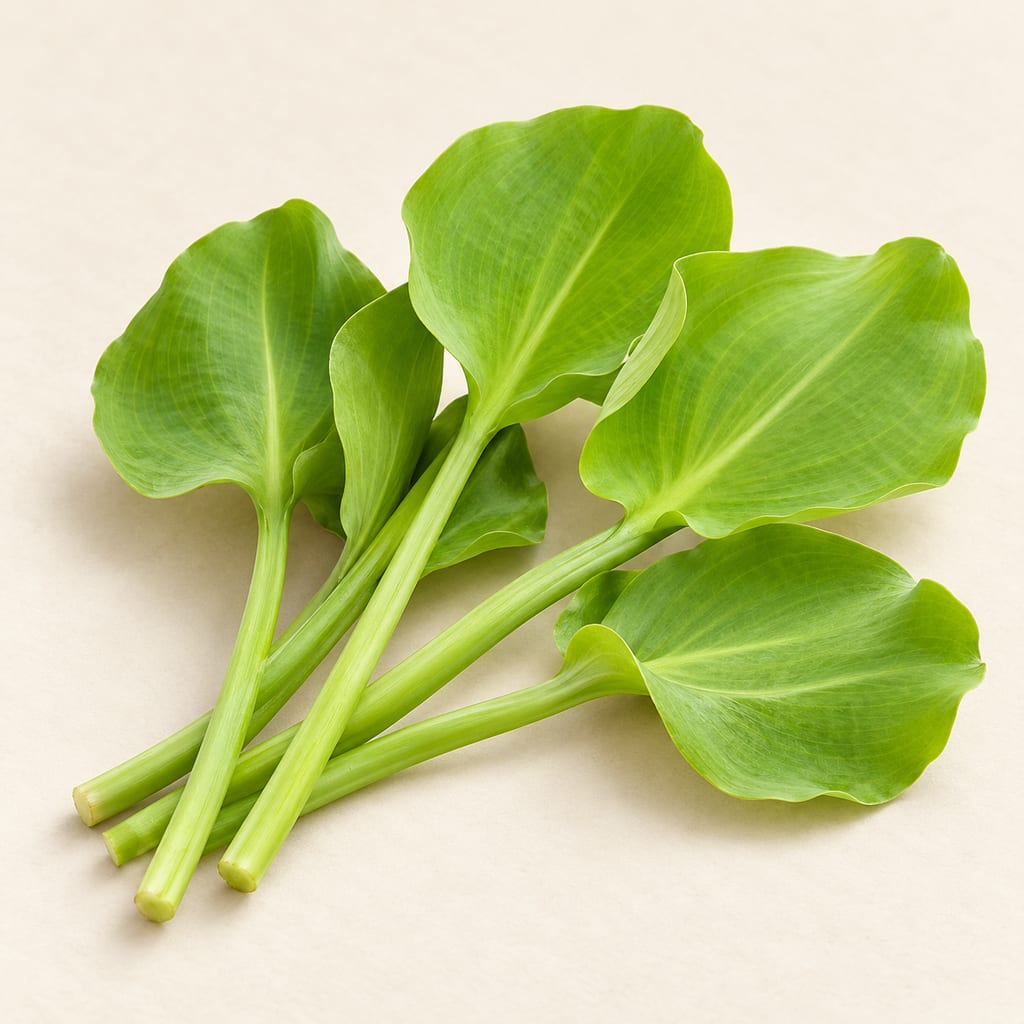
Genjer is an aquatic leafy vegetable used in parts of Java; food and growing reports describe differing plant parts and cultivation settings.
Names and range
Kew accepts Limnocharis flava (L.) Buchenau and places it in Alismataceae. The older PROSEA vegetable entry uses Butomaceae and lists Alisma flava, Limnocharis emarginata and L. plumieri as synonyms. PROSEA records genjer, bangeng and eceng as Indonesian names; an IPB profile labels genjer as Javanese and gendot as Sundanese. A shared common name such as eceng does not identify an aquatic plant. Kew and PROSEA place the species’ native range in tropical and subtropical America and list Java and Sumatra among introduced or naturalized areas. The West Java paper’s category “indigenous vegetables” describes its local crop grouping, not biological nativity.
Food parts and reported preparation
The 2015 West Java study reports genjer leaves eaten raw or gently boiled; it also describes slightly boiled vegetables served as gado-gado and leaves eaten with sambal. PROSEA describes young leaves with petioles and young, unopened inflorescences as vegetable parts, usually heated briefly rather than eaten raw. A 2013 LIPI article names young leaves and petioles, flower stalks and unopened flowers, and describes stir-frying them with tauco or small pieces of chicken or beef. The reports differ in detail and do not supply a complete, species-verified household recipe with amounts, sequence, yield or storage.
West Java cultivation accounts
The 2015 field study covers selected sites in Bogor, Cianjur and Tasikmalaya, not all of Indonesia. It describes genjer in lowland swamps, paddies, riverbanks and fish ponds, with a water-level observation below 20 cm and a statement about failure in ponds deeper than 30–40 cm. These are source-local field descriptions, not target water depths or food-quality criteria. In one farmer account, medium suckers about 12–15 cm tall were transplanted and the first harvest was possible five weeks later at a described 2–3-leaf stage with an inflorescence. The paper reports harvest frequencies and collected amounts that varied by site and soil fertility; it does not establish a household schedule.
Sources for this section
Handbook production and experimental boxes
PROSEA describes year-round cultivation in fertile sawah, seed or layer propagation, organic fertilizer at 10 t/ha one to two weeks before planting, about 30 cm square spacing, and harvest of leaves and inflorescences after two to three months in that setting. These are handbook-reported field practices, not container or greenhouse recommendations. Separately, Juhaeti’s replicated fertilizer experiment used six-leaf seedlings from a Bekasi seed accession in 42 × 35 × 15 cm plastic boxes. Its medium was a 2:1:1 mixture of soil, compost and manure; water was kept 2.5 cm above the medium. The study harvested five weeks after fertilizer treatment. Those values describe one experiment and should not be transferred as home growing controls.
Water quality, handling and open questions
Juhaeti cites earlier studies reporting that genjer can accumulate heavy metals and other pollutants and calls for controlled cultivation. The article does not establish a contaminant threshold or a test that identifies an acceptable collection site. Natural occurrence in a pond or paddy is not evidence that its plants or water are suitable for food. Santosa and colleagues report that genjer is more susceptible to physical-impact damage than other vegetables in their handling account, but give no household storage duration. The reviewed sources do not establish frost or heat limits, numeric pH, a home container method, heated or unheated greenhouse performance, collection rules, or a complete food-safety assessment.
Research gaps
The food reports are concentrated in Java; use and growing practice in other Indonesian regions remain under-reviewed.
No complete household recipe with species confirmation, quantities, ordered steps, yield and storage was established.
No water-quality or contaminant threshold for harvested genjer was found; no safe wild-collection rule is stated.
No frost, heat/humidity or pH range, household container trial, or heated/unheated greenhouse protocol was found.
No voucher or market specimen was examined, and no local legal or invasive-species classification was verified.
Sources for this section
- Limnocharis flava (L.) Buchenau | Plants of the World Online →
- Limnocharis flava (L.) Buchenau →
- Agronomy, Utilization and Economics of Indigenous Vegetables in West Java, Indonesia →
- Respon Genjer (Limnocharis flava (L.) Buchenau) terhadap Pemupukan dan Potensi Gizinya untuk Diversifikasi Konsumsi Sayuran →
- Genjer (Limnocharis flava) →
Research status
The underlying plant account received a partial source review. Its review scope is described in the original plant article.
Sources for this section
Places
Unknown
Relationship not established · Place not establishedThe available research does not establish a single origin for this ingredient.
Community
No community contributions have been published for this entry yet.
Share what you made
Sign in to contribute. Published comments and photos are free to read.
Sources
Royal Botanic Gardens, KewIngredient research
Limnocharis flava (L.) Buchenau | Plants of the World OnlineCited in: Names and range; Research gaps
M.H. van den Bergh; PROSEA Handbook 8: Vegetables; PROSEA FoundationIngredient research
Limnocharis flava (L.) BuchenauCited in: Names and range; Food parts and reported preparation; Handbook production and experimental boxes; Research gaps
Edi Santosa, Utami Prawati, Sobir, Yoko Mine and Nobuo Sugiyama; Jurnal Hortikultura Indonesia 6(3):125–134 (2015)Ingredient research
Agronomy, Utilization and Economics of Indigenous Vegetables in West Java, IndonesiaCited in: Names and range; Food parts and reported preparation; West Java cultivation accounts; Water quality, handling and open questions; Research gaps
Titi Juhaeti; Berita Biologi 12(1):107–117 (2013); Pusat Penelitian Biologi-LIPIIngredient research
Respon Genjer (Limnocharis flava (L.) Buchenau) terhadap Pemupukan dan Potensi Gizinya untuk Diversifikasi Konsumsi SayuranCited in: Food parts and reported preparation; Handbook production and experimental boxes; Water quality, handling and open questions; Research gaps
Pusat Kajian Hortikultura Tropika, Institut Pertanian BogorIngredient research
Genjer (Limnocharis flava)Cited in: Names and range; Research gaps