
Spices and aromatics
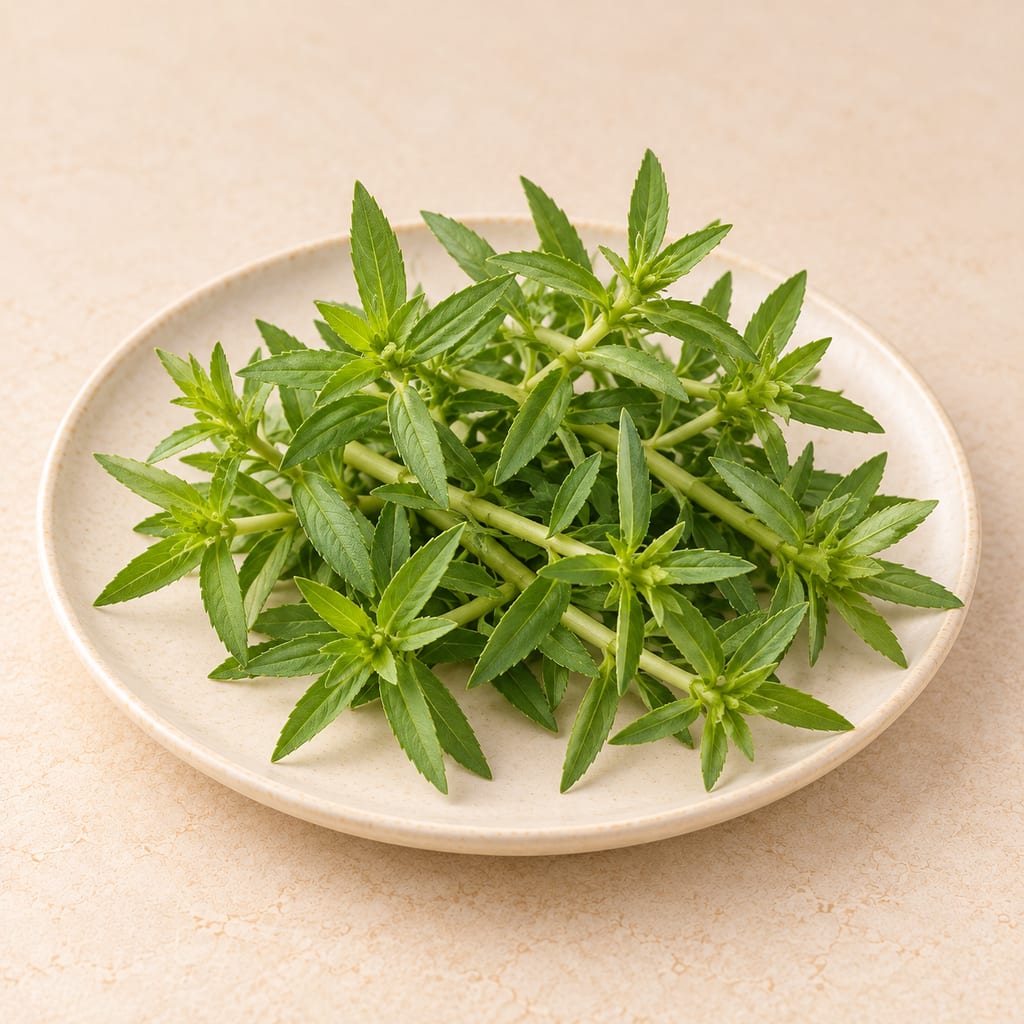
Rice paddy herb leaves
Kew accepts Limnophila aromatica and includes Cambodia in its range. A northwestern Cambodian market study records leaves; regional sources describe condiment use and aquatic habitat, while one Siem Reap press account gives conflicting season statements.
Name and taxonomic scope
Kew accepts Limnophila aromatica (Lam.) Merr. in Plantaginaceae and includes Cambodia in its broad native range. Kew lists Limnophila chinensis subsp. aromatica as a synonym. PROSEA notes that some authors instead treat L. aromatica as a subspecies of L. chinensis, so a name in a source does not by itself resolve which taxonomic concept it uses.
The Cambodian records do not provide a voucher linking their local names to one another. The market study labels its L. aromatica row “Finger grass”; a different row names L. chinensis as “Ma-om.” A Siem Reap article calls its reported crop L. aromatica and “Ma’am.” These labels are retained in their source contexts rather than treated as a single verified name mapping.
Sources for this section
A northwestern Cambodian market record
Seav and co-authors report interviews with 275 retailers in 14 markets across Battambang and Siem Reap, conducted from 24 to 31 July 2020. In their market table, the L. aromatica entry is “Finger grass” and the listed food part is leaves. The survey documents market availability and reported use; it does not name a household, collection site, farm, or voucher for that row.
Reported food uses
PROSEA describes L. aromatica among Limnophila species eaten as a condiment or side dish in Indo-China, Thailand and Indonesia, raw, steamed or cooked. That broad regional account does not identify a particular Cambodian dish or give a measured household preparation. The Cambodian market table identifies leaves but supplies no ingredients, amounts, cooking sequence, yield or storage details.
Habitat and reported cultivation
PROSEA describes L. aromatica in shallow ponds or marshy places. Its genus record says Limnophila species are aquatic or semi-aquatic and normally propagate by seed or rooted stems; these are genus-level observations, not a Cambodian home-growing protocol. The same genus record says L. aromatica needs a permanent water supply and has tender stems that are easily damaged. It gives no water depth, soil or pH, temperature range, container dimensions, protected-crop conditions or yield.
A March 2026 Agence Kampuchea Presse report describes one grower in Veal village, Sangkat Chreav, Siem Reap. The article first calls her plot a year-round production hub, then says she limits cultivation to the dry season because rainy-season flooding interrupts production. The conflict is unresolved, and the article gives no plot measurements or tested remedy.
Evidence limits
PROSEA also mentions drying in Vietnam, but that is not a Cambodian preparation or storage method. No complete source-batched Cambodian recipe, storage endpoint, local crop trial, or reconciled planting and harvest calendar was verified. The press report includes a grower’s description of produce as “safe, chemical-free”; this is an attributed statement, not a food-safety assessment.
Research gaps
The market study's L. aromatica leaf entry and its separate L. chinensis cutting entry have no voucher-backed local-name crosswalk.
The publisher-hosted Seav et al. PDF timed out; the inspected copy was an author-uploaded manuscript.
The Siem Reap article gives conflicting year-round and dry-season-only statements; no independent crop calendar or farm measurements were found.
No Cambodian household recipe, processing sequence, storage endpoint, measured yield, soil or pH requirement, temperature range, container protocol or greenhouse method was verified.
Common names and this account do not identify a gathered specimen or establish its safety.
Sources for this section
- Limnophila aromatica (Lam.) Merr. | Plants of the World Online →
- Wild World of Wild Food Plants in Cambodia: The Utilization, Challenges, and Opportunities to Scaling up the Use of Wild Food Plants →
- Limnophila aromatica (Lamk) Merr. →
- Limnophila R.Br. →
- Culinary Herb Cultivation Bolsters Rural Incomes in Siem Reap →
Research status
The underlying plant account received a partial source review. Its review scope is described in the original plant article.
Sources for this section
Places
Unknown
Relationship not established · Place not establishedThe available research does not establish a single origin for this ingredient.
Community
No community contributions have been published for this entry yet.
Share what you made
Sign in to contribute. Published comments and photos are free to read.
Sources
Royal Botanic Gardens, KewIngredient research
Limnophila aromatica (Lam.) Merr. | Plants of the World OnlineCited in: Name and taxonomic scope; Research gaps
Agritropica: Journal of Agricultural Sciences, Universitas BengkuluIngredient research
Wild World of Wild Food Plants in Cambodia: The Utilization, Challenges, and Opportunities to Scaling up the Use of Wild Food PlantsCited in: Name and taxonomic scope; A northwestern Cambodian market record; Reported food uses; Research gaps
PROSEA FoundationIngredient research
Limnophila aromatica (Lamk) Merr.Cited in: Name and taxonomic scope; Reported food uses; Habitat and reported cultivation; Evidence limits; Research gaps
PROSEA FoundationIngredient research
Limnophila R.Br.Cited in: Habitat and reported cultivation; Research gaps
Agence Kampuchea PresseIngredient research
Culinary Herb Cultivation Bolsters Rural Incomes in Siem ReapCited in: Name and taxonomic scope; Habitat and reported cultivation; Evidence limits; Research gaps
FermenteaResearch provenance
Rice paddy herb in Cambodian market and growing accounts: original plant researchCited in: Research status