
Spices and aromatics
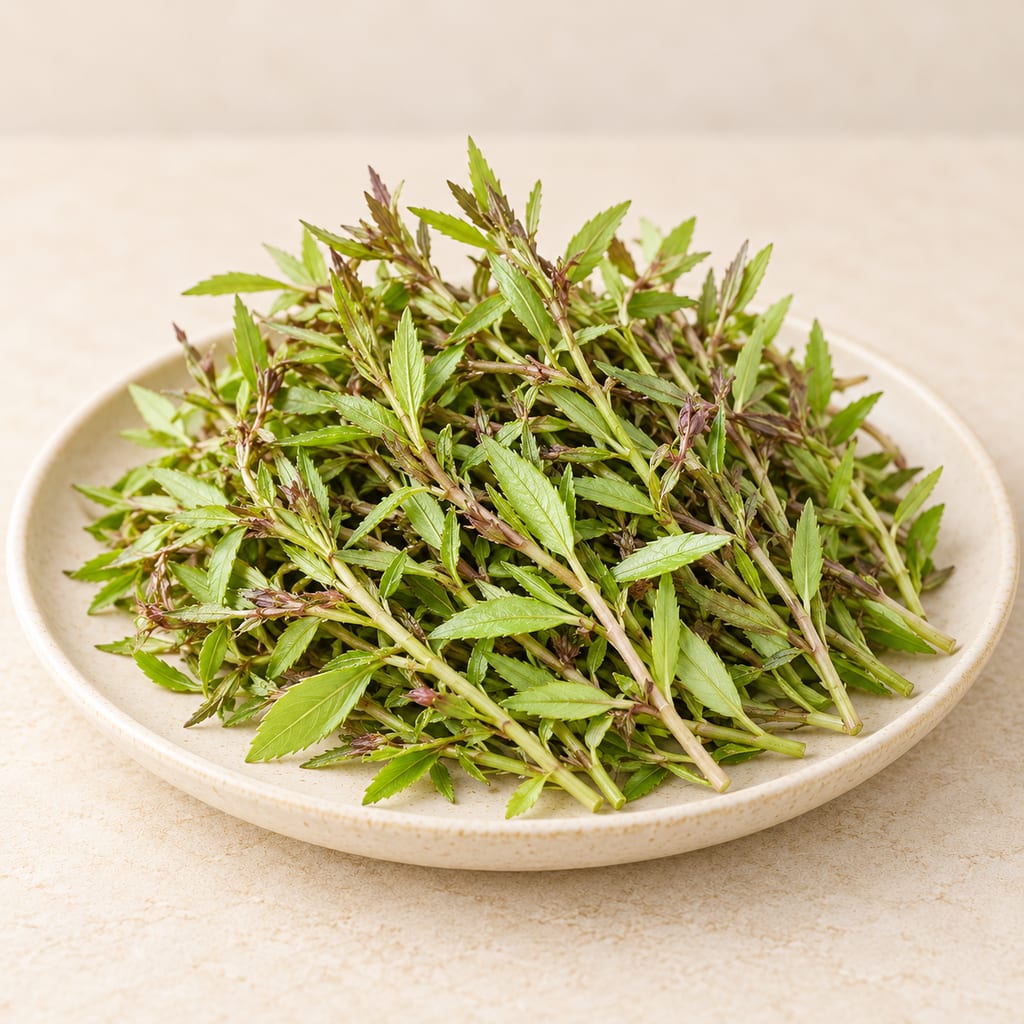
Geoffray’s marshweed shoots
Lao field and ethnobotanical accounts describe young shoots used to flavor bamboo-shoot soup, alongside paddy-field and limited garden-growing records.
Name and identity
Kew accepts Limnophila geoffrayi Bonati in Plantaginaceae and lists Cambodia, Laos, Thailand and Vietnam in its range. The Pha Tad Ke page prints “L. geoffrayi Bon.” and uses an older Scrophulariaceae classification. The Lao checklist lists L. geoffrayi separately from L. chinensis. Pha Tad Ke warns that similar “false bug grass” names can refer to more than one plant, so a shared local label alone does not confirm identity.
The Luang Prabang market paper lists L. chinensis as a different species; that entry is not used as food evidence for L. geoffrayi. L. aromatica is also a distinct species.
Lao food accounts
A 2006 Savannakhet village-use table lists L. geoffrayi, Phak ka nyeng, as a paddy-field food plant. The article describes it as a fragrant herb for keng noomai, bamboo-shoot soup, in rainy-season paddy context and reports drying plants for the dry season. A companion Economic Botany paper from the same authors, villages and 2002–04 field period describes the same soup and drying use. These papers are complementary accounts from shared field settings, not independent population samples.
Pha Tad Ke attributes a similar young-shoot soup and dry-season drying account to stories from Lao friends, but does not name their community, dates or locality. A 2025 discussion also mentions the species as a soup herb, without linking that mention to a locality, informant or voucher table row.
Sources for this section
- Limnophila geoffrayi →
- Land-use patterns and plant use in Lao villages, Savannakhet Province, Laos →
- Plant Diversity in Paddy Fields in Relation to Agricultural Practices in Savannakhet Province, Laos →
- Traditional Use of Wild Edible Plants of Wetland by Local People in the Lao People’s Democratic Republic →
Growing records and field context
The two 2006 Savannakhet papers place the plant in paddy fields. Their site description covers Nakhou and Bak villages at 140 m and 160 m elevation and reports an average annual temperature of 26.5°C and 1,473 mm annual rainfall, including 1,299.2 mm in May–October and 173.8 mm in November–April. These are study-location descriptors, not measured temperature or water tolerances for L. geoffrayi.
A 2024 Economic Botany abstract reports surveys of vendors and growers in Vientiane and Houaphan, and names L. geoffrayi among paddy-field vegetables grown for market. The separate supplementary table records a Vientiane row as “Wild & Planted” and “Home & Sale,” with voucher-number entry Y. Kosaka 120 FOF. It does not state this row’s method, garden location, plant part or yield. The abstract reports that L. geoffrayi had been grown since the 2000s; it does not specify a transplant history. The supplement’s transplantation footnote belongs to L. chinensis.
Sources for this section
- Land-use patterns and plant use in Lao villages, Savannakhet Province, Laos →
- Plant Diversity in Paddy Fields in Relation to Agricultural Practices in Savannakhet Province, Laos →
- Drivers for Switching from Gathering Wild Paddy Field Plants to Growing them in Gardens as Vegetables in the Lao People’s Democratic Republic →
- Supplementary Data Table S1 to Drivers for Switching from Gathering Wild Paddy Field Plants to Growing them in Gardens as Vegetables in the Lao People’s Democratic Republic →
Food reports and their limits
The sources identify young shoots as soup herbs and report drying for the dry season, but give no complete household batch, drying conditions, endpoint or storage duration. The accounts are descriptive food records, not an executable recipe or validated preservation method.
No inspected source gives a frost threshold, soil pH, propagation protocol, household container method, greenhouse system, crop yield or current harvest permission. The 2024 table classification does not fill those gaps.
Sources for this section
- Limnophila geoffrayi →
- Land-use patterns and plant use in Lao villages, Savannakhet Province, Laos →
- Plant Diversity in Paddy Fields in Relation to Agricultural Practices in Savannakhet Province, Laos →
- Drivers for Switching from Gathering Wild Paddy Field Plants to Growing them in Gardens as Vegetables in the Lao People’s Democratic Republic →
- Supplementary Data Table S1 to Drivers for Switching from Gathering Wild Paddy Field Plants to Growing them in Gardens as Vegetables in the Lao People’s Democratic Republic →
- Traditional Use of Wild Edible Plants of Wetland by Local People in the Lao People’s Democratic Republic →
Research gaps
The 2024 main article body remains inaccessible in this review; its abstract and separate supplementary table do not explain the species-specific grower, method, date, plant part or performance.
Voucher code Y. Kosaka 120 FOF has not been linked to an examined herbarium specimen, and Pha Tad Ke’s food account has no voucher or named locality.
No complete household soup or drying batch with quantities, sequence, endpoint and storage was found.
No species-specific frost, heat, light, soil-pH, propagation, container or greenhouse data were established.
Similar local names and the older Scrophulariaceae placement require source-specific treatment; no field identity or harvest permission is approved.
Sources for this section
- Limnophila geoffrayi Bonati | Plants of the World Online →
- Limnophila geoffrayi →
- Land-use patterns and plant use in Lao villages, Savannakhet Province, Laos →
- Plant Diversity in Paddy Fields in Relation to Agricultural Practices in Savannakhet Province, Laos →
- A Checklist of the Vascular Plants of Lao PDR, version 1.0 →
- Wild food plants and fungi sold in the markets of Luang Prabang, Lao PDR →
- Drivers for Switching from Gathering Wild Paddy Field Plants to Growing them in Gardens as Vegetables in the Lao People’s Democratic Republic →
- Supplementary Data Table S1 to Drivers for Switching from Gathering Wild Paddy Field Plants to Growing them in Gardens as Vegetables in the Lao People’s Democratic Republic →
- Traditional Use of Wild Edible Plants of Wetland by Local People in the Lao People’s Democratic Republic →
Research status
The underlying plant account received a partial source review. Its review scope is described in the original plant article.
Sources for this section
Places
Unknown
Relationship not established · Place not establishedThe available research does not establish a single origin for this ingredient.
Community
No community contributions have been published for this entry yet.
Share what you made
Sign in to contribute. Published comments and photos are free to read.
Sources
Royal Botanic Gardens, KewIngredient research
Limnophila geoffrayi Bonati | Plants of the World OnlineCited in: Name and identity; Research gaps
Pha Tad Ke Botanical Garden, Ethnobotanic DatabaseIngredient research
Limnophila geoffrayiCited in: Name and identity; Lao food accounts; Food reports and their limits; Research gaps
Yasuyuki Kosaka, Shinya Takeda, Saysana Sithirajvongsa and Khamleck Xaydala, Tropics 15(1):51–63 (2006)Ingredient research
Land-use patterns and plant use in Lao villages, Savannakhet Province, LaosCited in: Lao food accounts; Growing records and field context; Food reports and their limits; Research gaps
Yasuyuki Kosaka, Shinya Takeda, Saysana Sithirajvongsa and Khamleck Xaydala, Economic Botany 60(1):49–61 (2006), DOI 10.1663/0013-0001(2006)60[49:PDIPFI]2.0.CO;2Ingredient research
Plant Diversity in Paddy Fields in Relation to Agricultural Practices in Savannakhet Province, LaosCited in: Lao food accounts; Growing records and field context; Food reports and their limits; Research gaps
V. Lamxay, S. Lanorsavanh, K. Chanthavong, K. Souvannakhoummane and S. Bounphanmy, National University of Laos (2021)Ingredient research
A Checklist of the Vascular Plants of Lao PDR, version 1.0Cited in: Name and identity; Research gaps
Łukasz Łuczaj et al., Journal of Ethnobiology and Ethnomedicine 17:6 (2021), DOI 10.1186/s13002-020-00423-yIngredient research
Wild food plants and fungi sold in the markets of Luang Prabang, Lao PDRCited in: Name and identity; Research gaps
Yasuyuki Kosaka, Khamsing Keothoumma, Khambay Khamphilavong, Atsaphone Kattiyalath and Kim Dua Nguyen, Economic Botany 78(4):341–353 (2024), DOI 10.1007/s12231-024-09620-2Ingredient research
Drivers for Switching from Gathering Wild Paddy Field Plants to Growing them in Gardens as Vegetables in the Lao People’s Democratic RepublicCited in: Growing records and field context; Food reports and their limits; Research gaps
Springer Nature, supplementary file to Kosaka et al. (2024)Ingredient research
Supplementary Data Table S1 to Drivers for Switching from Gathering Wild Paddy Field Plants to Growing them in Gardens as Vegetables in the Lao People’s Democratic RepublicCited in: Growing records and field context; Food reports and their limits; Research gaps
Khambay Khamphilavong et al., International Journal of Plant, Animal and Environmental Sciences 15 (2025):144–156, DOI 10.26502/ijpaes.4490185Ingredient research
Traditional Use of Wild Edible Plants of Wetland by Local People in the Lao People’s Democratic RepublicCited in: Lao food accounts; Food reports and their limits; Research gaps
FermenteaResearch provenance
Geoffray’s marshweed (Limnophila geoffrayi): original plant researchCited in: Research status