
Substrates
Common mallow greens
Common mallow is reported as a cooked wild green in two Moroccan studies, with one species-specific Khobbiza account and a separate mixed-greens preparation.
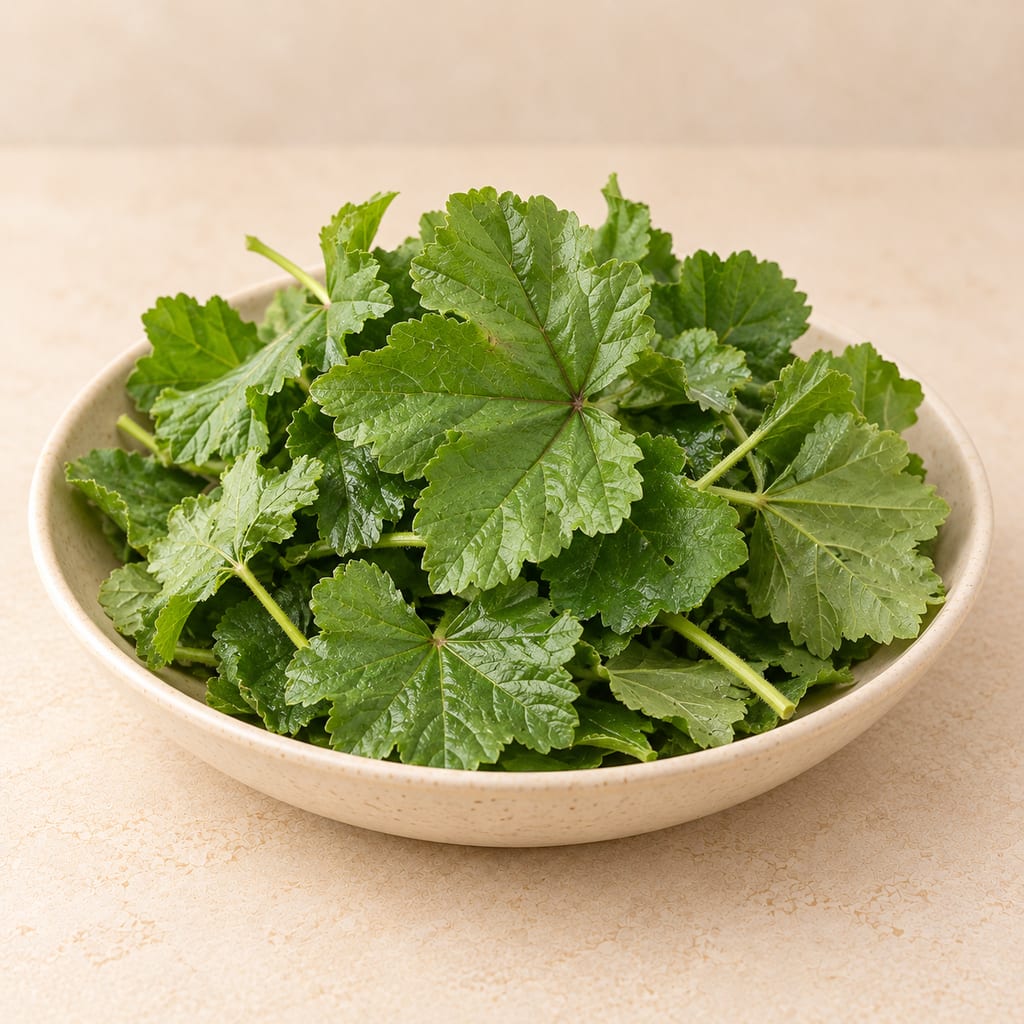
Name and regional records
Kew accepts Malva sylvestris L. and lists Morocco and Tunisia within its native range. The Messiwa study in Al-Haouz, Morocco, records the names Tibi, Khobbiza and Beqoula for this species. Those are names reported in that study, not universal names for one plant. In the Jbala study, Beqoula covered four identified taxa: Lavatera trimestris, Malva neglecta, M. sylvestris and M. parviflora. The authors grouped them as Malva sp. when calculating some use indices, so those figures do not measure M. sylvestris alone.
Moroccan food accounts
The Messiwa authors report that participants prepared Khobbiza from M. sylvestris cooked alone with spices. They associate that dish with the winter and spring period they call Lberd, and describe it as an alternative to a Khobbiza made with Portulaca oleracea in summer. The article records a regional account, not a measured recipe: it gives no amounts, yield, ordered cooking stages, endpoint or storage directions.
The Jbala article describes a different preparation, Beqoul: a variable bundle of young wild greens is chopped and steamed, then cooked with olive oil, garlic, parsley, lemon, salt and spices. Malva sp. is one of its common groups, but the source does not establish that every bundle contains M. sylvestris or that every listed ingredient is used with it. This mixed preparation is regional context, not a mallow-only recipe.
Growing information by setting
For UK gardens, the RHS profile lists full sun, moist-but-well-drained or well-drained soil, and seed propagation. It assigns RHS hardiness H5; the RHS scheme defines that band as hardy in most of the UK through severe winters, −15 to −10°C. This is a UK horticultural category, not a measured frost-survival limit for Moroccan plants. An Austrian seed-production practice abstract describes April sowing in a settled, fine-crumbled seedbed at 2–3 cm, with flowering generally from May to August. That field practice is specific to its Austrian project and is not a household leaf-production schedule.
What remains unresolved
The cited food studies do not provide a complete, measured household batch or storage guidance. They do not support a fermentation or preservation method. CAPM's April 2026 alert concerns confusion involving gathered plants presented as mallow and Mandragora officinarum; it is a warning about uncertain identification, not evidence that correctly identified M. sylvestris caused poisoning. The alert is not a field-identification guide.
The sources do not establish a Moroccan or Tunisian garden protocol, container size, heated or unheated greenhouse conditions, local irrigation schedule, or edible-leaf harvest and regrowth interval. The UK RHS profile and Austrian seed-crop abstract describe different settings and uses.
Sources for this section
- Ethnobotanical study on wild edible plants traditionally used by Messiwa people, Morocco →
- Ethnobotanical study of wild edible plants gathered and sold by Jbala society in the Tingitan Peninsula (Northwest Morocco) →
- Malva sylvestris | common mallow →
- Mallow propagation is challenging. Mallow (Malva sylvestris) is a very drought-resistant plant with low requirements concerning soil →
- La consommation de la mauve: entre cueillette de plantes sauvages, confusion botanique et risque d’intoxication →
Research gaps
No measured Khobbiza batch with ingredient amounts, sequence, cooking endpoint and storage was verified.
The Jbala Beqoul bundle varies and its Beqoula group contains four taxa; no mallow-only preparation is established there.
No species-specific Moroccan or Tunisian cultivation trial, household container protocol, heated or unheated greenhouse regime, or local frost/heat threshold was verified.
CAPM's alert poster was not reread in this public-text pass; its narrow misidentification summary is carried from the dossier's documented prior visual inspection. The poster is not an identification guide or a general toxicity finding for correctly identified M. sylvestris.
Sources for this section
- Malva sylvestris L. →
- Ethnobotanical study on wild edible plants traditionally used by Messiwa people, Morocco →
- Ethnobotanical study of wild edible plants gathered and sold by Jbala society in the Tingitan Peninsula (Northwest Morocco) →
- Malva sylvestris | common mallow →
- Mallow propagation is challenging. Mallow (Malva sylvestris) is a very drought-resistant plant with low requirements concerning soil →
- La consommation de la mauve: entre cueillette de plantes sauvages, confusion botanique et risque d’intoxication →
Research status
The underlying plant account received a partial source review. Its review scope is described in the original plant article.
Sources for this section
Places
Unknown
Relationship not established · Place not establishedThe available research does not establish a single origin for this ingredient.
Community
No community contributions have been published for this entry yet.
Share what you made
Sign in to contribute. Published comments and photos are free to read.
Sources
Royal Botanic Gardens, Kew, Plants of the World OnlineIngredient research
Malva sylvestris L.Cited in: Name and regional records; Research gaps
Ridwane Ghanimi et al., Journal of Ethnobiology and Ethnomedicine (2022)Ingredient research
Ethnobotanical study on wild edible plants traditionally used by Messiwa people, MoroccoCited in: Name and regional records; Moroccan food accounts; What remains unresolved; Research gaps
Hasnae Ben Sbih et al., Journal of Ethnobiology and Ethnomedicine (2026)Ingredient research
Ethnobotanical study of wild edible plants gathered and sold by Jbala society in the Tingitan Peninsula (Northwest Morocco)Cited in: Name and regional records; Moroccan food accounts; What remains unresolved; Research gaps
Royal Horticultural SocietyIngredient research
Malva sylvestris | common mallowCited in: Growing information by setting; What remains unresolved; Research gaps
EU CAP Network, EIP-AGRI practice abstract; Austrian organic cover crop seeds projectIngredient research
Mallow propagation is challenging. Mallow (Malva sylvestris) is a very drought-resistant plant with low requirements concerning soilCited in: Growing information by setting; What remains unresolved; Research gaps
Centre Anti-Poison et de Pharmacovigilance du Maroc (CAPM), Ministry of Health (April 2026)Ingredient research
La consommation de la mauve: entre cueillette de plantes sauvages, confusion botanique et risque d’intoxicationCited in: What remains unresolved; Research gaps
FermenteaResearch provenance
Common mallow (Malva sylvestris): original plant researchCited in: Research status