
Spices and aromatics
Water mint (Mentha aquatica)
A Gumare study reports a Kwena leaf beverage and seasonal availability; Botswana flora and a UK gardening profile provide different kinds of context, not a local crop protocol.
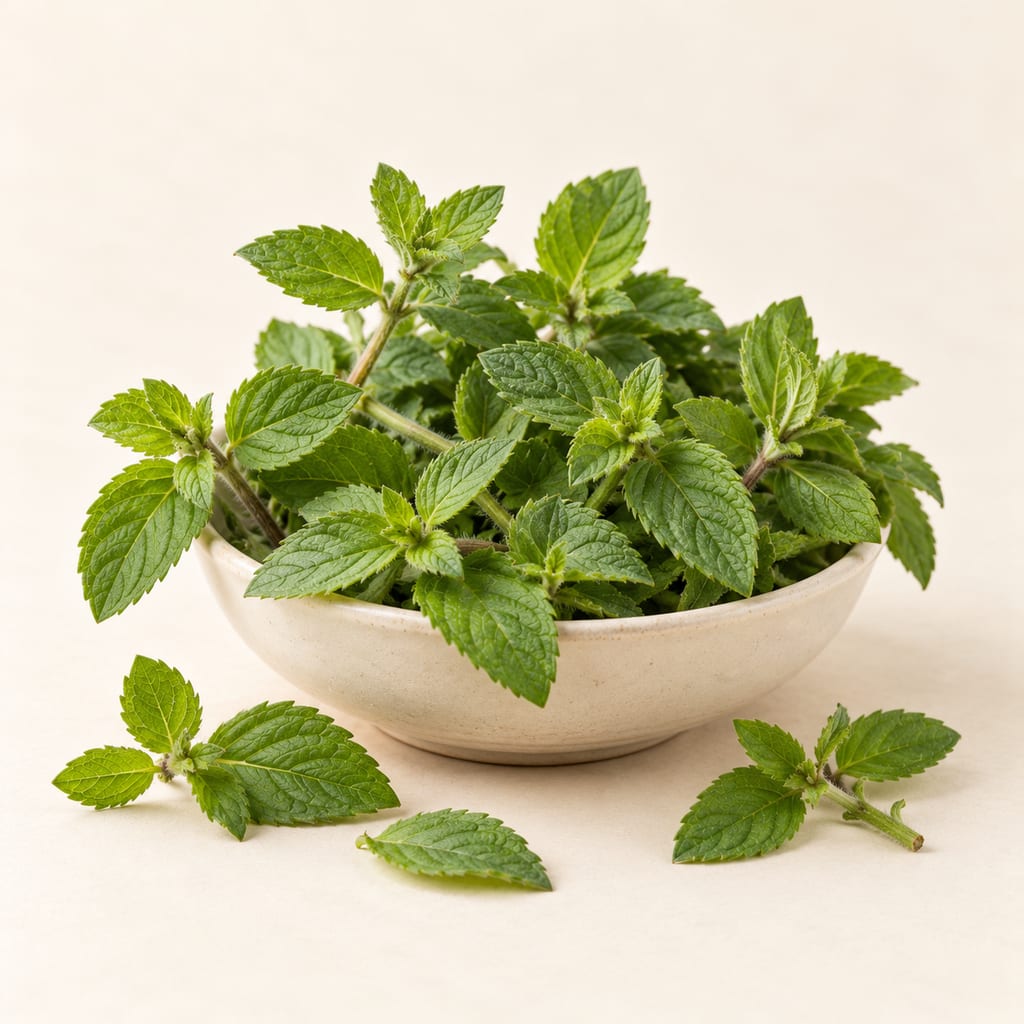
Accepted name and regional identity
Kew accepts Mentha aquatica L. in Lamiaceae and describes it as a perennial with a broad native range. Flora of Botswana separately lists the species as native and records wet-place habitat. Its frequency and red-data fields are blank, and the photographs displayed with the entry are captioned to locations in Belgium.
The Gumare article explicitly maps the name Kwena to Mentha aquatica leaves, but does not identify a voucher or link the name to an individual respondent or one language group. The article includes several named community groups; that broader study design does not resolve the Kwena mapping.
Reported leaf beverages
The Gumare food study describes Kwena leaves washed and boiled with milk for about ten minutes, then consumed hot. It also mentions tea made with brown sugar and water. The article presents these as reported food uses; it does not give quantities, yield, heating intensity, cooling controls or a validated preparation endpoint. They are not complete recipes.
The reported availability period is October to June. The article also reports about 8–12 hours of room-temperature holding for the beverage and about a year for dried leaves, alongside statements about no reported food-safety concerns in the study sample. These are interview reports, not tested shelf-life or safety findings. The paper's medicinal claims do not establish clinical efficacy and are not repeated as benefits here.
Sources for this section
What garden guidance does and does not cover
The Royal Horticultural Society lists full sun or partial shade, clay or loam, poorly drained moisture and acid, alkaline or neutral pH categories. It also describes pond baskets in water up to 25 cm or muddy pool margins, spring division and container use. These are RHS garden profile details under UK growing conditions; they are not Botswana crop recommendations or numeric pH limits.
The RHS gives a UK hardiness rating of H6, defined there as −20 to −15°C. Its profile says the plant can reach 90 cm in introductory prose, while the structured maximum-height field says 0.1–0.5 m. Both source values are retained; the discrepancy is not resolved by choosing one. The profile notes rhizomatous spread and dryness-associated powdery mildew or mint rust, again in its gardening context.
Sources for this section
Botswana growing evidence
The Gumare paper reports village climate and mentions wild food plants, while Flora of Botswana records the species in wet places. These records do not show a managed water-mint crop. The inspected sources provide no Botswana measurements for sowing, propagation, containers, protected growing, irrigation, food harvest or regrowth. The regional plant record is occurrence context, not evidence of local production or abundance.
A similarly named mint is a different species
Mentha australis is a separately accepted species in Kew's record, native to Australia. A common-name overlap recorded in other research does not make M. australis a synonym of M. aquatica or establish that a local plant, ingredient or recipe can be substituted between them.
Open questions
A voucher or taxonomic worksheet for the Gumare Kwena record, an explicit language/community mapping, and source-specific Botswana propagation and production evidence remain unavailable. PlantZAfrica could not be directly inspected in this pass. No safe holding time, food-preservation process, medicinal benefit, plant-identification approval or Botswana growing prescription is established.
Research gaps
No voucher or taxonomic worksheet confirms the Gumare Kwena sample, and the study does not map the name to one language or respondent.
The reported beverage and dried-leaf holding durations were not experimentally validated; quantities, yield and a measured process endpoint are absent.
No Botswana cultivation trial, pot protocol, protected-crop method, propagation study or food-harvest yield was found in the inspected sources.
PlantZAfrica direct retrieval returned HTTP 403; its indexed snippet is not used as inspected evidence. RHS hardiness and garden details remain UK context.
Sources for this section
- Mentha aquatica L. | Plants of the World Online →
- Plant-based traditional foods and beverages of Gumare Village, Botswana →
- Flora of Botswana: Species information: Mentha aquatica →
- Mentha aquatica | RHS Plant Profile →
- Mentha aquatica | PlantZAfrica →
- Mentha australis R.Br. | Plants of the World Online →
Research status
The underlying plant account received a partial source review. Its review scope is described in the original plant article.
Sources for this section
Places
Unknown
Relationship not established · Place not establishedThe available research does not establish a single origin for this ingredient.
Community
No community contributions have been published for this entry yet.
Share what you made
Sign in to contribute. Published comments and photos are free to read.
Sources
Royal Botanic Gardens, KewIngredient research
Mentha aquatica L. | Plants of the World OnlineCited in: Accepted name and regional identity; A similarly named mint is a different species; Research gaps
Food Production, Processing and Nutrition 5, article 28 (2023), Springer NatureIngredient research
Plant-based traditional foods and beverages of Gumare Village, BotswanaCited in: Accepted name and regional identity; Reported leaf beverages; Botswana growing evidence; Open questions; Research gaps
Flora of Botswana (Hyde, Wursten, Ballings and Coates Palgrave)Ingredient research
Flora of Botswana: Species information: Mentha aquaticaCited in: Accepted name and regional identity; Botswana growing evidence; Open questions; Research gaps
Royal Horticultural SocietyIngredient research
Mentha aquatica | RHS Plant ProfileCited in: What garden guidance does and does not cover; Research gaps
South African National Biodiversity Institute, PlantZAfricaIngredient research
Mentha aquatica | PlantZAfricaCited in: Botswana growing evidence; Open questions; Research gaps
Royal Botanic Gardens, KewIngredient research
Mentha australis R.Br. | Plants of the World OnlineCited in: A similarly named mint is a different species; Research gaps
FermenteaResearch provenance
Water mint and Kwena in Gumare: original plant researchCited in: Research status