
Spices and aromatics
Muña leaves
A source-bounded account of muña food uses in the Peruvian Andes and the limited evidence available for cultivation and household preparation.
Accepted name and the word muña
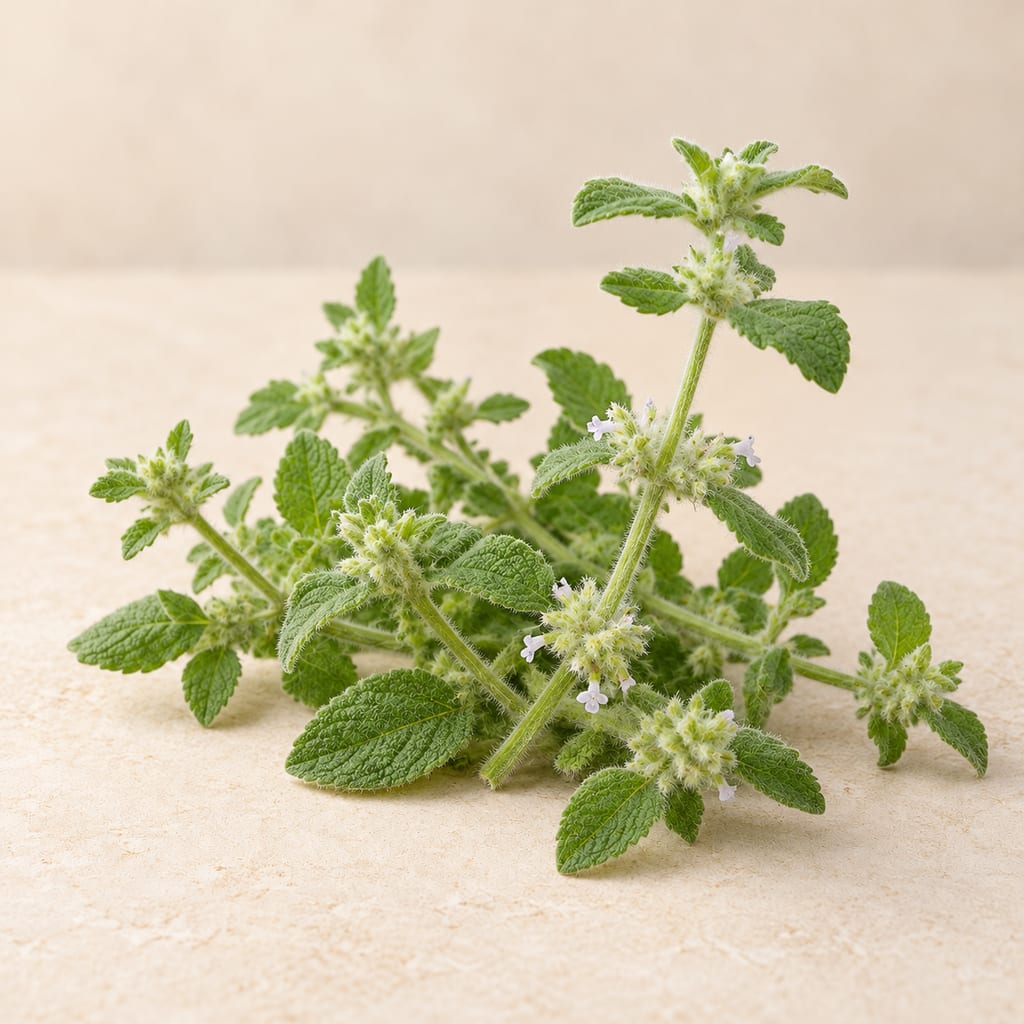
Kew accepts Minthostachys mollis and lists three accepted varieties: var. hybrida, var. mandoniana and var. mollis. Its native range includes Peru and neighboring western South American countries. The 2017 Slow Food Peru account names M. mollis for a Puno food product called muña, but does not identify a variety or provide a voucher. The regional name therefore does not establish the identity of every plant or market bunch called muña.
The food account describes a small-leaved aromatic shrub. Those brief sensory and appearance notes are not an identification key and should not be used to identify a gathered specimen.
Andean food contexts
The Slow Food account describes muña as an aromatic ingredient in soups, chupes and sauces. For Aymara communities around Lake Titicaca, it reports leaves among the ingredients for shihuayro, ground on a batán with Andean herbs, toasted maize, salt and ají. It also describes branches and leaves flavoring carachi broth served with native potatoes and chuño. These are source-specific food accounts, not full recipes.
The book gives no measured amounts, batch yield, ordered preparation steps, serving quantities, storage conditions or independent safety evaluation for either dish. Its traditional medicinal explanations are not evidence of clinical benefit and are not presented as recommendations here.
Sources for this section
Regional season and growing context
For Yunguyo province in Puno, the account associates muña with potato harvest and the San Juan observance on 24 June. Its product table reports an autumn harvest and May–June as the preferred period. The same book says the plant occurs on mountain slopes and near streams and is cultivated around fields and in home gardens. These are regional descriptions, not a planting calendar or measured habitat-to-garden prescription for the full range.
The inspected sources do not establish a named hardiness scheme, frost or heat threshold, light requirement, soil class or pH, irrigation schedule, ordinary seed or cutting method, container design, or greenhouse protocol. Kew's biome and range information does not fill those cultivation gaps.
Propagation evidence and limits
Laboratory micropropagation is reported in a 2011 thesis, with wild explants collected at Quinua, Ayacucho, at 3,396 m. Sterile in-vitro establishment and rooting are laboratory procedures, not home propagation directions. Historical reports of missing field methods in Ayacucho do not establish that cultivation is absent today.
Sources for this section
Evidence still needed
A voucher- or variety-linked study of cultivated Peruvian muña would clarify which plants the regional food name refers to. This review did not establish a complete shihuayro or broth method, a food-safety or storage endpoint, a field propagation protocol, measured container or protected-crop guidance, current collection rules, or a licensed species-matched reference image.
Research gaps
The Slow Food account names M. mollis but gives no variety or voucher; muña is not treated as unique to a documented variety or market specimen.
The food accounts provide no complete household recipe, quantities, yield, storage guidance or food-safety endpoint.
No field propagation, numeric climate limit, soil-pH guidance, container method or greenhouse protocol was established.
The micropropagation thesis was only partially inspected earlier and could not be reopened during this review; its laboratory methods do not establish home growing instructions.
Current collection rules and a licensed, species-matched public reference image were not established.
Research status
The underlying plant account received a partial source review. Its review scope is described in the original plant article.
Sources for this section
Places
Unknown
Relationship not established · Place not establishedThe available research does not establish a single origin for this ingredient.
Community
No community contributions have been published for this entry yet.
Share what you made
Sign in to contribute. Published comments and photos are free to read.
Sources
Royal Botanic Gardens, Kew, Plants of the World OnlineIngredient research
Minthostachys mollis (Benth.) Griseb.Cited in: Accepted name and the word muña; Regional season and growing context; Evidence still needed; Research gaps
Slow Food Editore, 2017Ingredient research
El Arca del Gusto en Perú: productos, saberes e historias del patrimonio gastronómicoCited in: Accepted name and the word muña; Andean food contexts; Regional season and growing context; Evidence still needed; Research gaps
Universidad Nacional de San Cristóbal de Huamanga, 2011Ingredient research
Micropropagación de Minthostachys mollis (Kunth) Griseb. muñaCited in: Propagation evidence and limits; Evidence still needed; Research gaps
FermenteaResearch provenance
Muña (Minthostachys mollis): original plant researchCited in: Research status