
Substrates
Momordica balsamina greens
A Muda food-use study identifies nkakana as Momordica balsamina. A separate UEM abstract uses cacana for the same printed name but calls the plant introduced; another crop overview prints Momordica indica, a different current taxonomic concept. The source records remain distinct.
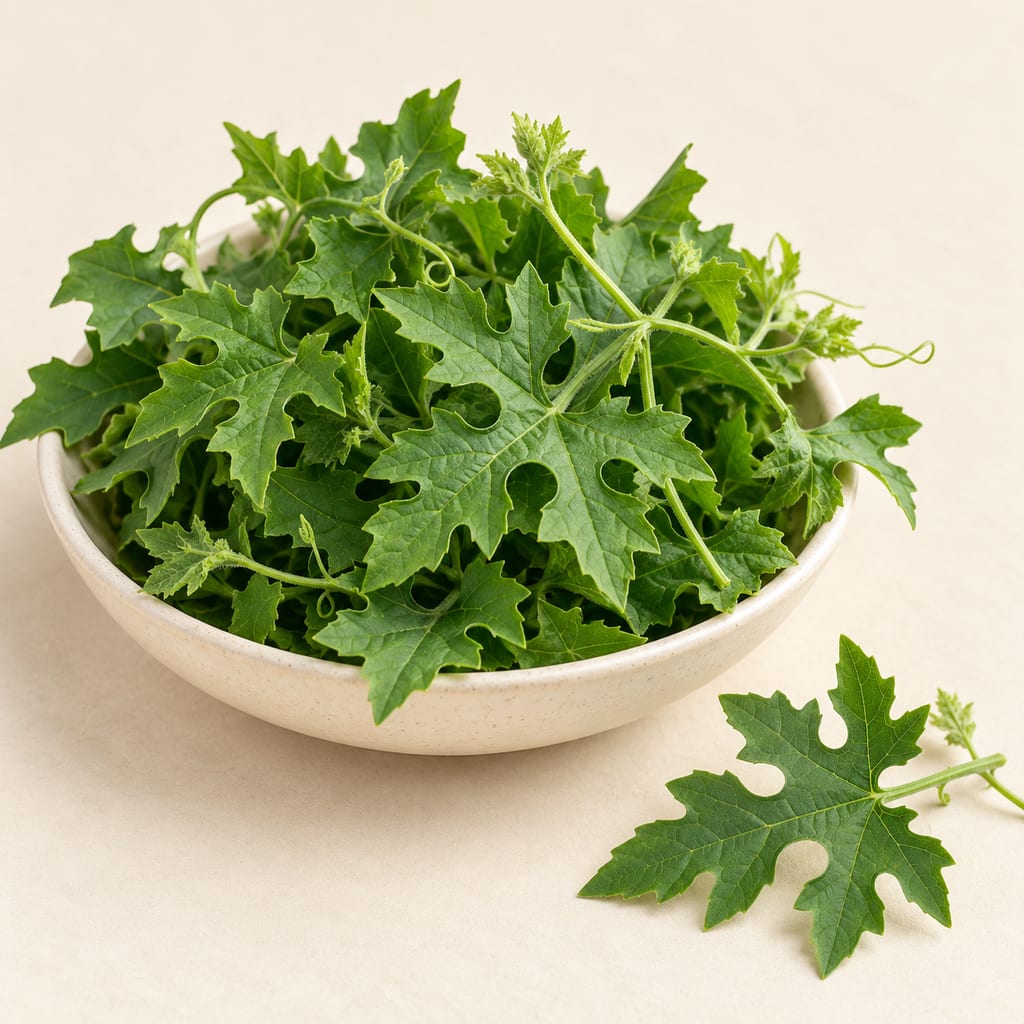
Names and scope
Kew accepts Momordica balsamina L. and lists Mozambique in its native range. The Muda-Serração study explicitly identifies its local name nkakana as M. balsamina. A separate UEM abstract title also prints M. balsamina for cacana, while describing the plant as exotic and invasive. The abstract provides no voucher or population history to explain that statement against Kew’s broad range record.
Sources for this section
A separate cacana name in a crop overview
An Embrapa and IIAM horticulture overview prints cacana as Momordica indica. Kew treats M. indica as a synonym of M. charantia subsp. charantia, not M. balsamina. This resolves the current name crosswalk for the source’s spelling, but it does not identify plants behind local or market uses. These records should not be merged without a specimen or accession link.
Food use in Muda-Serração
Bruschi and colleagues report interviews with 52 people in four Muda-Serração communities in Gondola District, Manica Province, in 2005–2006. Table 3 records M. balsamina/nkakana leaves as food, with four citations from four informants. The discussion describes boiled leaves as a caril served with xima and/or other items. It also reports that informants considered food products from the plant available through the year. These are local interview findings, not a national prevalence estimate or a complete recipe.
What the cultivation account does and does not show
Kew describes M. balsamina as an annual climber of seasonally dry tropical biome. The Muda paper describes its study area as humid subtropical, with 1,000–1,500 mm annual rainfall and sandy, slightly acidic soils; those are regional site conditions, not crop requirements. A UEM conference abstract names Mapinhane, Pambara, Macunhe and Mangalisse, and reports a four-treatment, ten-replication study with weekly and harvest observations. It does not explain the treatments, accessions, site allocation, soil, management, harvest dates or numeric yields. It says Mapinhane material had stronger agronomic attributes, but the result cannot be generalized from the abstract.
Sources for this section
Preparation and unresolved evidence
The Muda account supports a source-specific description of boiled leaves served as caril, but gives no quantities, ordered preparation, timing, endpoint or storage. No executable recipe is presented. The UEM abstract’s origin claim remains unresolved against the POWO range record, and no Muda table-row voucher or UEM accession was located. No household container, greenhouse, propagation or irrigation protocol was established in the reviewed sources.
Sources for this section
Research gaps
The Muda paper describes collection and botanical identification of specimens but does not link a voucher number to the M. balsamina table row.
No full UEM trial report was found; its treatments, sample origin, accession/voucher, site conditions and harvest measurements remain unknown.
POWO lists M. balsamina as native in Mozambique while the UEM abstract calls cacana exotic and invasive; no population history resolves the difference.
The Embrapa market passage’s M. indica spelling maps to M. charantia subsp. charantia in current POWO taxonomy, but the crop material is not specimen-identified.
No complete household recipe, validated cooking endpoint, storage evidence, container trial or greenhouse protocol was inspected.
Sources for this section
- Momordica balsamina L. | Plants of the World Online →
- Traditional uses of plants in a rural community of Mozambique and possible links with Miombo degradation and harvesting sustainability →
- Efeito do local nas caracteriticas morfológicas e atributos agronómicos da cacana (Momordica balsamina L) →
- Horticultura em Moçambique: Características, Tecnologias de Produção e de Pós-Colheita (2015 edition) →
- Momordica indica L. | Plants of the World Online →
- Momordica charantia subsp. charantia | Plants of the World Online →
Research status
The underlying plant account received a partial source review. Its review scope is described in the original plant article.
Sources for this section
Places
Unknown
Relationship not established · Place not establishedThe available research does not establish a single origin for this ingredient.
Community
No community contributions have been published for this entry yet.
Share what you made
Sign in to contribute. Published comments and photos are free to read.
Sources
Royal Botanic Gardens, KewIngredient research
Momordica balsamina L. | Plants of the World OnlineCited in: Names and scope; What the cultivation account does and does not show; Preparation and unresolved evidence; Research gaps
Bruschi, Piero; Mancini, Matteo; Mattioli, Elisabetta; Morganti, Michela; Signorini, Maria Adele. Journal of Ethnobiology and Ethnomedicine 10:59 (2014)Ingredient research
Traditional uses of plants in a rural community of Mozambique and possible links with Miombo degradation and harvesting sustainabilityCited in: Names and scope; Food use in Muda-Serração; What the cultivation account does and does not show; Preparation and unresolved evidence; Research gaps
Egas José Armando, Carlos Eduardo Muteguere, Simeão Gabriel Balane and Bartolomeu Félix Tangune; Universidade Eduardo Mondlane, XI Conferência Científica proceedings (2021)Ingredient research
Efeito do local nas caracteriticas morfológicas e atributos agronómicos da cacana (Momordica balsamina L)Cited in: Names and scope; What the cultivation account does and does not show; Preparation and unresolved evidence; Research gaps
Technical editors Lenita Lima Haber, Carvalho Carlos Ecole, Walter Bowen and Francisco Vilela Resende; Embrapa, IIAM and University of FloridaIngredient research
Horticultura em Moçambique: Características, Tecnologias de Produção e de Pós-Colheita (2015 edition)Cited in: A separate cacana name in a crop overview; Research gaps
Royal Botanic Gardens, KewIngredient research
Momordica indica L. | Plants of the World OnlineCited in: A separate cacana name in a crop overview; Research gaps
Royal Botanic Gardens, KewIngredient research
Momordica charantia subsp. charantia | Plants of the World OnlineCited in: A separate cacana name in a crop overview; Research gaps
FermenteaResearch provenance
Momordica balsamina in Mozambique: cacana and nkakana accounts: original plant researchCited in: Research status