
Substrates
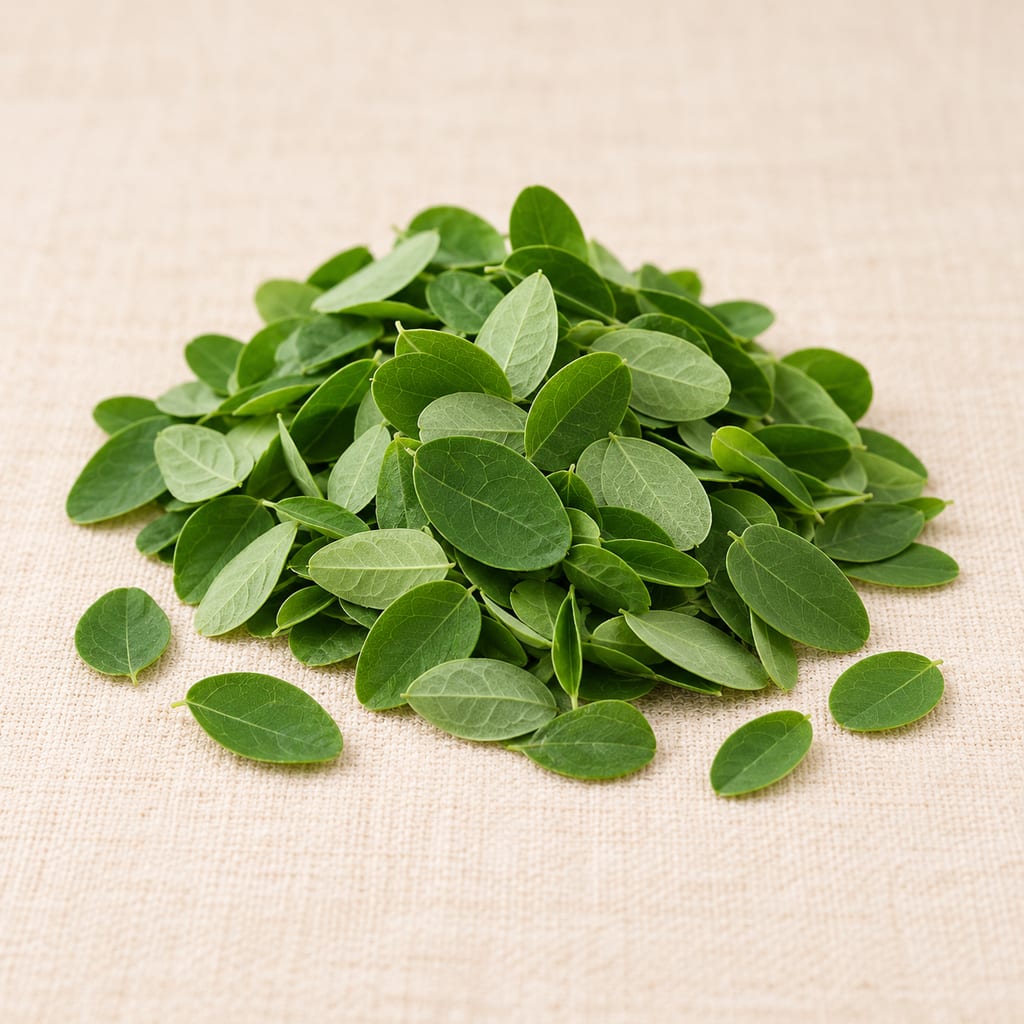
Moringa leaves
Source-linked accounts describe Moringa oleifera food uses in several regions, including Mauritius, alongside cultivation figures with their local scope made explicit.
Species and common names
Kew accepts Moringa oleifera Lam. and gives its native range as northeast Pakistan to northwest India. The species is also known as drumstick tree and, in the Philippines, malunggay; NParks records names including kelur, merunggai and 辣木. Drumstick is a common name for its long young pod, not another taxon. Moringa pterygosperma is a synonym listed by Kew and NParks. Common names alone do not verify a plant species.
Sources for this section
Food uses by part and region
A Nigerian survey of 280 respondents reports Moringa oleifera leaves used as a vegetable in soup, in salads and for tea; the survey documents reported use, not a single recipe. NParks describes leaves cooked like spinach or dried and crushed into powder for soups and sauces. It also describes cooked flowers and immature green pods used in curries, with the tender inside eaten and tough pod valves discarded. These are separate plant parts and source contexts, not one interchangeable preparation.
Sources for this section
Household preparation examples
The available food descriptions support simple research leads: cooked leaves in Nigerian soup, salad or tea; cooked leaves or leaf powder in Singaporean dishes; and young pods served in curry. The sources do not give one complete formula with quantities, yield, cooking time and storage. They are not executable recipes or validated safety instructions. No root-condiment or medicinal use is presented here.
Sources for this section
Climate and growing conditions
NParks describes a full-sun tree grown in fertile, well-drained soil, with moderate water preference, drought tolerance and a strong response to pruning. Feedipedia's agronomic synthesis reports best growth in warm conditions averaging 25–30°C and annual rainfall around 1,000–2,000 mm; it also reports survival at lower rainfall with reduced foliage and low tolerance of waterlogging. Its compiled soil-pH range is broad, 4.5–9, where drainage is adequate. These are references from varied tropical and subtropical settings, not a guarantee for a particular garden or cultivar.
Sources for this section
Propagation, harvest and seasonal limits
Feedipedia reports seed sowing directly or in containers near the start of the rainy season on an elevated seedbed to reduce waterlogging; its summary describes seed propagation as suited to foliage production and cuttings for other crop purposes. NParks also lists seed and stem-cutting propagation. Feedipedia reports frost can kill plants back to ground level, with regrowth after temperatures rise. Its forage synthesis reports foliage harvest before 2.5 months and cutting intervals varying from 15 to 75 days; those compiled figures are not a household leaf-yield promise. The reviewed sources do not establish an unheated or heated greenhouse schedule, a cold-protection method, or local pest thresholds.
Sources for this section
What remains uncertain
No complete locally authored household batch was reopened, and the Nigerian abstract does not specify ingredient amounts or cooking order. The available garden sources do not set a universal frost-safe minimum, heat ceiling, humidity limit, container size or greenhouse regime. Feedipedia is a forage and agronomy synthesis, so its field figures should not be read as validated food-crop instructions. This article confines food and cultivation statements to sources naming Moringa oleifera.
Mauritius food reports and cultivation guidance
A 2017 qualitative study reports leaves called “Bred Mouroum” and pods called “Baton Mouroum” in Mauritius. Its authors interviewed 14 people aged 70 or older, one selected through a Senior Citizen Association in each of 14 regions; interviews were conducted in Creole in October 2014. Respondents described leaves in stews or broths, fish soup, masala curry and dholl, and pods in broth or dholl. One participant described a Maar Chonka meal combining rice-boiling water, aromatics, fried Bombay duck, cooked maize and Moringa leaves. These are attributed interview accounts; the paper does not supply measured quantities, a complete cooking schedule or storage validation.
FAREI calls Moringa oleifera a local variety and perennial, lists planting throughout the year and says all local agroclimatic zones suit it. Its field guidance gives light, well-drained soil at pH 5.0–7.5, seed propagation and a local caution against cuttings for field transplant because of reported wind and drought vulnerability. The guide distinguishes intensive leaf plots from green-pod plots: it reports 28 mm of water per week for the first three months after sowing and 22 mm per week in dry periods for continuous leaf production; first leaf harvest at about 3–4 months followed by 30–45 day intervals; and first green pods at about one year. It says leaves are not harvested in the green-pod system. These are Mauritius extension figures for field systems, not measured universal tolerances or a household pot protocol. The source describes nursery bags before transplant, but does not establish productive mature-container or greenhouse growing.
Research gaps
No specimen, cultivar or market-name identity was assessed.
The survey and NParks descriptions do not provide complete source-batch recipes, food-safety endpoints or storage life.
Feedipedia's climate, pH and harvest ranges synthesize diverse agronomic contexts and are not home-garden guarantees.
No container size, greenhouse regime, local pest threshold or reliable winter-survival method was established.
Food and cultivation statements are limited to sources naming Moringa oleifera.
FAREI Mauritius figures describe field extension guidance and do not establish a universal home-growing envelope or productive mature-container/greenhouse system.
Sources for this section
- Moringa oleifera Lam. →
- Moringa oleifera Lamk →
- Ethno-medicinal and culinary uses of Moringa oleifera Lam. in Nigeria →
- Moringa (Moringa oleifera) →
- Perceptions and Practices on the Use of Moringa oleifera Lam: A Qualitative Study amongst Elderly Mauritians →
- Moringa/Brède mouroum (Moringa oleifera), Guide Agricole crop page →
- Le Guide Agricole 2019, Moringa / Brède mouroum, printed pp. 317–320 →
Research status
The underlying plant account received a partial source review. Its review scope is described in the original plant article.
Sources for this section
Places
Unknown
Relationship not established · Place not establishedThe available research does not establish a single origin for this ingredient.
Community
No community contributions have been published for this entry yet.
Share what you made
Sign in to contribute. Published comments and photos are free to read.
Sources
Royal Botanic Gardens, Kew, Plants of the World OnlineIngredient research
Moringa oleifera Lam.Cited in: Species and common names; Research gaps
National Parks Board Singapore, Flora and Fauna WebIngredient research
Moringa oleifera LamkCited in: Species and common names; Food uses by part and region; Household preparation examples; Climate and growing conditions; Propagation, harvest and seasonal limits; Research gaps
Journal of Medicinal Plants Research / Academic JournalsIngredient research
Ethno-medicinal and culinary uses of Moringa oleifera Lam. in NigeriaCited in: Food uses by part and region; Household preparation examples; What remains uncertain; Research gaps
Feedipedia, Animal Feed Resources Information SystemIngredient research
Moringa (Moringa oleifera)Cited in: Climate and growing conditions; Propagation, harvest and seasonal limits; What remains uncertain; Research gaps
Kassim Nazim, Marie Chan Sun and Vidushi S. Neergheen-Bhujun, Journal of Complementary and Alternative Medical Research 2(2), 1–13 (2017)Ingredient research
Perceptions and Practices on the Use of Moringa oleifera Lam: A Qualitative Study amongst Elderly MauritiansCited in: Mauritius food reports and cultivation guidance; Research gaps
Food and Agricultural Research and Extension Institute (FAREI), MauritiusIngredient research
Moringa/Brède mouroum (Moringa oleifera), Guide Agricole crop pageCited in: Mauritius food reports and cultivation guidance; Research gaps
Food and Agricultural Research and Extension Institute (FAREI), MauritiusIngredient research
Le Guide Agricole 2019, Moringa / Brède mouroum, printed pp. 317–320Cited in: Mauritius food reports and cultivation guidance; Research gaps
FermenteaResearch provenance
Moringa (Moringa oleifera): original plant researchCited in: Research status