
Substrates
Water mimosa greens
Lao market and field accounts describe water mimosa as a wetland vegetable, while a regional handbook records separate Thai cultivation practices.
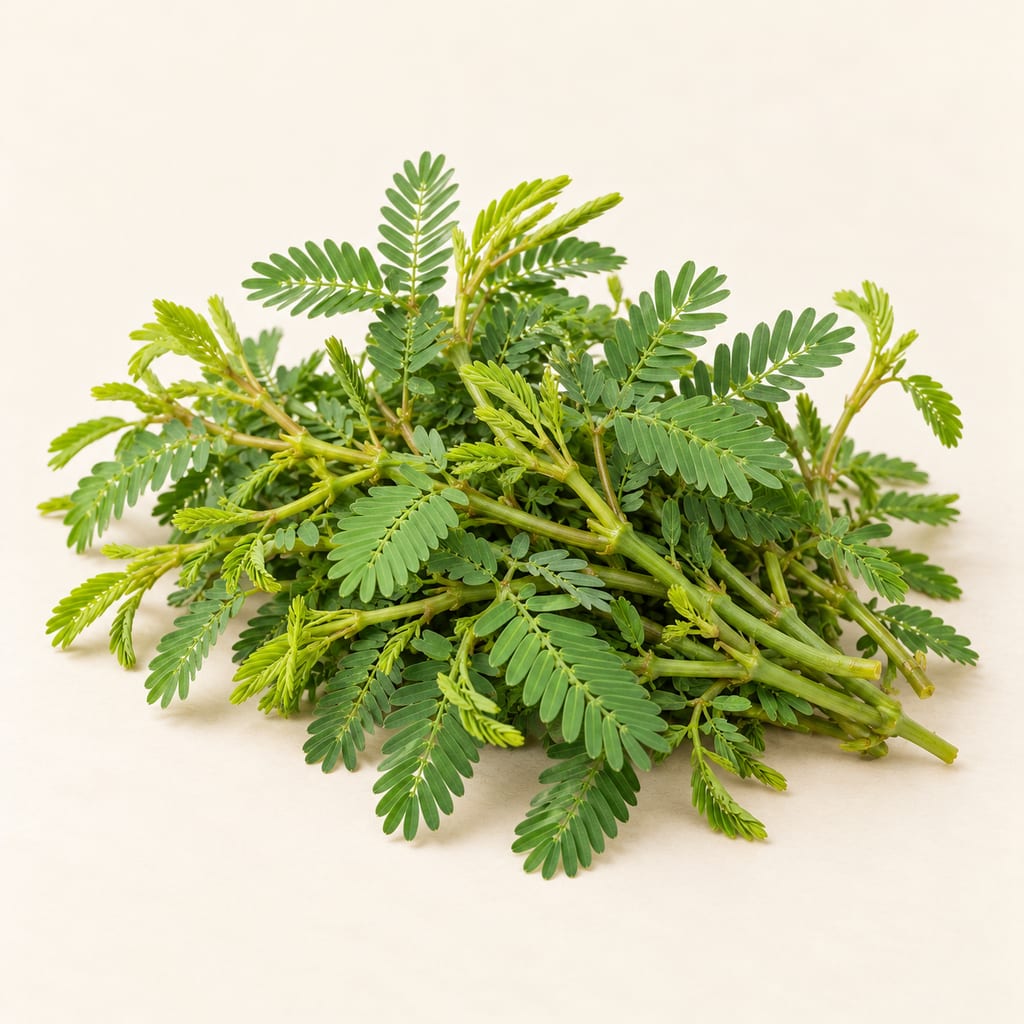
Name and identity
Kew accepts Neptunia oleracea Lour. in Fabaceae and lists Laos within its range. Sources use different Lao spellings: Pha Tad Ke prints phak kasèt, while the Luang Prabang market paper records phak ka sed for voucher WA 72415. The names stay attached to their own source records; they are not a general identification rule.
The Lao vascular checklist prints Neptunia oleracea and Neptunia prostrata as separate entries. PROSEA's 1993 profile treats N. prostrata as a synonym of N. oleracea. The checklist specimens listed under N. prostrata have not been reidentified here under Kew's current treatment.
Lao food records
A 2006 village-use study in Bak and Nakhou, Savannakhet Province, lists N. oleracea as a marsh plant eaten cooked as a vegetable and describes shoots sold in Bak markets. A separate Luang Prabang market survey records green parts used raw and in bamboo soup. Its table links the entry to voucher WA 72415 and marks observations in June, August, November and February. The paper's DNA barcoding methods concern fungi, not this plant row.
Pha Tad Ke describes young leaves and tender branches in raw or blanched use with spicy sauce, pickled as som phak, and in soups and stir-fries. It attributes a sour-soup and yam pha krachet account to a Thai neighbor; those dishes are not presented as Lao informant reports.
Reported cultivation in Thailand
The 1993 PROSEA profile describes full sun, hot and humid conditions, and a preference for 30–80 cm of slow-moving water. It reports poorer growth with shade, brackish water or saline soil. Its cultivation section says Thai growers conventionally use stem cuttings 50–150 cm long; it gives a May planting period and a 4–6 month crop. The first harvest is reported at 3–4 weeks, followed by 5–7 day intervals during that crop period. These are source-era Thai production details, not Laos measurements or home-growing targets.
The Savannakhet village-use study places the plant in marsh and paddy-field settings. The Luang Prabang survey reports market observations in four separate months. These records provide Lao habitat and market context but do not describe a measured local crop or a planting calendar.
Food reports and their limits
The accounts name raw, blanched, cooked, soup, stir-fry and pickled uses, but do not provide one complete batch with quantities, yield, ordered steps, process endpoint and storage conditions. The reports are descriptive food records, not an executable recipe or validated preservation method.
No inspected source establishes a Lao frost threshold, soil pH, water-quality limit, household container method, greenhouse system, crop yield or collection permission. The Thai cultivation figures cannot fill those gaps.
Research gaps
No complete source-batched household recipe with quantities, yield, ordered steps, endpoint and storage was established.
The source-era treatment of Neptunia prostrata differs from the current Kew record; listed checklist and market specimens have not been independently reidentified.
The detailed cultivation values are Thai-specific. No Laos crop trial, home container or greenhouse protocol was found.
No frost response, soil pH, water-quality threshold, current collection permission or local conservation assessment was established.
The 2013 Houaphan paper's full text and candidate-specific table evidence were not available in this review.
Sources for this section
- Neptunia oleracea Lour. | Plants of the World Online →
- Neptunia oleracea →
- Land-use patterns and plant use in Lao villages, Savannakhet Province, Laos →
- Wild food plants and fungi sold in the markets of Luang Prabang, Lao PDR →
- Neptunia oleracea (PROSEA), record 47 →
- A Checklist of the Vascular Plants of Lao PDR, version 1.0 →
Research status
The underlying plant account received a partial source review. Its review scope is described in the original plant article.
Sources for this section
Places
Unknown
Relationship not established · Place not establishedThe available research does not establish a single origin for this ingredient.
Community
No community contributions have been published for this entry yet.
Share what you made
Sign in to contribute. Published comments and photos are free to read.
Sources
Royal Botanic Gardens, KewIngredient research
Neptunia oleracea Lour. | Plants of the World OnlineCited in: Name and identity; Research gaps
Pha Tad Ke Botanical Garden, Ethnobotanic DatabaseIngredient research
Neptunia oleraceaCited in: Name and identity; Lao food records; Food reports and their limits; Research gaps
Yasuyuki Kosaka, Shinya Takeda, Saysana Sithirajvongsa and Khamleck Xaydala, Tropics 15(1):51–63 (2006)Ingredient research
Land-use patterns and plant use in Lao villages, Savannakhet Province, LaosCited in: Lao food records; Reported cultivation in Thailand; Food reports and their limits; Research gaps
Łukasz Łuczaj et al., Journal of Ethnobiology and Ethnomedicine 17:6 (2021), DOI 10.1186/s13002-020-00423-yIngredient research
Wild food plants and fungi sold in the markets of Luang Prabang, Lao PDRCited in: Name and identity; Lao food records; Reported cultivation in Thailand; Food reports and their limits; Research gaps
Y. Paisooksantivatana, Plant Resources of South-East Asia No. 8: Vegetables (1993)Ingredient research
Neptunia oleracea (PROSEA), record 47Cited in: Name and identity; Reported cultivation in Thailand; Food reports and their limits; Research gaps
V. Lamxay, S. Lanorsavanh, K. Chanthavong, K. Souvannakhoummane and S. Bounphanmy, National University of Laos (2021)Ingredient research
A Checklist of the Vascular Plants of Lao PDR, version 1.0Cited in: Name and identity; Research gaps
FermenteaResearch provenance
Water mimosa (Neptunia oleracea): original plant researchCited in: Research status