
Spices and aromatics
African basil leaves
A source-linked account of Ocimum gratissimum food use in Benin, Thailand and southern Nigeria, with regional growing reports and unresolved home-method details.
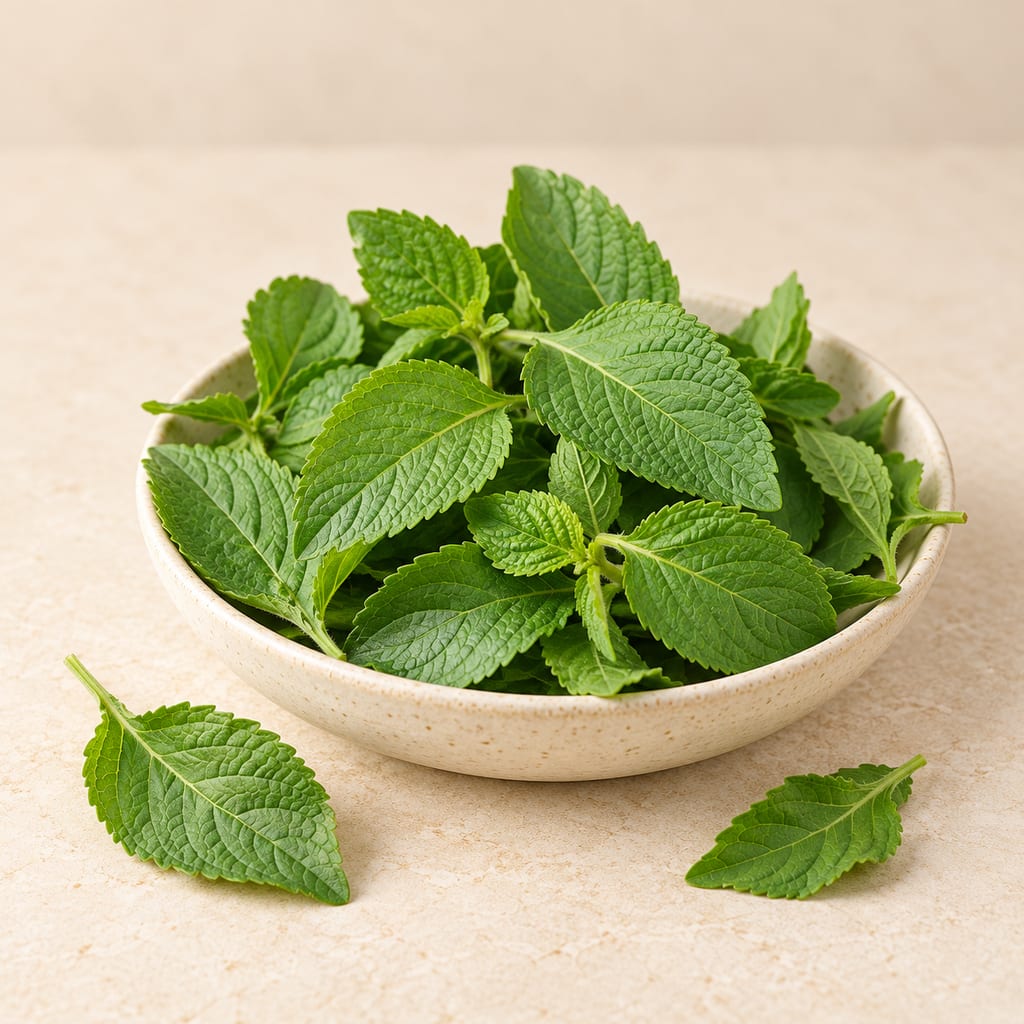
Names and species boundaries
Kew accepts Ocimum gratissimum L. and gives its native range as tropical and subtropical parts of the Old World. The RHS lists East Indian basil, fever plant and tree basil among its common names, and includes Ocimum basilicum “Tree” in its synonym field. Benin’s INRAB guide identifies Tchiayo as O. gratissimum; JIRCAS lists Thai names including Yeera and kaprao yuan. These local labels and profile entries describe source contexts; they do not identify an unlabeled plant or settle cultivar identity.
Food use in three regional accounts
A Benin technical report describes Tchiayo leaves cooked in a tomato-based sauce and dried, pounded leaves used in sauces served with pounded yam. JIRCAS describes Thai leaves fried with hot chili and minced garlic, or with meat, as a flavouring. A southern Nigerian study abstract reports Igbo use of scent leaf to flavour soups and stews; only its abstract was inspected. These reports show different regional uses rather than one pan-African recipe.
Growing reports
The Benin guide describes seed propagation through a nursery: sowing, regular watering, shade after emergence and transplanting to field beds. It reports year-round cultivation, with stronger production in rainy seasons and regular water needed in the dry season. JIRCAS describes direct seeding, full sun, well-drained soil with sufficient moisture, 50 × 75 cm transplant spacing and leaf harvest about two months after transplant in Thailand. The RHS assigns H1B under its UK scheme, recommending summer outdoor growing and under-glass conditions otherwise; it gives no measured frost-survival cutoff. These are regional observations, not a combined universal schedule.
A Benin sauce report, with limits
The 2015 INRAB report names a Tchiayo sauce with tomato, palm oil, fish, shrimp and seasonings. Its method includes boiling the leaves with potash or bicarbonate, but it does not state the alkali amount; several seasoning quantities and the final cooking endpoint are also unclear. This account is useful food context, not a complete household formula or a basis for inventing a safe alkali dose.
Sources for this section
Harvest, storage and crop problems
Benin reports describe repeated cutting and leaf regrowth; JIRCAS gives a Thai harvest interval of about two months after transplant. The 2019 Benin guide contains an internally inconsistent numeral for its first harvest interval, so no exact value is repeated here. The 2015 report says fresh leaves were kept for up to three days using a damp-cloth approach, but it gives no validated storage-safety basis or dried-leaf endpoint. Benin sources report aphids, whiteflies, caterpillars and other crop pests; the RHS separately lists possible glasshouse pests and grey mould.
What remains unresolved
The sources do not establish a household pot size, greenhouse setpoint, universal frost or heat limit, or one cultivation calendar for different climates. The reported sauce lacks ingredient detail and a complete endpoint, while postharvest reports do not validate a safe storage life. No claim about medicinal benefit, essential-oil use or plant identification is made here.
Research gaps
The Benin sauce report omits the potash/bicarbonate amount, several seasonings and a complete endpoint; it is not presented as a recipe.
No household mature-container or controlled greenhouse protocol was found. RHS H1B is a UK profile category, not a measured survival threshold.
Benin seed and RHS cutting propagation describe different source contexts; no comparative trial establishes that either method is impossible elsewhere.
The reported fresh-leaf storage practice and duration are not validated food-safety limits.
The Nigerian paper was inspected only as an abstract; no early culinary attestation or global use pattern is claimed.
Sources for this section
- Ocimum gratissimum L. →
- Ocimum gratissimum | East Indian basil →
- Maîtriser la culture du Tchiayo (Basilic africain), un légume traditionnel au Bénin →
- Ocimum gratissimum L. (Lamiaceae) →
- Ocimum gratissimum L. (Tchiayo en Fongbé): Du jardin à la table →
- Comparison of Neem Leaf and Scent Leaf Phytochemical and Nutritional Properties →
Research status
The underlying plant account received a source review. Its review scope is described in the original plant article.
Sources for this section
Places
Unknown
Relationship not established · Place not establishedThe available research does not establish a single origin for this ingredient.
Community
No community contributions have been published for this entry yet.
Share what you made
Sign in to contribute. Published comments and photos are free to read.
Sources
Royal Botanic Gardens, Kew, Plants of the World OnlineIngredient research
Ocimum gratissimum L.Cited in: Names and species boundaries; Research gaps
Royal Horticultural SocietyIngredient research
Ocimum gratissimum | East Indian basilCited in: Names and species boundaries; Growing reports; Harvest, storage and crop problems; What remains unresolved; Research gaps
MAEP / Institut National des Recherches Agricoles du Bénin and partnersIngredient research
Maîtriser la culture du Tchiayo (Basilic africain), un légume traditionnel au BéninCited in: Names and species boundaries; Growing reports; Harvest, storage and crop problems; What remains unresolved; Research gaps
Japan International Research Center for Agricultural Sciences (JIRCAS)Ingredient research
Ocimum gratissimum L. (Lamiaceae)Cited in: Names and species boundaries; Food use in three regional accounts; Growing reports; Harvest, storage and crop problems; Research gaps
Institut National des Recherches Agricoles du Bénin (INRAB), technical report 7697Ingredient research
Ocimum gratissimum L. (Tchiayo en Fongbé): Du jardin à la tableCited in: Food use in three regional accounts; A Benin sauce report, with limits; Harvest, storage and crop problems; What remains unresolved; Research gaps
International Journal of Academic Health and Medical ResearchIngredient research
Comparison of Neem Leaf and Scent Leaf Phytochemical and Nutritional PropertiesCited in: Food use in three regional accounts; Research gaps
FermenteaResearch provenance
African basil and scent leaf (Ocimum gratissimum): original plant researchCited in: Research status