
Spices and aromatics
Wood sorrel leaves
Oxalis acetosella is a small perennial of shaded woodland. Danish sources describe its sour leaves in salads and herb preparations, while Denmark’s food authority advises only limited garnish or herb use and gives a specific authority context for its intake figures.
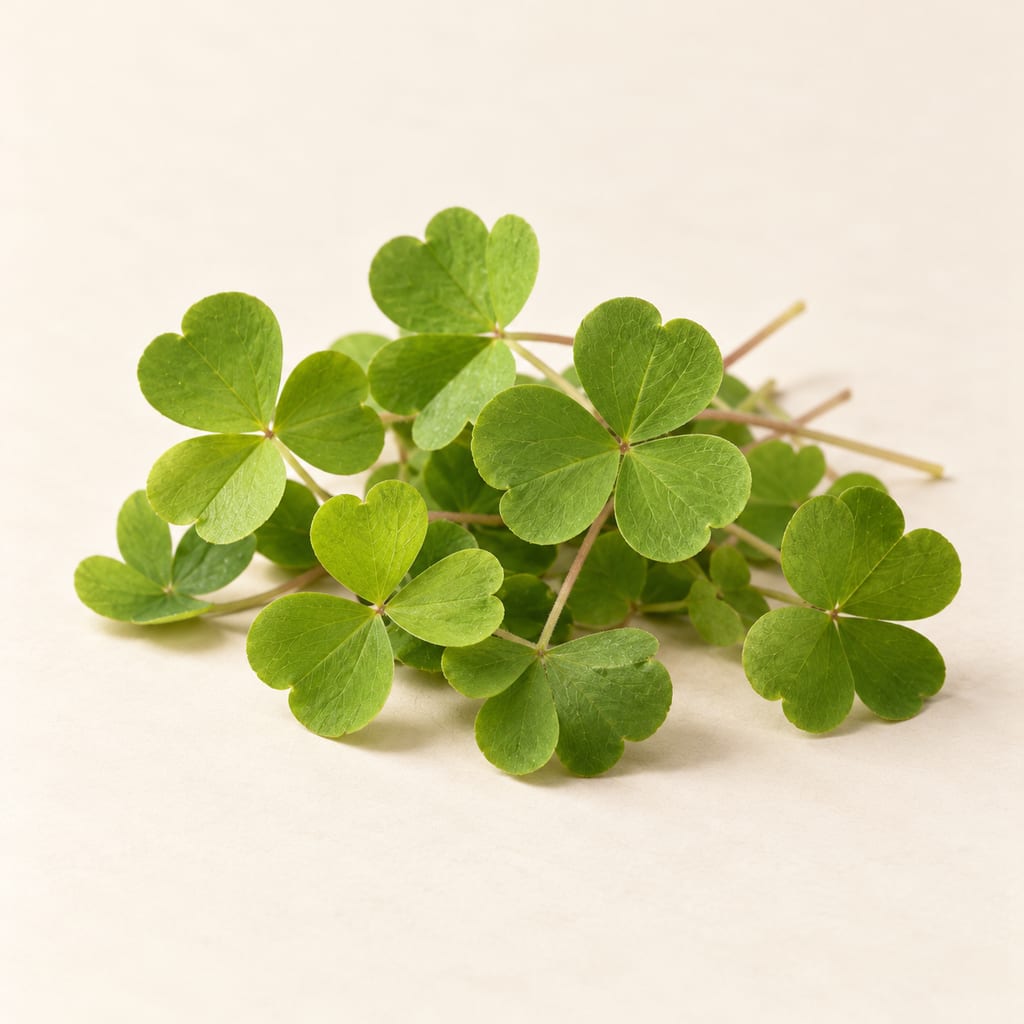
A woodland Oxalis
Kew accepts Oxalis acetosella L. and records its native range from Europe to Japan and Algeria. The Danish educational account calls it skovsyre, surkløver and kukkermad. It describes a low plant of shaded deciduous and coniferous woods, with three heart-shaped leaflets and white, pink-veined flowers. These descriptions help explain the regional name wood sorrel, but they are not a field-identification key. The word sorrel also appears in names for unrelated Rumex plants, so food reports for those plants should not be transferred to Oxalis.
The Danish account places flowering in April and May and describes additional small flowers later in summer. Those are observations from a Danish educational account, not a calendar for every climate.
Sources for this section
Reported leaf uses and an important limit
Skoven i Skolen lists the leaves for skovsalat, herb butter and herb patties. It names the dishes but does not give a complete batch with quantities, ordered preparation, yield or storage. The same account attributes the sharp sour taste to oxalic acid.
Denmark’s Veterinary and Food Administration says O. acetosella leaves should be used only in limited quantities as an herb or garnish. Its page says adults should not eat more than 14 g of fresh leaves in one day and gives 2 g of fresh leaves for a child weighing 10 kg. These are the authority’s stated risk-context figures, not a recipe amount, an individual recommendation or a universal safe threshold. The page also says that leaves when the plant is not flowering may be confused with white clover or other Oxalis, and that those lookalikes were not risk-assessed in that listing.
Sources for this section
What UK garden guidance says
The RHS profile, as recorded in the reviewed dossier, places this species in dappled or partial shade and lists sand, loam and clay, several pH categories, and moist but well-drained soil. It gives the RHS H5 UK scheme category, defined by that scheme as −15 to −10°C, and lists spring division, seed and small rhizome sections as propagation options. The scheme band is a horticultural classification, not a measured frost-kill threshold. These are garden-profile details rather than a tested food-crop system.
The Fermanagh BSBI account describes local woodland occurrences across a broad pH range and reports greater frequency below pH 5, while also noting moisture and shade associations. These are observations from one regional account, not a crop pH target. The reviewed sources do not establish productive container or greenhouse methods, a yield, a harvest interval or an irrigation schedule.
Sources for this section
What is still unresolved
The Danish food ideas are not complete recipes, and the authority’s intake context does not resolve individual dietary circumstances or establish a cooking method that removes risk. No validated botanical key, site-specific permission to collect, universal climate limit or commercial production protocol was reviewed.
Research gaps
The named Danish dishes have no measured ingredient list, ordered method, yield, endpoint or storage guidance.
The Danish authority's stated intake figures are not recipe quantities or universal individual guidance; no preparation-specific safety assessment was found.
The Danish authority notes possible confusion with white clover and other Oxalis when flowers are absent; this account does not provide an identification key or verify any gathered specimen.
No productive yield, harvest interval, container dimensions, greenhouse method, irrigation rate or universal heat and humidity limit was established.
The RHS and Fermanagh records describe UK horticulture and regional ecology; their categories do not establish a crop optimum or growing calendar elsewhere.
Research status
The underlying plant account received a partial source review. Its review scope is described in the original plant article.
Sources for this section
Places
Unknown
Relationship not established · Place not establishedThe available research does not establish a single origin for this ingredient.
Community
No community contributions have been published for this entry yet.
Share what you made
Sign in to contribute. Published comments and photos are free to read.
Sources
Royal Botanic Gardens, KewIngredient research
Oxalis acetosella L. | Plants of the World OnlineCited in: A woodland Oxalis; Research gaps
Skoven i SkolenIngredient research
Skovsyre (Óxalis acetosélla)Cited in: A woodland Oxalis; Reported leaf uses and an important limit; What is still unresolved; Research gaps
Danish Veterinary and Food AdministrationIngredient research
Skovsyre (blade) | Plantelisten til erhvervCited in: Reported leaf uses and an important limit; What is still unresolved; Research gaps
Royal Horticultural SocietyIngredient research
Oxalis acetosella | RHS Plant ProfileCited in: What UK garden guidance says; What is still unresolved; Research gaps
Botanical Society of Britain and IrelandIngredient research
Oxalis acetosella L. | Fermanagh Species AccountsCited in: What UK garden guidance says; What is still unresolved; Research gaps
FermenteaResearch provenance
Wood sorrel: a woodland leaf with a sharp, sour taste: original plant researchCited in: Research status