
Spices and aromatics
Rau răm leaves
Vietnamese food-use and regional cultivation reports for rau răm, with distinct field methods and limits kept in view.
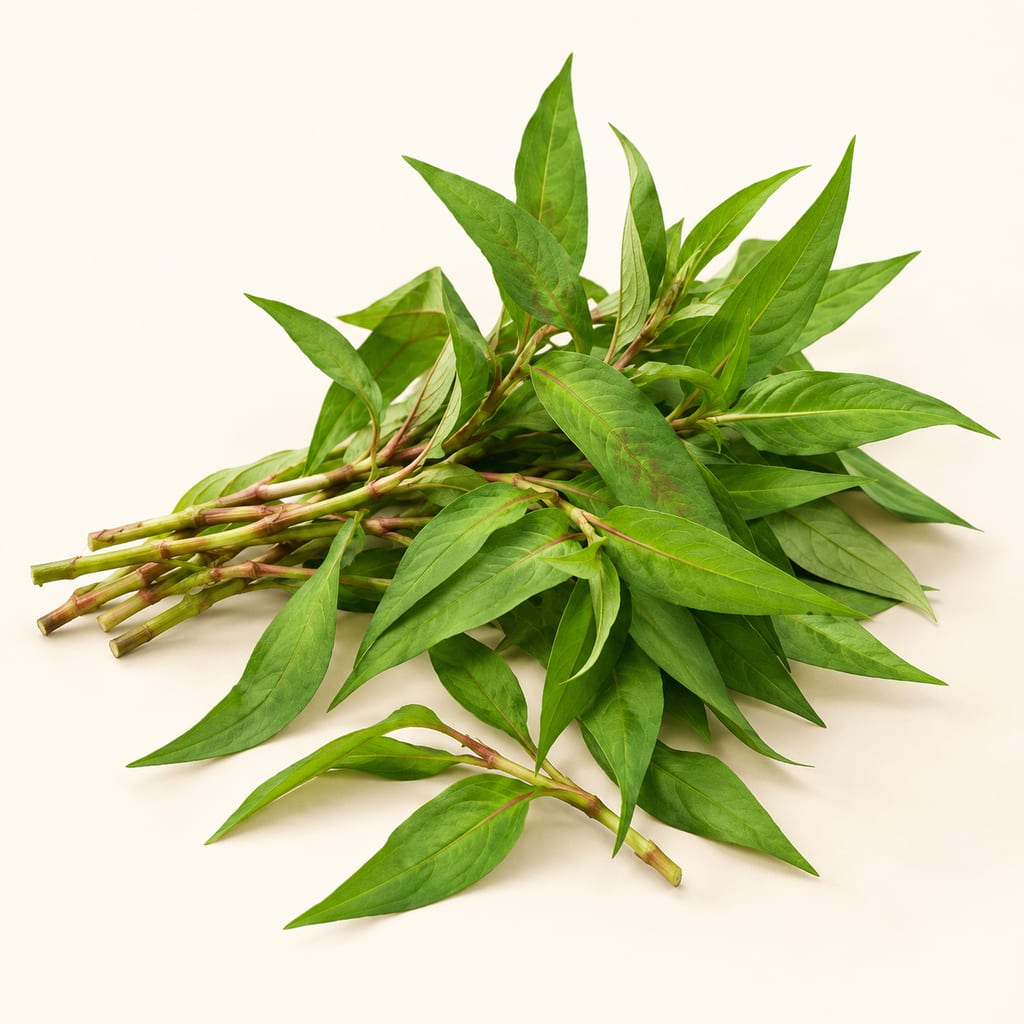
Name and species boundaries
Kew accepts Persicaria odorata (Lour.) Soják and includes Vietnam in its native range. The older name Polygonum odoratum, used by the Ho Chi Minh City manual, is a synonym for this species. PROSEA records rau răm as a Vietnamese name and lists “Vietnamese coriander” as a common name; that translated name does not make it coriander (Coriandrum sativum). PROSEA also warns of confusion with water pepper (Persicaria hydropiper) and with the unrelated Polygonatum odoratum in some texts.
Vietnamese food reports
PROSEA describes leaves used fresh in Vietnamese salads and with incubated duck eggs, and fresh or cooked with fish, shellfish, turtle, and frog dishes. It also reports rau răm shoots with water dropwort in cabbage preserved in brine. These are regional use descriptions in a handbook, not complete recipes: no quantities, brine ratio, fermentation conditions, or finished-product storage validation are given. The reported uses do not establish a food-safety control or medicinal benefit.
Sources for this section
Field cultivation in Vietnam
The Ho Chi Minh City manual describes planting at the beginning or end of the rainy season on low, moist ground, while cautioning against leaving shoot tips submerged for long periods. It gives stem cuttings about 12–15 cm long with five or six nodes, buried about two-thirds into moist ground. PROSEA describes a different cutting size and spacing for raised beds, and also reports direct planting into prepared muddy rice fields in lowland Vietnam. These are separate regional methods, not a combined household prescription. PROSEA says partial shade is best, full sun can be tolerated with ample moisture, and cold, dry northern Vietnamese winters may cause withering; its reported frost tolerance is only described as probable.
Harvest and protected-growing limits
The city manual describes branch or sectional harvest, leaving a short base, and says the crop can be harvested year-round in its local production context. PROSEA reports first harvest near two months and different later harvest intervals in Vietnam and the United States; it also says leaves may be picked as needed in home gardens. Its account of year-round leaf harvest in United States greenhouses is evidence for that reported production setting only: no temperature or humidity setpoint, container design, or household greenhouse protocol is stated. The sources do not give a safe storage duration; keeping leaves cool and moist is described only as maintaining fresh appearance.
Research gaps
No complete household recipe with quantities, preparation steps, yield, preservation controls, or storage validation was established.
The city manual and PROSEA give different regional cutting methods; neither establishes a universal home method or a measured container design.
No protected-crop setpoint, hardiness-zone conversion, exact frost threshold, safe storage duration, or food-safety endpoint was found.
Research status
The underlying plant account received a source review. Its review scope is described in the original plant article.
Sources for this section
Places
Unknown
Relationship not established · Place not establishedThe available research does not establish a single origin for this ingredient.
Community
No community contributions have been published for this entry yet.
Share what you made
Sign in to contribute. Published comments and photos are free to read.
Sources
Royal Botanic Gardens, Kew, Plants of the World OnlineIngredient research
Persicaria odorata (Lour.) SojákCited in: Name and species boundaries; Research gaps
Ho Chi Minh City Department of Science and TechnologyIngredient research
Kỹ thuật trồng rau gia vị an toànCited in: Name and species boundaries; Field cultivation in Vietnam; Harvest and protected-growing limits; Research gaps
Plant Resources of South-East Asia (PROSEA)Ingredient research
Persicaria odorata (Lour.) Soják, PROSEA Handbook 13: Spices, Record 587Cited in: Name and species boundaries; Vietnamese food reports; Field cultivation in Vietnam; Harvest and protected-growing limits; Research gaps
FermenteaResearch provenance
Rau răm (Persicaria odorata): original plant researchCited in: Research status