
Substrates
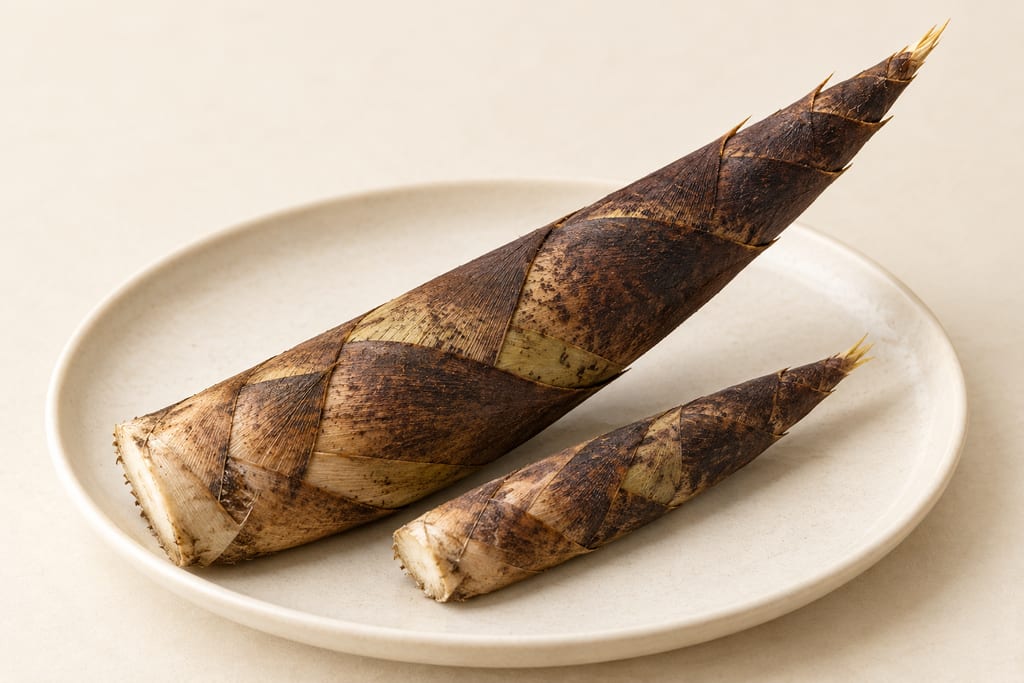
Madake bamboo shoots
Japanese sources identify madake, Phyllostachys bambusoides, as a historically eaten bamboo shoot and describe a regional emergence season. Kew uses P. reticulata for the accepted-name treatment, while other floras retain P. bambusoides; species-specific food processing and household cultivation details remain unresolved.
Madake and its competing botanical names
Japanese sources use madake for Phyllostachys bambusoides. Kew POWO currently treats that name as a synonym of accepted P. reticulata, citing recent East Asian flora treatments; it also lists authorities that continue to accept P. bambusoides. The Flora of New Zealand and Japanese source pages retain P. bambusoides. This account preserves both treatments rather than silently changing the name. A similar species epithet appears in Melocanna bambusoides, which Kew lists as a synonym of Melocanna baccifera; that is a different genus and not this madake taxon.
Sources for this section
Japanese shoot history and local season
Japan Search, drawing on National Diet Library material, names madake and hachiku among bamboo species with a long history of shoot use in Japan, and distinguishes them from moso bamboo (P. edulis), described there as the type most common in current commercial distribution. The Ota River office reports madake shoots emerging later than moso, in May–June in its Hiroshima-area account, and describes them as bitter. These are Japanese historical and regional observations, not a global food calendar or a measure of safe maturity.
Sources for this section
Food context without a preparation method
The documented food part is the young shoot. Japan Search lists dishes such as bamboo-shoot rice and simmered shoots with wakame, but its general dish descriptions are not tied to a madake batch. Its discussion of aku-nuki is likewise general bamboo-shoot context, not a validated madake processing method. The Ota River profile notes bitterness but gives no food process. This article therefore does not recommend raw use, a boiling time, disposal step or storage method.
Sources for this section
Regional cultivation and spread
The Ota River office describes madake as cultivated and naturalized in parts of Honshu, Shikoku and Kyushu, with stands along rivers and local May–June shoot emergence. The New Zealand flora describes extensive running rhizomes and a stand near the Whanganui River that spread from a planting. The RHS guide gives general bamboo advice on sun, moist but free-draining soil, division or rhizome-cutting propagation, and the vigorous spread of some running types. The RHS material is genus-level guidance, not a madake production trial or containment design.
What the sources do not establish
The inspected sources do not supply a madake-specific food safety endpoint, storage life, household harvest rule, container size, greenhouse protocol, or measured frost, heat, soil-pH or edible-yield target. Riverbank occurrence is not an irrigation prescription, and local naturalization reports do not establish a universal invasive classification.
Research gaps
No madake-specific food batch with an inspected preparation method, measured safety endpoint and storage information was established.
The accepted-name treatment remains different across taxonomic sources; a specimen-based comparison was not performed.
No species-specific container, greenhouse, pest-management, frost or productive shoot-yield guidance was verified.
Naturalization observations are local to Japan and New Zealand; intended-site conservation, legal and invasive-status checks remain open.
Sources for this section
- Phyllostachys bambusoides Siebold & Zucc. | Plants of the World Online →
- Phyllostachys reticulata (Rupr.) K.Koch | Plants of the World Online →
- Melocanna baccifera (Roxb.) Kurz | Plants of the World Online →
- Bamboo shoots →
- マダケ (Madake) →
- Phyllostachys bambusoides Siebold & Zucc. | Flora of New Zealand Series →
- How to grow bamboo →
Research status
The underlying plant account received a partial source review. Its review scope is described in the original plant article.
Sources for this section
Places
Unknown
Relationship not established · Place not establishedThe available research does not establish a single origin for this ingredient.
Community
No community contributions have been published for this entry yet.
Share what you made
Sign in to contribute. Published comments and photos are free to read.
Sources
Royal Botanic Gardens, KewIngredient research
Phyllostachys bambusoides Siebold & Zucc. | Plants of the World OnlineCited in: Madake and its competing botanical names; Research gaps
Royal Botanic Gardens, KewIngredient research
Phyllostachys reticulata (Rupr.) K.Koch | Plants of the World OnlineCited in: Madake and its competing botanical names; Research gaps
Royal Botanic Gardens, KewIngredient research
Melocanna baccifera (Roxb.) Kurz | Plants of the World OnlineCited in: Madake and its competing botanical names; Research gaps
Japan SearchIngredient research
Bamboo shootsCited in: Japanese shoot history and local season; Food context without a preparation method; What the sources do not establish; Research gaps
Ota River Office, Chugoku Regional Development Bureau, Ministry of Land, Infrastructure, Transport and TourismIngredient research
マダケ (Madake)Cited in: Japanese shoot history and local season; Food context without a preparation method; Regional cultivation and spread; What the sources do not establish; Research gaps
Manaaki Whenua – Landcare ResearchIngredient research
Phyllostachys bambusoides Siebold & Zucc. | Flora of New Zealand SeriesCited in: Madake and its competing botanical names; Regional cultivation and spread; What the sources do not establish; Research gaps
Royal Horticultural SocietyIngredient research
How to grow bambooCited in: Regional cultivation and spread; What the sources do not establish; Research gaps
FermenteaResearch provenance
Madake bamboo in Japanese food and growing records: original plant researchCited in: Research status