
Substrates
Asian plantain leaves
Plantago asiatica has a local Chinese food-use record and Japanese cultivation guidance whose medicinal-crop purpose limits how it can be applied to food growing.
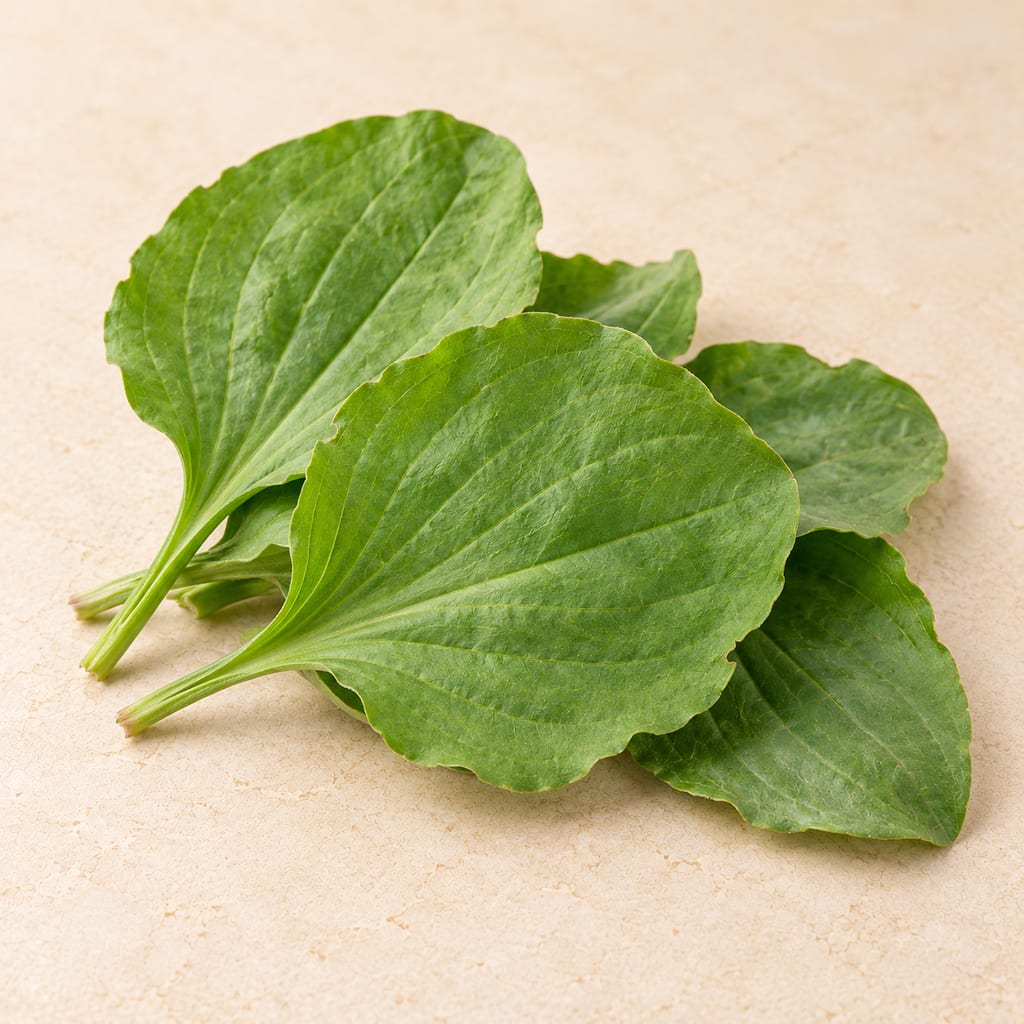
A local food-use record
The Taishan County study’s supplementary checklist lists Plantago asiatica L. with whole aerial parts/shoots, tea-substitute category, and water-boiled mode. Its row is marked “Yes” under “Medical plant” and carries an asterisk; the table legend defines the asterisk as a non-native marker in that catalog. These are the study’s classifications, not proof of medical efficacy or a global origin determination. The same row gives CFSI 1140.75, Order 3 and voucher specimen ZSY-009; CFSI is a cultural food significance measure, and the voucher is a specimen code. This is one Taishan record, not evidence that every plantain species or part is interchangeable or safe to eat. It supplies no complete household batch formula.
Identity, edibility and limits of the food report
Plantago asiatica L. is the accepted name in Kew’s Plants of the World Online, which gives the English name Asian plantain for the species. The Taishan supplementary checklist gives a species-level row for it: whole aerial parts or shoots, a tea-substitute use and a water-boiled preparation. The table’s non-native flag is kept as the study’s own claim and is not read as a taxonomic status.
The only food-use evidence here is that one local checklist entry. It names no broader preparation, quantity or endpoint, and it does not assess safety. The study records the taxon in Taishan County, Guangdong, with no habitat or harvest season given for it.
Inspected sources do not establish poisonous lookalikes, diagnostic field characters or a preparation-specific safety finding for this species. Do not identify a specimen from a food-use entry or a common name.
Reference and research only. Fermenta cannot identify a gathered specimen or guarantee that it is safe to eat. Competent local identification is needed before eating any wild plant.
Japanese growing context
Japan’s NIBN medicinal-plant database describes seed propagation and suitability across cool to warm Japanese regions. Summer dryness inhibits growth. It favours sunny, well-drained conditions and warns that poor ventilation and humid, enclosed conditions encourage powdery mildew. Regional distribution is not a quantified frost or heat threshold.
Sources for this section
Seed and seasonal context
NIBN describes small seeds needing light for germination and gives spring and autumn sowing windows in its Japanese cultivation setting. It discusses mulch for dryness and soil-splash control, with light summer shading where needed while preserving ventilation. This does not establish a universal calendar, a sowing depth or a germination temperature.
Sources for this section
Food harvest and protected growing
The NIBN harvest, drying and yield account concerns medicinal raw material. It is not adopted here as a culinary harvest schedule or food-storage protocol. A container system, greenhouse regime and reproducible food method remain unestablished.
Sources for this section
Research gaps
No specimen-level identification or local collection-rule review was made. The Taishan table marks the species as non-native within that catalog; current local occurrence and broader regional status were not independently checked.
No source-specific household quantities, food-safety controls or edible-storage life are established.
Quantitative frost/heat/humidity, photoperiod, container and greenhouse production evidence remains incomplete.
Research status
The underlying plant account received a partial source review. Its review scope is described in the original plant article.
Sources for this section
Places
Unknown
Relationship not established · Place not establishedThe available research does not establish a single origin for this ingredient.
Community
No community contributions have been published for this entry yet.
Share what you made
Sign in to contribute. Published comments and photos are free to read.
Sources
Frontiers in Sustainable Food SystemsIngredient research
An ethnobotanical study on wild edible plants in Taishan County, Guangdong, ChinaCited in: A local food-use record; Identity, edibility and limits of the food report; Research gaps
NIBN Research Center for Medicinal Plant ResourcesIngredient research
オオバコ: 植物体栽培及び植物の効率的生産法Cited in: Japanese growing context; Seed and seasonal context; Food harvest and protected growing; Research gaps
Zhang et al., Frontiers in Sustainable Food Systems / FigshareIngredient research
Data Sheet 1: supplementary Tables S1–S3Cited in: A local food-use record; Research gaps
Royal Botanic Gardens, Kew (POWO)Accepted name · Broad distribution
Plantago asiatica | Plants of the World OnlinePOWO accepted-name treatment for Plantago asiatica L.
Cited in: Identity, edibility and limits of the food report
Zhang et al., Frontiers in Sustainable Food Systems; FigshareTaxon specific food use checklist · Reported parts and methods
Data Sheet 1: An ethnobotanical study on wild edible plants in Taishan County, Guangdong, China (supplementary Tables S1-S3)Table S3 row for Plantago asiatica: whole aerial parts/shoots, tea substitute, water-boiled
Cited in: Identity, edibility and limits of the food report