
Substrates
Broadleaf plantain leaves
Plantago major is distinct from P. asiatica and other plantains in the food records reviewed here. Dulong survey material, Japanese food notes and horticultural sources describe different parts and settings, but do not establish a complete recipe or a safe wild-harvest method.
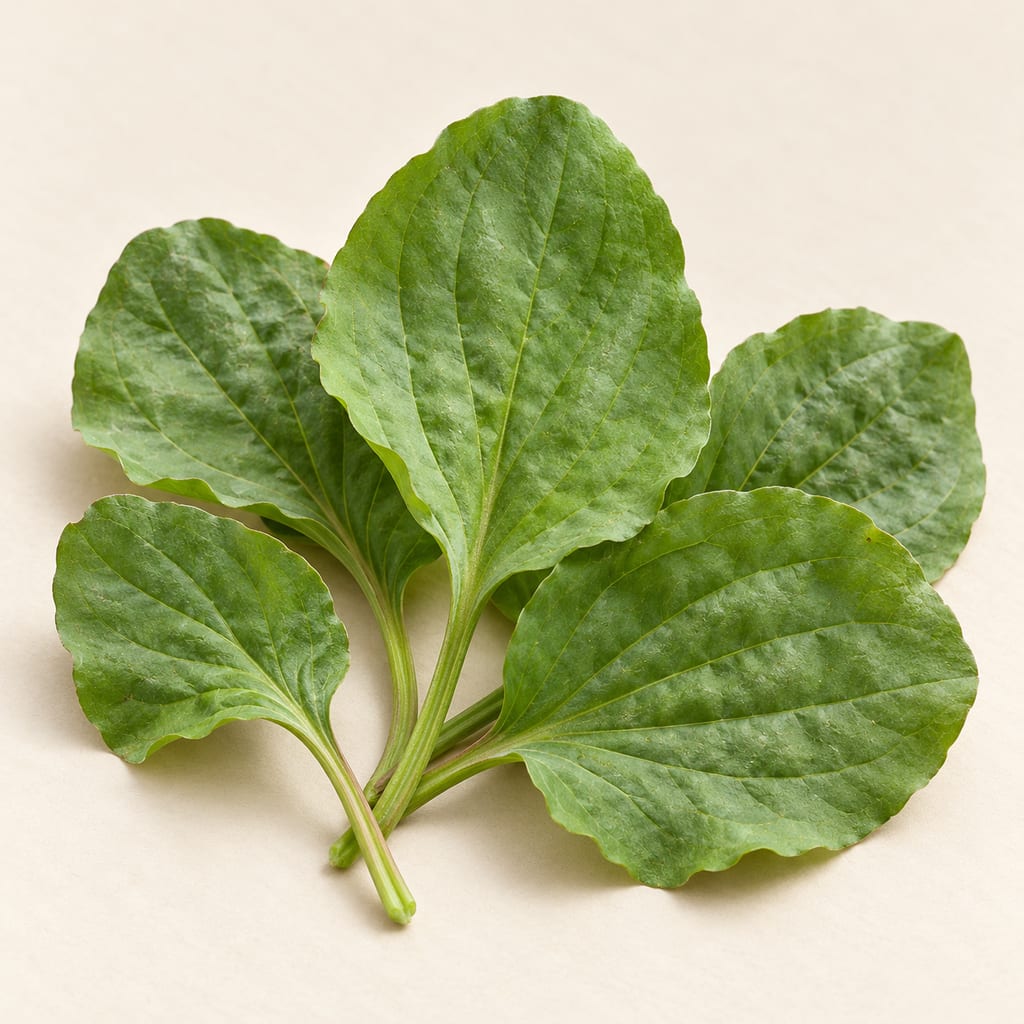
Keep plantain species distinct
Kew accepts Plantago major L. The species has a broad basal rosette and upright flower spikes; PROTA describes substantial variation in leaf shape and hairiness. Japanese sources use セイヨウオオバコ (seiyō-ōbako), with オニオオバコ and ヨウシュオオバコ also recorded. A common name or resemblance does not identify an individual plant.
The Dulong survey’s Table 3 keeps P. major separate from P. asiatica: row 94 names P. major, Chinese 大车前 and Dulong wa gui, with voucher DZL0001; row 93 is P. asiatica with voucher DZL0130. Food practices and names should not be transferred between those species or to P. lanceolata without an explicit source match.
Food-use reports describe different parts
In the Dulongjiang Township survey in Yunnan, row 94 records P. major as a wild vegetable, with aerial parts boiled and collected during months 3–8. This is a localized ethnobotanical report, not a batch recipe: the table gives no quantity, cooking duration, water amount, endpoint or storage method. The adjacent P. asiatica row is a separate record, not corroboration for the same taxon.
PROTA summarizes young leaves and immature flower stalks as vegetables eaten cooked or in salads, and seeds as food; the Japan Medical Herb Association describes young leaves for salad and older leaves for stew. The Amami database says the species has long been used as food but gives no dish. These accounts differ in geography and source detail and do not define one interchangeable preparation.
Growing notes are regional, not a kitchen protocol
For UK gardens, RHS lists full sun or partial shade, chalk, clay, loam or sand, moist but well-drained conditions, any of its acid/neutral/alkaline pH categories and H7 hardiness under the RHS UK scheme. It describes rapid spread, prolific seed production and removal before seeding as a way to limit spread. This is a garden profile, not an edible-crop trial or a temperature guarantee elsewhere.
PROTA's previously inspected account reports germination research at 25–30°C under a 16-hour photoperiod; this experimental condition is not a household setpoint. Tashkent Botanical Garden's English page describes Uzbek field sowing in autumn or spring, including shallow seed placement and locally specific seed-bed management. These are ecological summaries and regional agricultural methods; no container dimensions, household watering schedule or greenhouse setpoint was found.
Gathering, contamination and preparation limits
PROTA cautions that wild-collected plants near roads may contain lead and cadmium in its section on medicinal collection. It gives no food-specific threshold or validated washing remedy. The Dulong boiling note does not establish a contaminant control, safe cooking endpoint or storage life. Do not treat clean appearance, a place name or boiling alone as proof that a gathered lot is suitable to eat.
No complete source-batched recipe was inspected. The reported boiled aerial part, Japanese salad and stew notes are food-use descriptions only; quantities, preparation sequence, harvest identification and storage remain open questions.
Research gaps
The Dulong report is limited to one locality and its abbreviated table method; no complete batch recipe, household cooking endpoint or food storage guidance was established.
The Uzbek page is an English translation of regional field agriculture; its sowing instructions are not a home container protocol.
No species-specific container or greenhouse trial, home irrigation schedule or universal climate threshold was established.
PROTA’s roadside metal warning supplies no food-specific threshold or remedy; no local collection law or specimen-identification guide was reviewed.
Sources for this section
Research status
The underlying plant account received a partial source review. Its review scope is described in the original plant article.
Sources for this section
Places
Unknown
Relationship not established · Place not establishedThe available research does not establish a single origin for this ingredient.
Community
No community contributions have been published for this entry yet.
Share what you made
Sign in to contribute. Published comments and photos are free to read.
Sources
Royal Botanic Gardens, KewIngredient research
Plantago major L. | Plants of the World OnlineCited in: Keep plantain species distinct; Research gaps
Journal of Ethnobiology and EthnomedicineIngredient research
Ethnobotanical study on wild edible plants used by Dulong people in northwestern Yunnan, ChinaCited in: Keep plantain species distinct; Food-use reports describe different parts; Gathering, contamination and preparation limits; Research gaps
Plant Resources of Tropical Africa / Pl@ntUseIngredient research
Plantago major (PROTA)Cited in: Keep plantain species distinct; Food-use reports describe different parts; Growing notes are regional, not a kitchen protocol; Gathering, contamination and preparation limits; Research gaps
Royal Horticultural SocietyIngredient research
Plantago major | RHS Plant ProfileCited in: Keep plantain species distinct; Growing notes are regional, not a kitchen protocol; Research gaps
Amami Islands Biological Resources DatabaseIngredient research
野生植物詳細表示: セイヨウオオバコCited in: Keep plantain species distinct; Food-use reports describe different parts; Research gaps
Japan Medical Herb AssociationIngredient research
オオバコの植物学と栽培Cited in: Keep plantain species distinct; Food-use reports describe different parts; Gathering, contamination and preparation limits; Research gaps
Tashkent Botanical Garden, Institute of Botany of the Academy of Sciences of UzbekistanIngredient research
Plantago major L. | Growing technologyCited in: Growing notes are regional, not a kitchen protocol; Research gaps
FermenteaResearch provenance
Broadleaf plantain: food notes and cultivation evidence: original plant researchCited in: Research status