
Substrates
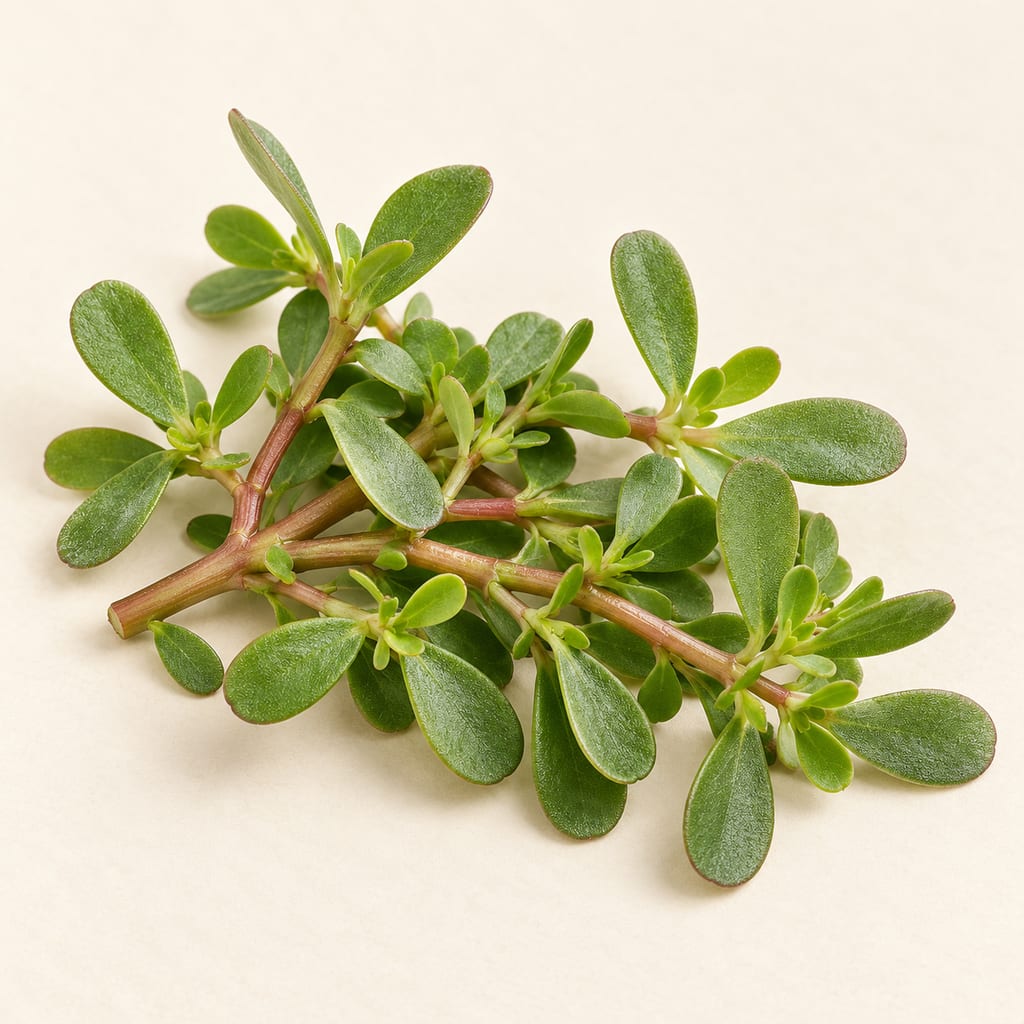
Purslane greens
Portulaca oleracea is documented as a food plant in distinct Mexican and Taishan contexts. A Morelos cookbook names a verdolaga-and-pork dish, a Mexican field trial measures one local crop, and Taishan sources disagree about the plant part; none provides a universal safe dose, detox method or gathering guide.
One accepted species, several regional names
Kew accepts Portulaca oleracea L. The National Taiwan University flora labels that species 馬齒莧 and lists several Taiwan-language names; the Taishan ethnobotany article uses 瓜子菜 (guazicai), while the Morelos cookbook calls its ingredient verdolaga. These labels belong to their own sources and places. The article is about P. oleracea and does not transfer food claims to P. quadrifida or another plant sold as purslane.
Food traditions and an unresolved Taishan part record
A Nahua cookbook from Morelos includes “Verdolagas con carne de puerco.” Its printed recipe combines purslane greens with pork and seasonings and describes grinding, separate cooking and a final simmer. The source-specific proportions and steps are not reproduced here as an executable recipe; its text does not give serving yield, a pork temperature endpoint, cooling or storage instructions.
In Taishan County, the article describes Portulaca oleracea as a gathered wild vegetable sold in bundles and typically stir-fried alone or with eggs. Its main-text edible-part discussion says whole aerial parts, but Supplementary Table S3 lists roots for this species and gives voucher ZSY-046. The authors report identifying and depositing survey vouchers; that record does not resolve the part conflict or identify another plant. Taiwan's 馬齒莧 record supplies taxonomic and naming context, not evidence that the Taishan or Morelos specimens shared a local preparation.
What one Mexican field trial measured
A 2017 field experiment at Montecillo, Estado de México, used material obtained from Mixquic, described by the authors as erect, little-branched, large-leaved and green-stemmed. The plot was at 2,215 m, with a temperate local climate, silty clay loam and measured soil pH 8.2. It was sown in July 2014 and harvested for measurements at 27, 34 and 42 days after emergence. These are details of one site and one source of material, not a national calendar, hardiness range or promise of household regrowth.
The paper compares experimental nitrogen, phosphorus and potassium treatments and measures fresh foliage nitrate. Its findings apply to those trial plots, treatment levels and harvest stages. They do not establish a universal fertilizer prescription, safe serving or nitrate threshold for purslane grown elsewhere. The inspected sources did not provide a species-specific container design or greenhouse setpoint.
Sources for this section
Composition and gathering limits
The field paper's nitrate results are measurements from one experimental crop under stated fertilizer treatments; they cannot be generalized to every plant, soil, harvest or serving. The dossier also flags oxalate as an evidence question, but no taxon- and preparation-specific oxalate source was re-opened for this article. No dietary limit, safe dose, universal detoxification result or cooking endpoint is set here.
The named cookbook dish and Taishan stir-fry account are food-use records, not safety controls. No field-identification key, contamination-screening method, local collection permission or storage life for a prepared dish was established.
Research gaps
The Morelos cookbook PDF timed out in this review; its dish details remain from the prior direct inspection and should be reopened before detailed public recipe work.
The Taishan narrative's whole-aerial-part statement conflicts with Supplementary Table S3's root entry; the part used remains unresolved.
The Montecillo experiment is one 2014 field trial using local Mixquic material; no universal climate, home-container, greenhouse, repeat-harvest or fertilizer protocol was established.
No oxalate source was re-opened for this article and no universal composition threshold, safe dose, detoxification method, contamination test or collection law was established.
No wild-plant identification guide or complete source-batched recipe with safe meat endpoint and storage guidance was established.
Sources for this section
- Portulaca oleracea L. | Plants of the World Online →
- Portulaca oleracea | Plants of Taiwan →
- An ethnobotanical study on wild edible plants in Taishan County, Guangdong, China →
- Data Sheet 1: An ethnobotanical study on wild edible plants in Taishan County, Guangdong, China →
- Respuesta de la verdolaga (Portulaca oleracea L.) a la fertilización con NPK →
- Recetario nahua de Morelos →
Research status
The underlying plant account received a partial source review. Its review scope is described in the original plant article.
Sources for this section
Places
Unknown
Relationship not established · Place not establishedThe available research does not establish a single origin for this ingredient.
Community
No community contributions have been published for this entry yet.
Share what you made
Sign in to contribute. Published comments and photos are free to read.
Sources
Royal Botanic Gardens, KewIngredient research
Portulaca oleracea L. | Plants of the World OnlineCited in: One accepted species, several regional names; Research gaps
National Taiwan University HerbariumIngredient research
Portulaca oleracea | Plants of TaiwanCited in: One accepted species, several regional names; Food traditions and an unresolved Taishan part record; Research gaps
Frontiers in Sustainable Food SystemsIngredient research
An ethnobotanical study on wild edible plants in Taishan County, Guangdong, ChinaCited in: One accepted species, several regional names; Food traditions and an unresolved Taishan part record; Composition and gathering limits; Research gaps
Frontiers FigshareIngredient research
Data Sheet 1: An ethnobotanical study on wild edible plants in Taishan County, Guangdong, ChinaCited in: Food traditions and an unresolved Taishan part record; Research gaps
Revista Fitotecnia MexicanaIngredient research
Respuesta de la verdolaga (Portulaca oleracea L.) a la fertilización con NPKCited in: What one Mexican field trial measured; Composition and gathering limits; Research gaps
Dirección General de Culturas Populares e IndígenasIngredient research
Recetario nahua de MorelosCited in: One accepted species, several regional names; Food traditions and an unresolved Taishan part record; Composition and gathering limits; Research gaps
FermenteaResearch provenance
Purslane and verdolaga in Mexican and Taishan food records: original plant researchCited in: Research status