
Spices and aromatics
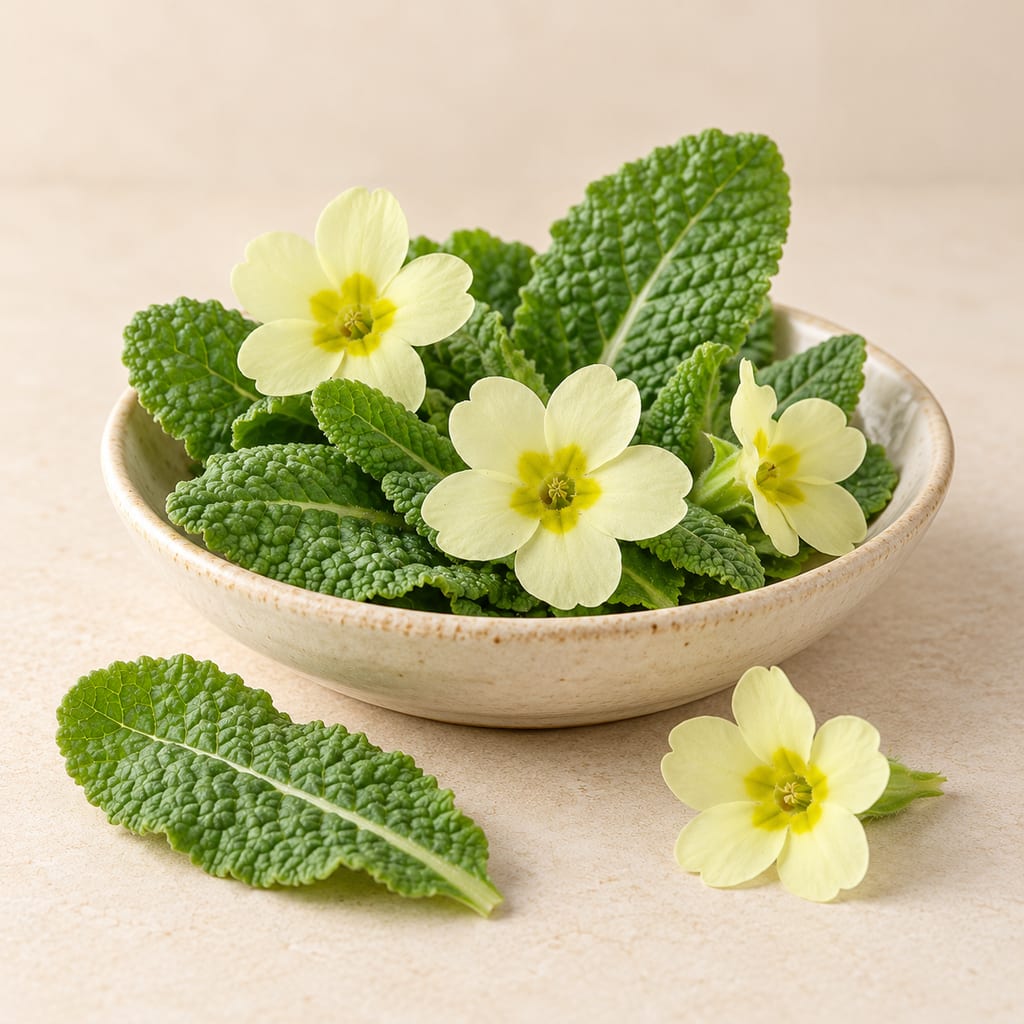
Primrose flowers and leaves
Primula vulgaris is a spring-flowering European perennial with documented flower-garnish and leaf-use notes, alongside regional garden guidance that does not define a household crop protocol.
Name and range
Kew accepts Primula vulgaris Huds. (Primulaceae), native from Europe to the western Caucasus and Lebanon. Kew treats Primula acaulis subsp. vulgaris as a homotypic synonym; its accepted infraspecifics include P. vulgaris subsp. alpina, atlantica, balearica, rubra and vulgaris. RHS also lists P. acaulis among its synonyms. Keep those names within this species record rather than folding in cowslip (P. veris), oxlip (P. elatior), or their hybrids.
RHS describes a low rosette-forming perennial with usually yellow spring flowers. The BSBI regional account distinguishes the usual separate flower stalks of P. vulgaris from the umbels of cowslip and notes both wild hybrids and cultivated variants. Those descriptions set scope; they are not a complete identification key.
Season and recorded food uses
The University of Kent DMC01 herbarium record names P. vulgaris and “primrose,” with a collection date of 31 March 2008 at Earley Wood, Petham, Kent. Its use field says leaves can be used in teas, flowers and leaves are edible, and the plant was “used as a cash crop in the past.” It gives no date or description for that past use, so it is not a dated food-history account.
RHS specifically lists primrose flowers as a decoration for cakes or trifle. This is a serving context, not a measured recipe. The UK RHS page describes early-spring flowering; the BSBI Fermanagh account gives a mainly March-to-May or early-June period, while Ulster Wildlife notes December-to-May flowering in Northern Ireland and earlier flowers in mild years. These regional calendars are not transferable harvest dates.
Growing evidence in context
RHS lists full sun or partial shade, sheltered exposure, moist but well-drained soil, and broad chalk/clay/loam/sand and acid/alkaline/neutral categories. It gives H7 in its UK hardiness scheme, whose H7 category is below −20°C; that rating is not an experimental frost-injury or lethal-temperature threshold. RHS lists seed or root basal cuttings and includes container and garden uses. Its general Primrose-group note on protected or indoor winter-to-spring flowering concerns some biennial container primulas, not a species-specific P. vulgaris greenhouse regime.
The BSBI account describes Fermanagh and wider British/Irish habitats, including damp moderately acid-to-alkaline sites and a western open-grassland versus drier south-eastern shade contrast. It notes absence from regularly flooded and some summer-drying soil settings and reports drought-associated weakening. These are regional ecological observations, not a crop climate envelope or irrigation prescription. RHS lists pests and diseases including aphids, vine weevil, slugs, eelworms, leaf-mining flies, glasshouse red spider mite, leaf spot and grey mould; the BSBI account also discusses genus-level virus and root-rot susceptibility. Neither source supplies treatment thresholds or a food-crop harvest schedule.
Northern Ireland status and limits
Primrose appears in Schedule 8 Part II of the Wildlife (Northern Ireland) Order 1985. The BSBI regional account describes the listing as allowing flowers to be picked but not the plant uprooted. This is a Northern Ireland statement, not a rule for other jurisdictions or permission to gather at a particular site.
The inspected food references do not provide quantities, a complete preparation sequence, yield, storage window or safety endpoint. RHS edible-flower guidance is general: it advises checking identity, using fresh flowers, avoiding sites frequented by livestock or dog walkers, washing flowers, and considering possible reactions or chemical treatment. It is not a species-specific safety assessment.
Research gaps
The Kent herbarium record’s “cash crop in the past” note is undated and does not identify a crop, method or historical source.
No complete household recipe or species-specific food-safety assessment was verified; cake/trifle decoration is only a serving suggestion.
RHS and BSBI growing records are garden-profile and regional ecological evidence, not a tested household production system; no pot dimensions, productive greenhouse regime, crop thresholds, harvest quantity or storage window was established.
The Northern Ireland legal entry does not establish collection rules elsewhere or site-specific permission.
Sources for this section
- Primula vulgaris Huds. | Plants of the World Online →
- Primula vulgaris (Pr/Prim) | RHS Plant Profile →
- Primula vulgaris Huds., Primrose | BSBI Fermanagh Species Account →
- DMC01 Primula vulgaris Huds. | Kent Ethnobotanical Herbarium →
- Edible flowers →
- The Wildlife (Northern Ireland) Order 1985, Schedule 8 →
- Primrose (Primula vulgaris) | Wildlife Explorer →
Research status
The underlying plant account received a partial source review. Its review scope is described in the original plant article.
Sources for this section
Places
Unknown
Relationship not established · Place not establishedThe available research does not establish a single origin for this ingredient.
Community
No community contributions have been published for this entry yet.
Share what you made
Sign in to contribute. Published comments and photos are free to read.
Sources
Royal Botanic Gardens, KewIngredient research
Primula vulgaris Huds. | Plants of the World OnlineCited in: Name and range; Research gaps
Royal Horticultural SocietyIngredient research
Primula vulgaris (Pr/Prim) | RHS Plant ProfileCited in: Name and range; Season and recorded food uses; Growing evidence in context; Research gaps
Botanical Society of Britain and IrelandIngredient research
Primula vulgaris Huds., Primrose | BSBI Fermanagh Species AccountCited in: Name and range; Season and recorded food uses; Growing evidence in context; Northern Ireland status and limits; Research gaps
University of Kent, Centre for Biocultural DiversityIngredient research
DMC01 Primula vulgaris Huds. | Kent Ethnobotanical HerbariumCited in: Season and recorded food uses; Research gaps
Royal Horticultural SocietyIngredient research
Edible flowersCited in: Season and recorded food uses; Northern Ireland status and limits; Research gaps
UK legislation, legislation.gov.ukIngredient research
The Wildlife (Northern Ireland) Order 1985, Schedule 8Cited in: Northern Ireland status and limits; Research gaps
Ulster WildlifeIngredient research
Primrose (Primula vulgaris) | Wildlife ExplorerCited in: Season and recorded food uses; Research gaps
FermenteaResearch provenance
Primrose: regional food notes and garden evidence: original plant researchCited in: Research status