
Spices and aromatics
Horopito leaves
Horopito is a New Zealand endemic whose peppery leaves are described as a culinary flavouring; garden advice is qualitative and household preparation evidence remains incomplete.
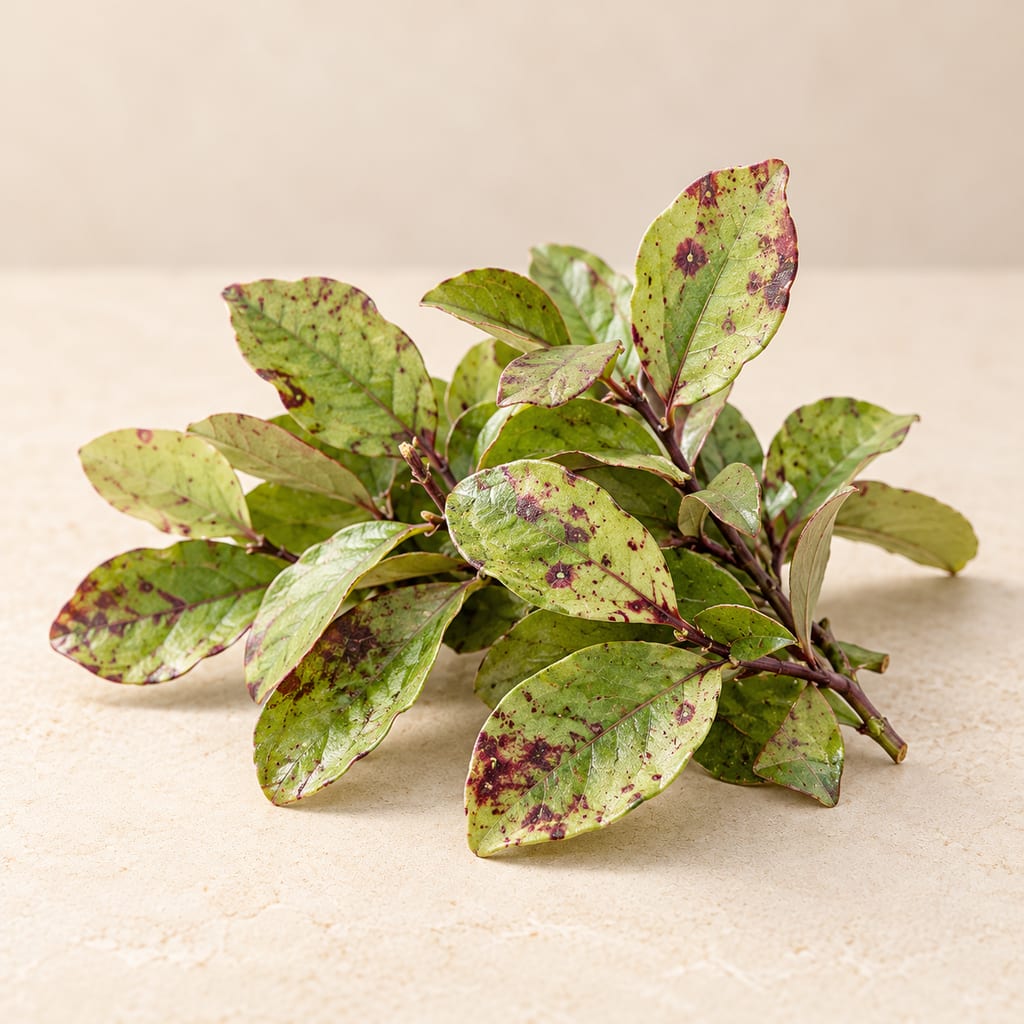
Name and range
Kew accepts Pseudowintera colorata (Raoul) Dandy and gives New Zealand as its native range. NZPCN calls it red horopito and mountain horopito and records it as endemic. Te Papa identifies the plant as P. colorata and uses the common name pepper tree. That common name also applies to kawakawa, Piper excelsum, a member of a different family. Te Ara describes the distinction between horopito in Winteraceae and kawakawa in Piperaceae.
NZPCN describes P. colorata as a shrub with pepper-tasting leaves, red-blotched above and pale beneath. It lists P. axillaris and P. insperata as similar species. The descriptions support comparison, not a complete field-identification key.
Habitat and seasonal observations
NZPCN describes this New Zealand endemic in coastal, lowland and montane forest margins and shrubland, with flowering reported in November to March and fruiting in December to June. Those are regional natural-history observations, not a garden production calendar. Its current national conservation entry is Not Threatened in the 2023 assessment. The same page lists later regional categories for Northland and Auckland; these are conservation assessments, not collection permissions.
Sources for this section
Reported food use
Dunedin Botanic Garden describes horopito as a culinary spice and suggests using its leaves instead of black pepper in cooking. It does not specify whether leaves are fresh or dried, or give an amount. Te Papa says the peppery leaves are increasingly used as an indigenous flavouring. Te Ara reports that horopito and kawakawa leaves were commercially harvested, washed, dried and ground into powders or flakes used as herbs, seasonings, coatings and additions to stuffing, meat, fish, vegetables and doughs. This account groups the two plants and does not give a species-only product formula.
Growing notes
Dunedin Botanic Garden's curator-authored 2015 article gives qualitative garden advice for horopito: it describes slow growth, tolerance of wind and frost, and success in soils that are not too dry or too wet. It suggests a slightly shady site or an open position, where leaf colour may be brighter, and says the plant can be grown in a pot. The article does not state a frost temperature, pot size, soil pH, watering schedule, expected leaf yield or greenhouse conditions.
The garden article describes a usual shrub around 2 metres tall and says the plant can sometimes reach 10 metres as a tree. NZPCN separately describes a shrub to 3.5 metres. The sources use different descriptions; neither is a container size or a guaranteed mature height.
Sources for this section
What remains unresolved
The food sources do not provide a complete household recipe, leaf quantity, yield, preparation endpoint or storage guidance. Te Ara's processing account is commercial and covers two plants; the Dunedin article's cooking suggestion is qualitative. The reviewed food and garden accounts do not establish a safe amount or food-safety endpoint.
The horticultural account gives useful local qualitative advice but no controlled trial, pH range, propagation method, container dimensions or protected-growing settings. The reviewed sources do not determine local collection permissions or supply a complete field-identification method.
Research gaps
Dunedin Botanic Garden supports qualitative outdoor and pot-growing statements but gives no pot dimensions, propagation procedure, yield, pH or greenhouse settings.
The Te Ara food account groups horopito and kawakawa and does not supply a species-only batch or handling endpoint.
Dunedin Botanic Garden does not specify fresh versus dried leaf form or culinary amount.
No local collection permission or complete field-identification method was established.
Research status
The underlying plant account received a source review. Its review scope is described in the original plant article.
Sources for this section
Places
Unknown
Relationship not established · Place not establishedThe available research does not establish a single origin for this ingredient.
Community
No community contributions have been published for this entry yet.
Share what you made
Sign in to contribute. Published comments and photos are free to read.
Sources
Plants of the World Online, Royal Botanic Gardens, KewIngredient research
Pseudowintera colorata (Raoul) DandyCited in: Name and range; Habitat and seasonal observations; Research gaps
New Zealand Plant Conservation NetworkIngredient research
Pseudowintera colorataCited in: Name and range; Habitat and seasonal observations; Growing notes; Research gaps
Dunedin Botanic Garden, Dunedin City Council; by Kate CaldwellIngredient research
Native Tree Adds SpiceCited in: Reported food use; Growing notes; What remains unresolved; Research gaps
Museum of New Zealand Te Papa TongarewaIngredient research
horopito | Te Papa Collections topicCited in: Name and range; Reported food use; Research gaps
Te Ara – The Encyclopedia of New Zealand; Joanna OrwinIngredient research
Pepper trees: horopito and kawakawa | Shrubs and small trees of the forestCited in: Name and range; Reported food use; What remains unresolved; Research gaps
Te Ara – The Encyclopedia of New Zealand; Charles Royal and Jenny Kaka-ScottIngredient research
Māori foods – kai MāoriCited in: Reported food use; What remains unresolved; Research gaps
FermenteaResearch provenance
Horopito (Pseudowintera colorata): original plant researchCited in: Research status